






















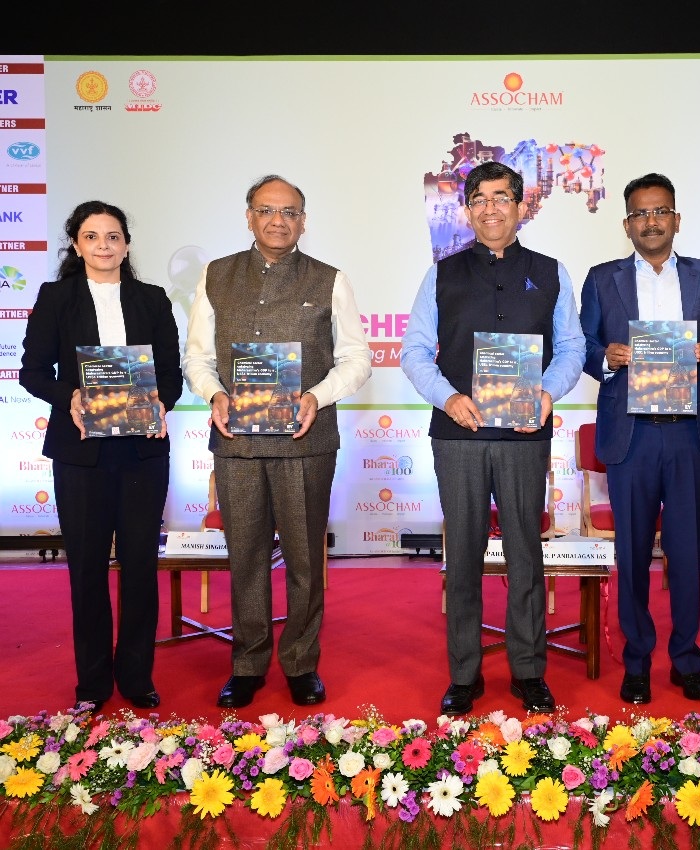
Maharashtra continues to assert its leadership in key sectors such as chemicals, petrochemicals, pharmaceuticals, and agrochemicals—excelling not just in numbers but also in commitment and execution. Speaking at The Chemical Conclave 2.0: Catalyzing Maharashtra’s GDP to a $1 trillion economy, Dr. P. Anbalagan, Secretary, Industry, Government of Maharashtra, highlighted the state’s sweeping reform agenda.
He emphasized, “With over 500 regulatory reforms, deep decriminalization measures, and the launch of Maitri 2.0—a statutory single-window clearance system—we are systematically eliminating friction in compliance and permissions.”
Dr. Anbalagan further noted that integrated smart industrial estates, pharma zones, and greenfield investments in gasification are transforming the state’s industrial landscape. The shift from a regulation-heavy approach to reform-driven governance is actively enhancing the ease of doing business.
NITI Aayog and MITRA Align on Decriminalization and Compliance Simplification
Reinforcing this shift, Dr. Anbalagan noted that NITI Aayog, MITRA (Maharashtra Institution for Transformation), and the state government have aligned their efforts on key reform areas—especially promoting ease of doing business, reducing regulatory burden, and decriminalizing procedures that are civil in nature.
Addressing Geographical Imbalance in Economic Contribution
Praveen Pardeshi, CEO of MITRA stated, “Currently, Pune, Thane, and Mumbai alone contribute over 54% of Maharashtra’s GDP. It’s time to balance this by driving investments towards the eastern regions of the state”.
He also emphasized the need to recycle industrial land, taking cues from developed nations like England, Germany, and Japan—where land use is optimized despite geographical constraints. “MITRA will collaborate with MIDC to enable this transformation,” Pardeshi added.
ESG and Global Compliance: An Urgent Call for the Industry
Manish Singhal, Secretary General of ASSOCHAM, urged the industry to focus on Environmental, Social, and Governance (ESG) compliance. Highlighting the European Union Deforestation Regulation (EUDR), he said, “Sustainability is no longer optional. The West is insisting on environmentally sustainable agricultural production, and it’s in our interest to adapt quickly.”
He also flagged the challenges faced by the steel industry due to the upcoming Carbon Border Adjustment Mechanism (C-BAM), which imposes higher import duties starting January next year. “The chemical industry forms a critical part of the manufacturing value chain in India and must lead in embracing sustainability,” he added.
Fast-Track Environmental Clearances: A Need of the Hour
In a special address, Prof. ManMohan Sharma—Padma Vibhushan, Padma Bhushan awardee and Emeritus Professor of Eminence at ICT—called for urgent reforms in environmental clearances. “In this digital age, it should not take a month or more to confirm the merits of an environmental application. We need to expedite the process and ensure that technology is used to eliminate delays,” he stressed.
ASSOCHAM: Enabling Industry-Government Synergy
ASSOCHAM continues to act as a crucial bridge between the Indian government and the business sector. From policy advocacy and industry representation to skill development and global trade promotion, the chamber is working tirelessly to create an enabling environment for business growth. As per the press release, at the conclave, ASSOCHAM and Ernst & Young (EY) also unveiled a joint knowledge report outlining strategies to catalyze Maharashtra’s journey toward becoming a $1 trillion economy.