


























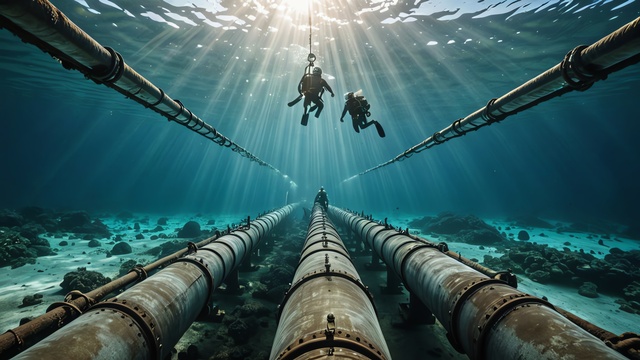
The government is reportedly fast-tracking plans to develop a deep-sea natural gas pipeline from Oman to strengthen the country’s long-term energy security amid ongoing tensions in the Strait of Hormuz. The proposed undersea pipeline project, estimated at around ₹40,000 crore, aims to ensure uninterrupted gas supplies from the Gulf region while reducing India’s dependence on volatile global LNG spot markets.
Government Pushes for Strategic Energy Security
The ministry of petroleum and natural gas is preparing to initiate a detailed feasibility study for the ambitious project following a pre-feasibility assessment conducted by South Asia Gas Enterprise (SAGE). The government is expected to assign state-run companies including GAIL, Engineers India Limited, and Indian Oil Corporation to prepare the comprehensive report. If the feasibility study receives a positive outcome, India may begin formal government-level discussions with Oman on gas supply agreements, financing mechanisms, and project execution plans.
Pipeline Route to Avoid Geopolitical Hotspots
The proposed pipeline route will pass through the Arabian Sea via Oman and the UAE, strategically bypassing geopolitically sensitive regions. The pipeline could potentially provide India access to vast natural gas reserves from countries including Oman, United Arab Emirates, Saudi Arabia, Iran, Turkmenistan, and Qatar. Collectively, the region is estimated to hold nearly 2,500 trillion cubic feet of natural gas reserves, making it one of the world’s most resource-rich energy corridors.
One of the Deepest Undersea Pipelines in the World
As reported by businesstoday.in, the proposed pipeline is expected to be laid at depths reaching up to 3,450 metres, potentially making it one of the deepest undersea gas pipelines globally. Advancements in deep-sea pipeline laying and repair technologies have significantly improved the technical feasibility of such large-scale offshore infrastructure projects. As part of its preliminary work, SAGE has already laid nearly 3,000 metres of test pipeline along the proposed route at an estimated cost of ₹25 crore to study seabed conditions and engineering challenges.