


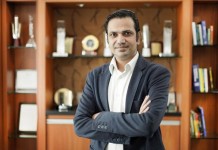








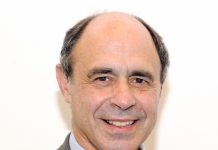





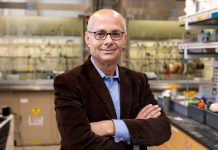
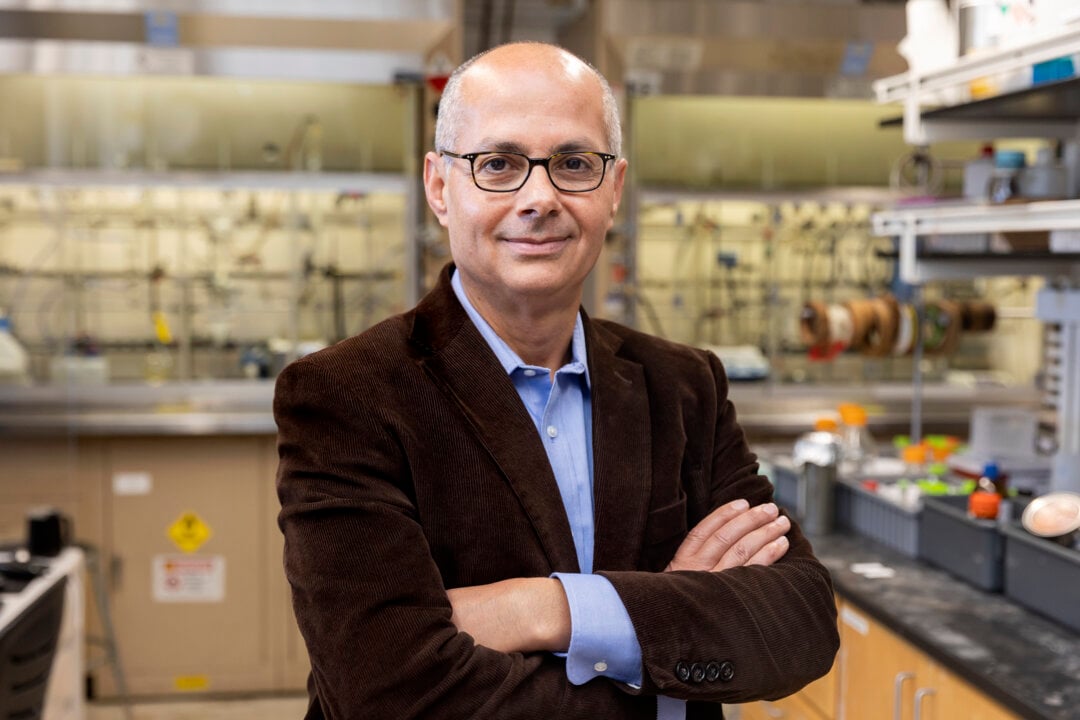
Omar Yaghi, Nobel Laureate Chemistry 2025. From a crowded room in a Jordanian refugee home to a Nobel Prize in Chemistry his journey is shaped by resilience and curiosity. His first spark came not from a lab, but a dusty library book filled with mysterious stick-and-ball diagrams. Today, his frameworks are helping solve some of the world’s biggest challenges — water, carbon and beyond.
Early Life in Jordan
Omar M. Yaghi was born in 1965 in Jordan, into a family of Palestinian refugees whose original home was in old Palestine, in a city called Masmiya, between Jaffa and Jerusalem. His parents had fled in 1948, during the wider displacement of Palestinians following the establishment of Israel. Yaghi’s father had studied only up to the sixth grade; his mother could not read or write.
Life in his childhood was austere. Yaghi recalls: “We were a dozen of us in one small room, sharing it with the cattle that we used to raise.” The house lacked running water and electricity. Water was a rare and precious resource available just once every two weeks for a few hours. During that time, the family would collect and store enough to survive until the next delivery.
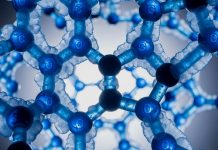
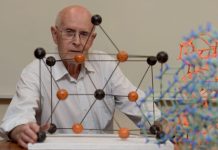
At age 10, Yaghi’s curiosity took him to a local public library. There, he opened a book and saw diagrams made of ‘sticks and balls,’ a visual representation of molecules, though he didn’t know it at the time. Still, he was “immediately drawn” to their form and structure. As he later reflected, that early encounter with molecules in a dusty library was where his journey to the Nobel Prize truly began.
A Solo Journey to the U.S.
At 15, his father told him it was time to go to America and pursue an education. He left for the U.S. alone, arriving in Troy, New York. He enrolled at Hudson Valley Community College, where he took foundational courses in English, science and math, while supporting himself by bagging groceries and mopping floors.
He later transferred to the State University of New York at Albany, where he earned his bachelor’s degree in chemistry in 1985, graduating cum laude. He credits this period for cementing his love for the discipline: “I was in love with chemistry from the very beginning,” he recalled. “When I moved to Albany, I immediately got into research.”
After his undergraduate studies, Yaghi earned his PhD in chemistry at the University of Illinois at Urbana–Champaign in 1990, then undertook a postdoctoral fellowship at Harvard. His faculty career took him through Arizona State University, the University of Michigan, UCLA and eventually UC Berkeley, where he now holds the James and Neeltje Tretter Chair.
At the time though, he had dreamed of publishing one well-cited paper, maybe something that would be referenced 100 times. Today, his group’s research has been cited over 250,000 times. He is now recognized as the father of reticular chemistry and metal-organic frameworks (MOFs). He has earned numerous distinguished honours beyond the Nobel—for example, the Wolf Prize in Chemistry in 2018, the Gregori Aminoff Prize in 2019, the King Faisal International Prize in Science in 2015 and many more.
A Molecular Legacy
Yaghi is best known for pioneering reticular chemistry and developing metal-organic frameworks (MOFs) — porous molecular structures capable of capturing carbon dioxide, harvesting water from dry air and storing gases. These materials, once abstract ideas, are now central to global efforts in clean energy and climate technology.
Though his research now tackles global challenges, Yaghi insists these were not his original aims. “The beauty of molecules—not their utility was his first love.” As he put it: “I didn’t set out to solve the world’s carbon or water problem. I set out to build beautiful things and solve an intellectual problem.”
When speaking with young students, Yaghi encourages them not to worry about having a grand plan. “Just pick anything in your surroundings and think deeply about what it’s made of,” he advises. He believes that genuine curiosity, when followed earnestly, will lead to meaningful discoveries.
Yaghi holds American and Jordanian citizenships, and in 2021, he was granted Saudi citizenship by royal decree. Yaghi’s work has earned him global acclaim, but he remains grounded in the lessons of his youth. The anxiety over water scarcity, the intellectual hunger that emerged from poverty and the loneliness of his early years continue to shape how he mentors students and builds scientific collaborations. He often reminds his students that “science is the greatest equalizing force in the world.”
References
https://www.nobelprize.org/prizes/chemistry/2025/yaghi/interview/
https://www.nobelprize.org/prizes/chemistry/2025/yaghi/facts/
https://www.britannica.com/biography/Omar-M-Yaghi
https://yaghi.berkeley.edu/bio.html
https://news.berkeley.edu/2025/10/08/uc-berkeleys-omar-yaghi-shares-2025-nobel-prize-in-chemistry/
https://www.washingtonpost.com/world/2025/10/08/nobel-prize-palestinian-omar-yaghi-chemistry/
https://www.uctv.tv/shows/Conversation-with-Omar-Yaghi-24389
https://www.nobelprize.org/prizes/chemistry/2025/yaghi/photo-gallery/