




















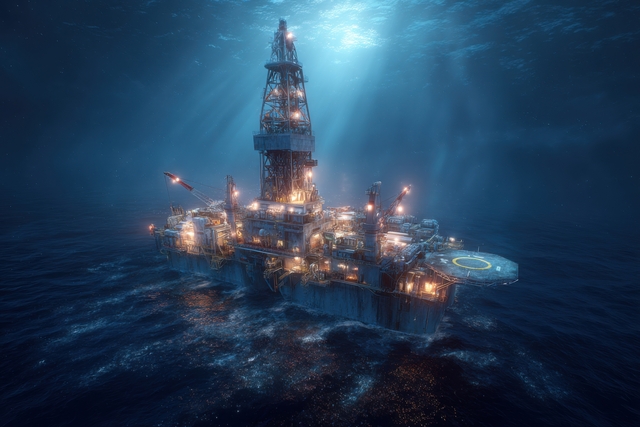
India’s ambitious exploratory drilling project led by Oil and Natural Gas Corporation (ONGC), Oil India Ltd (OIL), and BP is facing significant cost escalations even before operations have begun. The campaign aims to probe geological formations deeper than 6,000 meters across four offshore basins to unlock untapped oil and gas reserves — but spiralling costs are posing fresh challenges.
Deepwater Campaign to Explore Untapped Hydrocarbon Potential
The two state-run exploration and production (E&P) companies, ONGC and OIL, have teamed up with BP as the technical services provider (TSP) to drill four stratigraphic test wells. These wells are designed to analyse subsurface geology, validate petroleum systems, and de-risk future commercial exploration efforts.
The planned drilling sites are located in Bengal, Saurashtra, Mahanadi, and the Andaman offshore regions — areas considered critical to India’s future energy security. Initially, the Finance Ministry sanctioned ₹3,200 crore for the project. However, costs have since surged, with the price of drilling a single well climbing from ₹800 crore to approximately ₹1,200 crore.
Strategic Significance Amid National Deepwater Push
The cost overruns come as India steps up efforts to bolster its domestic hydrocarbon production. Last month, the government launched the National Deep Water Exploration Mission (NDWEM) to accelerate deep-sea exploration and reduce import dependency. Although the current stratigraphic drilling initiative does not form part of NDWEM, it is expected to help the mission achieve its objectives by identifying new frontier reserves.
India has identified the Andaman & Nicobar (A&N) offshore basin as a promising new hydrocarbon province. Situated within the Bengal-Arakan sedimentary system, this tectonically active region hosts numerous stratigraphic traps conducive to oil and gas accumulation. Its proximity to proven petroleum systems in Myanmar and North Sumatra further enhances its strategic value, especially after major gas discoveries in South Andaman offshore Indonesia.
Preparations Underway for Drilling by FY26–27
“Prospect generation is now underway and will take another three to four months. Drilling to depths of 6,000–6,500 meters will take around three months once rigs and services are in place,” said a senior official involved in the project. Decisions on commercialisation will follow only after the discovery of viable reserves. “At present, no discussions on monetisation have taken place with BP,” the official added.
Renewed Exploration Momentum as Mature Fields Decline
India’s renewed focus on exploration comes as many of its legacy fields, such as Mumbai High, have matured and are yielding declining volumes. In response, the government opened up nearly one million sq km of previously restricted offshore acreage in 2022, unlocking new exploration frontiers — particularly in deepwater and frontier regions like the Andaman-Nicobar basin.
ONGC and OIL have already launched exploratory drilling in the Andaman ultra-deepwater zone, targeting depths of up to 5,000 meters. Early results have been encouraging. For example, the ANDW-7 well, drilled in a carbonate play in the East Andaman Back Arc region, revealed traces of light crude and condensate, heavy hydrocarbons such as C-5 neo-pentane, and reservoir-quality facies.
Geological Insights Validate Petroleum Potential
Vast Untapped Potential
Preliminary findings from these surveys have revealed multiple promising geological features that require validation through drilling. According to the Hydrocarbon Resource Assessment Study (HRAS) of 2017, the Andaman basin holds an estimated 371 million tonnes of oil equivalent (MMTOE) of hydrocarbon potential. Thehindubusinessline.com reports that as India intensifies its deepwater exploration push, the ONGC-OIL-BP stratigraphic drilling campaign could play a pivotal role in unlocking new energy frontiers, provided it manages cost challenges effectively.