Home Blog Page 482

Conversation with AspenTech on Sustainability

The AspenTech team of Dr. Vikas Dhole, along with Manish Chawla, Sr Vice President, Mr Abhinav Chowdhary, Country-Manager – India, were in conversation with Chemical Industry Digest, in Mumbai recently, specifically on sustainability. Aspen Technology (AspenTech) is a leader in asset optimization software providing solutions to optimize asset design, operation and maintenance lifecycle. AspenTech combines decades of process modelling expertise with artificial intelligence.

Excerpts from the discussions are reproduced here.

Sustainability is no more a jargon or a buzzword. Nor is it just to promote brand equity through vision statements of corporates. According to Dr.Vikas Dhole, General Manager Sustainability Industry Business Unit with Aspen Technology Inc, “There is a radical industry change globally, in recent times. We are starting to see real action on sustainability in terms of investments by industry: capex, as well as opex, driving higher and higher efficiencies in manufacturing, improving current operations, reducing emissions and so on. While these are in tweaking existing operations, there is the realization in industry that this alone would not be enough to achieve Net Zero.

Dr. Vilas DholeSignificantly enhanced capex investments are required, which involves incorporating latest technologies in carbon capture and storage, shifting to biomass, renewables, employing green hydrogen etc. As companies need to work on profitable lines, they are exploring optimum pathways to achieve sustainability”.

Manish Chawla, Sr. Vice President, Chief Customer Officer for Aspen Tech, revealed a very interesting and welcome aspect, “Companies have now gone beyond considering only reducing carbon emissions, recycling etc.; they are seeing new business opportunities by adopting sustainability practices. This is spawning an entirely new world of new products and processes and new applications. Companies are seeing this as an opportunity to create a new source of growth. So, there is a big mindset shift taking place. Not only chemical companies, but engineering companies too will benefit from the spate of new projects that are coming up and slated to come up for moving towards sustainability”.

Pointing out to the strong global public awareness and public opinion favouring sustainability, Dr.Dhole stated that these are powerfully influencing company owners and top managers. Stakeholders, which include not only the general public, but one’s customers, the younger generation and even the employees – has become another major driver, as they canform an opinion on a company’s attitude and performance on sustainability. It has reached a stage where if companies are not serious on sustainability, they would be at a great disadvantage,” stated Dr. Dhole.

Multiple Pathways to Sustainability

Digital solutions with the latest developments in Industry 4.0 can help customers accelerate their sustainability journey. Dr. Dhole elaborated on the different sustainability pathways in the march towards Netzero, which companies and countries must choose and strategize on which of the pathways are most suitable and the quickest routes. There are proven solutions that provide returns on investments, he informed.

Companies can easily adopt energy efficiency, emissions management, water conservation and waste reduction. Newer technologies that are already available include biobased feedstocks, use of renewable energy like solar, wind etc., shifting to hydrogen economy as well as carbon capture and storage. Electrification based on renewables is very important for India, but this needs good grid management to integrate with current power generation models. AspenTech, Dr. Dhole said, can help with grid management systems for which they have proven expertise.

At the same time, research and development work on newer areas is also happening, for developing new materials, for plastics recycling and in producing chemicals from carbon dioxide.

Challenges Involved

Replying to our question on the challenges involved in the many pathways to sustainability, Dr. Dhole said that there are challenges all the way and listed the following:

  • How to make existing assets more efficient and operations more sustainable with a company’s available resources.
  • How renewables-based electricity can be stabilized and integrated with existing power generating and transmission systems or grid management.
  • Major challenges are in the emerging technologies such as carbon capture and storage, hydrogen generation through electrolysis using renewable power, and how to make these high capital-intensive technologies less costly.

Chemical Industry Digest also discussed about the challenges in the shift to bio-based feedstocks, which supply sources are disorganized with uncertainty and unreliability in continuous supply, when compared to fossil fuel-based oil and gas, coal etc. where there is reliability in the supply chain.

Manish Chawla quoteChawla said that with bio-feedstocks the entire supply chain needs drastic overhaul. Companies are completely redefining their supply chains, making radical changes and investments to create reliable supply chain of bio-feedstocks. He said that there are companies in Western Europe who are redefining themselves as agriculture companies.

Dr. Dhole added that bio-feedstocks provide a great opportunity for digital technologies to stabilize the bio supply chain, streamline it and integrate it with existing manufacturing operations.

Future of Oil and Gas

How would the shift to renewables in this huge energy transition that is taking place impact the future of oil and gas?

Dr. Dhole said, “I don’t foresee a total shift from oil and gas to renewables and other alternatives in the foreseeable future, since accelerating global economic growth will only increase the demand for fuels and feedstocks. What will happen is that the absolute dependency on fossil fuels will diminish as other sources like renewables, hydrogen, CO2 etc. will become part of the fuel/feedstock mix”.

Digital technologies are important for energy transition, emphasized Dr. Dhole. “In the process industries, we can now model an asset reliably, including all the criteria from design to operation using historical operating data of lifecycles of last fifty years. Tremendous strides have been made in the scientific and engineering areas to make this happen. This knowledge significantly expands the capability of decision-making particularly in scaling complex challenges. AspenTech has developed proven technologies including AI-based solutions”.

On whether Net Zero target can be achieved globally by 2070, Dr. Dhole said, it will depend on how the newer technologies become economically viable. And in this respect,it will be innovation that will drive sustainability. Governments facilitating investments in innovation will greatly spur the movement of sustainability. He spoke of how the US government’s Inflation Reduction Act is making available huge funds for investments in R&D to develop newer technologies. This Act, Chawla said, has sparked lot of interest in Europe and other countries for emulation. Dr. Dhole added that there is greater collaboration globally in many areas in R&D in sustainability including collaborations between academia and industry. Companies are reporting their carbon footprints openly.

Opportunity for India’s Innovation Centres

In India too, we need greater collaboration between industry and academic institutions. This is a huge opportunity for India in innovation, he said as we have enormous scientific and engineering talent proven IT capability and with lot of new startups also coming up. Many innovation centres have also come up in India.

Indian companies, particularly the top tier ones, are in the forefront on digitalisation according to Dr. Dhole. In the SME segment, there is a huge variation in digitalisation and possibly, the biggest opportunity for digitalisation to drive energy efficiency programs, emission reduction etc. SMEs represent a high-growth segment for the company, Chawla.

AspenTech has solutions specifically for SMEs, which can help them leapfrog without going through the long-drawn-out process that larger companies went through earlier.

Many Indian companies have established energy transition business groups in their companies to drive implementation of innovation, development and for incorporation of new technologies in sustainability supported by the traditional groups of engineering, operations, etc.

Digital technologies are important for energy transition, emphasized Dr. Dhole. “In the process industries, we can now model an asset reliably, including all the criteria from design to operation using historical operating data of lifecycles of last fifty years. Tremendous strides have been made in the scientific and engineering areas to make this happen. This knowledge significantly expands the capability of decision-making particularly in scaling complex challenges. AspenTech has developed proven technologies including AI-based solutions”.

AspenTech helps companies with both opex and capex plans in their pledge towards NetZero. In conclusion, Dr. Dhole informed, “We are collaborating with Indian companies, both big and small, in their strategic initiatives. We have co-innovation partnerships with our customers and engineering companies. We are also in tie-ups with leading technology education and research institutes like IITs, ICT and other institutes of technology in India, where our academic software are used widely. As part of our commitment to sustainability, we also provide industry scale sustainability models to train up chemical engineers. We also have dedicated training programs for sustainability, which are modular, so that any engineer can be trained up quickly”.

Views on Sustainability – Nadir B. Godrej

Sustainability has emerged as a transformative catalyst, revolutionizing the way businesses and industries operate, especially in the hydrocarbon to downstream sectors. It goes beyond simple efforts to improve manufacturing efficiency and reduce carbon emissions; instead, it presents a compelling chance to capitalize on novel business prospects.

Yet, achieving tangible outcomes requires a shift in company culture and structure, which necessitates a corresponding change in mindsets. This transformation can be accomplished when top-level management wholeheartedly embraces sustainability as an integral part of their core responsibilities.

To understand the scope and importance of sustainability and how it is driving technological and attitudinal changes in industry Chemical Industry Digest quizzed N B Godrej,  Chairman and Managing Director of Godrej Industries Ltd. and Chairman of Godrej Agrovet Ltd., and Co-Chair of Godrej Good & Green Governing Council whose views are presented here.

  1. To what extent has your company taken up sustainability as a top management responsibility and how do you ensure that your workforce is sensitised on this?  Sustainability is a new philosophy along with deep rooted technological and attitudinal changes required.  What about the matching changes needed in the culture of the corporate organisation?  Also from your interactions, how seriously do you feel the industry overall has taken it up?
  • At Godrej Industries, we believe that sustainability is not just a trend but a long-term commitment that requires cultural transformation
  • To ensure that our workforce is sensitised to sustainability, we have implemented various initiatives. We conduct regular training and awareness programs to educate employees about the importance of sustainability and its impact on the environment, society, and our business. These programmes cover topics such as resource efficiency, waste reduction, energy conservation, and responsible supply chain management. We also encourage employee participation in sustainability initiatives and provide platforms for them to contribute their ideas and suggestions

  • Sustainability is an important challenge for businesses and communities, and addressing climate change challenges is critical. Corporates should focus on decreasing their carbon footprint, investing in renewable energy, and implementing sustainable practices in their operations and supply chains to handle climate-related problems. Corporates should also contribute to environmental protection by decreasing waste, conserving natural resources, and fostering biodiversity. They should also invest in nature-based climate change solutions such as reforestation, wetlands conservation, and sustainable agriculture. Businesses can not only safeguard the environment but also create long-term value for their stakeholders and contribute to the sustainable development of society by implementing sustainable practices.
  1. The scope and definition of sustainability varies from company to company. For some planting a ring of trees around their plants is a sustainable action. For some others changes in chemistries and changes in the range of products itself.  For some only reduction in emissions.
    What all constitutes and comprises the sustainability suite of actions?  What is your definition of sustainability?
  • For us, at Godrej, sustainability is building an environmentally conscious business, imbibing environmental management concepts into our growth strategy and manufacturing process. We continue to find and apply measures that can reduce and optimise our resource utilisation and reduce emissions. We have a relentless focus on improving productivity, energy efficiency and maximising sustainability at our manufacturing facilities through usage of state-of-the-art technologies and processes
  • Godrej Industries defines sustainability as creating a more employable and environmentally friendly world, putting people and the planet ahead of profit.

Mr N B Godrej with his love for poetry has explained ‘Sustainability’ in all its bounteous lyrical detail.

Sustainability  

All industries should play a role
In the carbon neutral goal.
GHG emissions should be reduced
More green energy should be produced.
And so without partiality
Our goal for all’s neutrality.
Whether water, carbon or solid waste
And very soon we will make haste
To make our net emissions zero.
Will that make the group a hero?
In 2010 the goal looked tall
But we took a reasoned call
Technology would save the day.
So far it has turned out that way.
To achieve these goals we will strive
To do it all by 2035.
As technology takes a leap
Green energy gets very cheap.
Keen observers quickly saw
That Solar also tracks Moore’s law.
Whether groundnut shell or bagasse
Our India’s full of biomass.
And bamboo now is on the way.
A major role it can play.
At first we thought we’d have to spend
But that’s not true, for in the end,
The more we thought and the more we slaved
We did invest but we also saved.
And solar is still getting cheaper
And as we start digging deeper
In India it will hit the goal
Of being cheaper than even coal
In just a handful of years.
Already we and our peers
Are sourcing solar electricity
At lower rates than from the utility.
For quite some time we’ve been extorted
As their finances aren’t still sorted.
A silver lining can be seen,
Since it incentivises green.
Offsets help elimination
And rural electrification
With distributed solar power
Is now the need of the hour.
Our cost of water is not so high
But yet we do attempt to try
To reduce our water consumption
But all the same it’s a safe assumption
Our water use won’t disappear
And so to be neutral I fear
We will have to mitigate.
Though fortunately I can state
That developing a watershed
Doesn’t cost much and instead
Our agribusiness can benefit.
The government will do its bit
But where it fails we’ll fill the breach
And hopefully we will reach
Many farmers on the cheap
But the benefits that we reap
Will compensate for the cost
And once again nothing’s lost.
There are many paths that we can see
For achieving Carbon neutrality.
But the cheapest way is certainly
Through energy efficiency.
Real interest rates are rather low
And high returns quickly flow
From any energy saving device.
For business this is very nice.
Not only are returns quite brisk,
There’s also very little risk.
In India mandated CSR
Can help us go very far.
Multiple benefits is what one sees
With water projects or growing trees.
Good livelihoods are created
Our carbon emissions are abated.
Trees planted at a river’s source
Maintain the flow throughout its course.
So many benefits we can see:
The preservation of biodiversity,
Different species can be tried.
Useful products can be supplied
Like biomass or edible fruits
And yet the trunk and the roots
Can sequester carbon, clean the air,
A win-win that is very fair.
So while we decarbonise
Why not also monetise.
So never fall for either or.
Our hearts and minds demand much more.

  1. There are multiple ways to be on the road  to sustainability: circular manufacturing, revisiting existing chemistries to manufacture greener products, shifting to renewables/biomass, and so on. What are your suggestions?  Practice all of it, some of it, or step by step? How should a manufacturing company go about this?  And in what stages?
  • Environmental sustainability is a key part of our manufacturing process. At Godrej, we have a vision beyond business, to build a more inclusive and greener world. We have aspired to create a more employable workforce, build a greener world, and innovate for ‘good’ and ‘green’ products.
  • We have based our sustainability goals on shared value, addressing critical socio-economic and environmental needs of the society by leveraging our business expertise.
  • Our objective for 2025 is to craft more prominent and bolder sustainability goals that align with our businesses. We are continuing on our journey to build a more reasonable and greener world by focusing on people, communities, and stakeholders. Emphasis areas are as follows:
    • Empower communities with equipping skills
    • Influence sustainable consumption
    • Improve Health and Well-being
    • Lead sustainability actions

We also make efforts to reduce our plastic use by producing concentrated products and ensuring that most of the plastic we use is recycled or repurposed.

  1. It has also been articulated by experts that moving on the road to sustainability will also throw up many new business opportunities. What is your experience?  And what are the kinds of opportunities possible?
  • India’s clean energy transition is rapidly underway, benefiting the entire world and the country is setting the bar for a novel approach to economic growth that might sidestep the carbon-intensive strategies many nations have previously adopted and serve as a model for other emerging markets
  • The adoption of Green Open Access Rules will allow businesses and industries to produce and obtain energy for their own needs. In 2023, we can expect higher levels of technology development, deeper engagement between consumers and generators of renewable energy, and higher levels of investment in the nation provided that the government continues to provide support and that underlying long-term market drivers remain in place. Time of day pricing of electricity will effectively manage demand and reduce the need for storage of electricity.
  • The most economical way of way of carbon sequestration is growing trees. If these trees produce food and biomass the net cost is zero or negative and yet the trunk and roots continue to sequester carbon. Godrej Agrovet is the largest producer of Palm Oil in India. We plan rapid expansion based on the Government’s enlightened policy. The farmers get a good income and a lot of carbon gets sequestered as the trees grow. Palm Oil and Palm Kernel Oil can be used for food. Palm kernel meal can be used for animal feed. The byproducts of palm oil refining Palm Fatty Acid Distillate (PFAD) and Palm Kernel Fatty Acid Distillate (PKFAD) are used to produce soap and oleo chemicals such as fatty acids, glycerin and fatty alcohols that are by their very nature green. In areas where oil palm is grown we have noticed the rainfall is steadier. It is well known that trees bring rain. The oil palm needs water to grow but thanks to drip irrigation the requirement is reduced. We are exploring bamboo as a source of biomass. We can replace fossil fuels and yet the roots continue to sequester carbon even though the biomass is harvested and used. Other trees that produce fruits or edible seeds can also be grown and we are studying these as well.
  1. This brings us to the very important role of R & D and innovation. To what extent is your R & D helping you in achieving your sustainability goals?  Shouldn’t R & D be the focus of top management attention?  Any notable R & D achievements (one or two) of your company in sustainability that could be mentioned?
  • At Godrej, we look at products from both ‘good’ and ‘green’ lenses. A ‘good’ product/service being one that addresses a critical issue for marginalised sections of the society such as health, hygiene, water, sanitation, housing, education or livelihoods. A ‘green’ product as that which reduces energy, greenhouse gas emissions, water or material consumption, eliminates toxic materials or uses recyclable, renewable and/or natural material.
  • We developed a phosphate-free formulation for our pH neutral liquid detergent, Ezee. Phosphates disturb the ecosystem balance by promoting large overgrowth of algae in lakes. Our formulation does not cause any adverse reaction in the ecosystem.
  • Godrej Magic’ hand-wash is an innovative, sustainable new solution to cleaner hands. It is a first-of-its-kind powder to liquid hand-wash. It is also an environmentally sustainable as it uses half of the plastic and 1/4th less paper consumption in packaging, and 1/4th less fuel consumption for transporting.
  • Our agricultural and chemical research also promotes sustainability. We use the principles of green chemistry to develop better synthetic routes with less wastage, lower energy and lower carbon footprint.. As a result several of our factories are zero discharge and we have greatly reduced our solid waste. We always try to turn waste into gold and all it needs is deep thought and research. These initiatives require investment but the returns are very high.
  • Our Oleochemical R&D developed a powerful surfactant sophorolipid through a bio fermentation process. It has antibacterial and antiviral properties as well. The raw material is vegetable oil and hence the process is very green.

Petrochemical Industry Braces for New Heights

0

Abstract

As electric vehicle adoption grows, the demand for gasoline declines, impacting oil refineries. Indian refineries are shifting investments to petrochemicals, which are expected to drive future oil demand growth. However, challenges like inadequate infrastructure and regulations may hinder progress. Government support, incentives, and global partnerships are crucial for the Indian petrochemical industry to capitalize on its potential.

Introduction

The global transportation sector is undergoing a significant transformation. As the demand for electric vehicles EVs grows, there is a visible decline in the demand for gasoline worldwide. The presence of EVs on the roads is expected to displace approximately 5 million barrels of refined oil daily which has raised concerns for the oil refinery business. However, state-owned refineries in India, such as Bharat Petroleum (BPCL) and Indian Oil (IOCL), are prepping the game by redirecting their investments towards the downstream industries, mainly petrochemicals.

Petrochemicals, are derived from refinery processes, by cracking naphtha, natural gas etc and now also direct crude to chemicals. They find way into numerous everyday products, including textiles, agrochemicals, drugs and pharma detergents, cosmetics, fertilizers, etc, etc.

High Trajectory

Petrochemicals are poised to consume over a third of the oil demand growth by 2030 and nearly half by 2050, as per the International Energy Agency’s forecast. The petrochemical sector in India is reflective of this global trajectory, with robust year-on-year revenue growth of 19%-20%. Such high numbers can be attributed to the revival of domestic demand and a notable surge in exports. Multinational companies operating in downstream industries are actively adopting the China Plus One strategy, seeking to diversify their supply chains and reduce dependency on China. This strategic shift presents an opportunity for Indian chemical companies to establish a stronger foothold in global markets, opening new avenues of growth for the Indian chemical industry.

However, there are significant challenges that could impede progress and lead to a trade deficit by 2040. Inadequate infrastructure, scarcity of raw materials, and inconsistent regulations pose significant hurdles for the Indian petrochemical industry. India heavily relies on imports of crucial chemicals due to the limited availability of domestic feedstock. Additionally, the fragmented and inconsistent regulatory landscape involving multiple ministries, departments, and organisations could create a climate of uncertainty, slowing the growth of domestic players.

The Challenges

Addressing these challenges requires the swift implementation of a Product Linked Incentive (PLI) Scheme to ensure the availability of cost-competitive raw materials and improve logistical capabilities. The active participation of global oil and gas majors in downstream chemical opportunities presents an opportunity for Indian companies to take the lead in intermediates and speciality chemicals, bolstering the strength of the supply chain. The Indian government has taken steps to support the petrochemical industry through initiatives such as “Make in India” and “Skill India,” which promote foreign investment and foster growth in chemical manufacturing. Targeted tax incentives, including exemptions or reduced rates on excise duty, customs duty, and value-added tax (VAT), have also been extended to select petrochemical products. The government’s ongoing measures, including the facilitation of 100% foreign direct investment, the establishment of Petroleum, Chemicals, and Petrochemical Investment Regions (PCPIR) zones, and forthcoming policies valued at ₹34 lakh crore ($420 billion), are poised to attract substantial capital and galvanise sectoral growth.

With a market size of USD 190 billion, the Indian petrochemical industry holds immense potential. Its growth trajectory aligns seamlessly with the government’s ambitious initiatives aimed at establishing India as a global manufacturing hub. By capitalising on its abundant resources and skilled workforce, India has a unique opportunity to emerge as a key player in the oil and gas industry.

Indian Chemical Industry Face Supply Constraint and not Demand Constraint

Abstract

The steady growth of the Indian economy has led to an increase in demand for bulk, intermediate, and specialty chemicals. However, the problem lies in the insufficient supply capacity to meet this demand, leading to heavy reliance on imports for basic and intermediate chemicals, as well as finished chemical products.

Introduction

It is generally said that production capacity of any chemical or allied product should be built based on the present demand and projected demand in the coming years.  In other words, the theory is that demand precedes supply and supply capacity should be built in tune with the demand trend. In recent years,with the steady growth of Indian economy in multiple directions, the demand for bulk, intermediate and speciality chemicals in India has been steadily increasing. In today’s condition, it appears that there is no particular concern about demand prospects.  The problem is that supply is not being built as required by the growth in demand. Such situation has made several  Indian chemical industrial units and chemical consumers to be excessively dependent on import of basic and intermediate chemicals as well as finished chemical and allied products.

Indian import export trade – Case study China

China has emerged as India’s top source of import for several products including chemicals and the share of China in India’s total merchandise import has steadily increased. During the last decade or so, while India has signed many Free Trade Agreements with different countries, there has been no noticeable decline in China’s market share in India’s total import.

At sectoral level, 10 product groups account for about 80 percent of India’s total import from China. Among these, the top three product groups make up for more than 60 per cent of India’s total import from China. These product categories include basic organic and inorganic chemicals, intermediate chemicals, pharmaceuticals, apart from electronic goods, mobile phones, semiconductors of different types, electrical appliances.

On the other hand, the latest data show that in 2022-23, India’s export to China has declined in absolute terms. Consequently, China’s share in India’s export basket came down to 3.4 per cent in 2022-23 from 5.04 per cent in 2021-22.

Selected top export items to China from India

(April to March)

In $ million

  Commodity 2019-20 2020-21 2021-22 2022-23 Average
             
  Petroleum products other than crude 2,098.44 1,017.58 1,830.28 1,907.02 1,713.33
  Cyclic hydrocarbons 1,409.53 956.97 988.29 268.39 905.8


Refined petroleum products are India’s most important export item to China. Other than that, India’s exports to China have been mostly dominated by agricultural goods. iron ore, semi-finished products of iron, copper and copper products, fish and marine products, vegetables, vegetable oils and rice. Share of India’s export of chemical and allied products to China in the overall export is at negligible level.  This is mainly due to lack of adequate manufacturing capacity in India for chemical and allied products.

PLI Scheme

Considering such supply constraint scenario, Government of India has done well to implement Production Linked Incentive (P L I) scheme to accelerate the pace of manufacturing capacity build up in the country. However, it is reported that the PLI Scheme has had a slow start with disbursals of just Rs. 2900 crore so far out of the corpus of Rs.1.97 lakh crore.

industry representatives in certain sectors including chemicals, textiles and food processing have been complaining about the high threshold levels of investments and turnover for eligibility to avail   PLI scheme, that are viewed as a disincentive for smaller investors. While this view may be appropriate to some extent, the ground reality is that adequate number of viable proposals with strong technology inputs have not been submitted for availing PLI scheme in several cases including chemical and allied products.

In any case, PLI schemes can be provided by government only for a few products.  Therefore, depending upon PLI Scheme for manufacturing capacity build up in all potential areas is not appropriate.

Import dependence on chemicals

Today, there are many chemicals where Indian import is steadily increasing with no plans for capacity build up being announced to the level of requirement, in spite of steady growth in domestic and global demand.

A few examples are given below

Product Present annual import

quantity in tonne


Present annual domestic production  in tonne
Methanol 2,815,925 167,000
Poly vinyl chloride 2,469,480 1471,000
Poly acetal 61,731 Nil
Polycarbonate 224,233 Nil
Styrene monomer 1,093,429 Nil
Vinyl acetate monomer 211,730 Nil
Acrylo nitrile 233,758 Nil
Adipic acid 57,466 Nil
Bisphenol A 85,662 Nil
Citric acid 131,440 Nil
Lysine HCl 75,630 Nil
Methyl methacrylate 88,437 Nil
Methylene Diisocyanate (MDI) 161,311 Nil
Nylon 6,6 ~33,000 Nil
Polycrystalline silicon ~10,000 Nil
Silicon metal ~72,000 Nil
Propionic acid 25,406 Nil
Titanium dioxide rutile pigment 220,000 30,000
Poly vinilydene chloride ~10,000 Nil

While a few examples are given above, there are host of several other bulk, intermediate and speciality chemicals, where import level is surging due to steady increase in demand and lack of efforts to build domestic capacity.

It is vaguely argued that certain manufacturing sectors in India may be gaining from Indo-China import trade, as availability of cheap intermediate inputs from China has possibly helped Indian companies to stay competitive in the domestic and international market.But it is also true that some sectors and sub sectors of Indian manufacturing have been adversely affected because of cheap import from China.  This is particularly so, in the case of chemicals and allied products.

Why supply constraint?  – Galore of explanations and excuses

A number of reasons such as the following have been stated by stake holders and observers in India for the domestic capacity build up efforts in chemical industry falling behind the need. However, the fact is that while there are constraints, there are also enough ways to overcome the constraints to achieve big leap forward.  What is required is change for better in the mindset, approach, strategy and confidence level of investors and project promoters in India.

Feedstock scenario

Issue

As India has excessive dependence on import of crude oil and natural gas and the landed price of imported crude oil and natural gas being much higher than in several other countries, the petrochemical-based derivative products cannot be produced at globally competitive price in India. In view of this reason, India remains as large importer of several chemicals such as methanol and polyvinyl chloride, where the price of imported product is lower than the domestic cost of production.

Way out

To overcome this issue, Indian companies should set up such projects abroad where crude oil and natural gas are adequately available and at lower cost. Reliance Industries has already shown the way by deciding to set up ethylene dichloride plant in middle east region and bring it to India to produce PVC. Similarly, methanol plant can be set up in some countries like Trinidad and Tobago, where natural gas is available adequately at acceptable cost and bring such methanol to India for production of derivative products and for domestic use.

Investment constraint

Issue

Number of companies in India that can invest adequately large amount for setting up globally competitive capacity projects are limited.  Without such large projects, India cannot penetrate in the global market in a big way.

Way out

Obviously, joint ventures must be set up in India with overseas investment and partnership. Indian project promoters have to take a lead. However, the problem is that even large companies in India in private sector are broadly controlled by families and professionalization at top management level are few and far between. Such family centred possessive attitude prevent the project promoters from accepting partnership with international companies by providing large equity base for such overseas organisations in the projects.  Such conditions are prevalent in public sector also. Many international companies want major equity stake in such joint ventures, as they share their technology and market. Obviously, their expectations are justified.

Technology

Issue

For production of most of the chemical and allied products, globally competitive technology is not available in India.  This is largely due to dismal research and development efforts in the country over the years.  India is dependent for import of technology even in the case of not only large-scale projects but also several medium scale and sometimes even small-scale projects and even from small countries like Taiwan, Israel and Korea.

Many proposed projects are stranded in India due to want of technologies

Way out

For rapidly building up manufacturing capacity, India has no alternative other than procuring technology from abroad. Particularly in the case of small and medium-scale projects, the cost of acquisition of technology from abroad is prohibitive, which Indian units cannot afford.  This is a very difficult situation. The more critical issue is that Indian companies are importing similar technology for similar product several times.  There are so many urea fertiliser plants and so many petroleum refineries operating in India but still Indianunits have to seek technology and engineering support from abroad for setting up more of such projects of similar nature.

Cooperation and collaboration between Indian R& D institutions and design and detailed engineering organisations to develop and scale up technology is the need of the day.  For such efforts, government can do little and initiatives have to come from technologists, industries and R & D bodies.  This seems to be nearly conspicuous by absence.

Many project promoters have said in private discussions that they lack confidence in Indian R & D institutions for technology acquisition, particularly since technologies developed by Indian R&D bodies are mostly at lab scale or bench scale level and which have not been proved in commercial scale operations.

Obviously, confidence with cooperative attitude is needed between industries and R& D bodies.  Perhaps, both industries and R&D bodies have to accept the blame to some extent for such situation.  R & D bodies too should show greater pragmatism in fixing the fees for technology transfer, considering the fact that there could be a calculated risk for the project promoters in some cases.

Global market penetration

Issue

There are no trading houses in India with global presence and competitiveness to operate internationally for chemical and allied products.   This is a big issue in penetrating the global market.

Way out

Global trading activity involves sophisticated management practice, with digitalisation, updated data base, market intelligence to forecast the demand and price trend, which are all vital factors. This calls for large investment too. Probably, trading houses in India can join together with specialisation in particular field to widen the operational base and give themselves enough strength and muscle power to operate in competitive conditions globally.

Cooperation between Indian industries

Issue

There is lack of cooperative attitude between Indian industrial units operating in similar field to join together and set up large capacity projects that would be globally competitive.

Way out

Given the investment and feedstock constraints and realising the need to put up large capacity projects, industries operating in similar field can put their heads together and promote ventures of globally competitive size.For example, there are number of starch units in India producing large quantity of starch and such starch units can join together to set up large scale starch-based projects.  Companies with agriculture base for producing tapioca, corn etc. also can join these starch base derivative projects. Such elegant cooperation would enable India to setup large scale starch-based projects such as citric acid, Lysine etc. which are totally imported now.

Counterproductive activism

Issue

Many worthwhile projects have been blocked in India due to politically backed environmental activists, who seem to lack adequate understanding of technological issues and the national need. The immediate example is the closure of Sterlite Copper in Tamil Nadu. Other example is the agitation against the Neutrino project in Tamil Nadu, which is a very important R & D project. Former President Dr. A P J Abdul Kalam appealed to the activists not to object to this vital project but the appeal of the learned scientist fell on the deaf ears.

There are so many other cases of blocked projects

Way out

Often it happens that vote bank politics is the primary driver for taking vital decisions in India by the government. In the case of such counterproductive attempts to stop meaningful projects, the governments have to take firm stand and implement the schemes with courage of conviction.  Not sure whether it can happen in India today, where it appears that politics often over rules economics and development interests.

Product dumping at low CIF price from abroad

Issue

While the domestic demand is increasing and supply gap in the country is increasing, there are problems in setting up new projects due to the import dumping at a price, which would be less than the production cost in India.

Way out

This is a genuine issue that should be considered by Government of India. Government of India often comes to the rescue of Indian companies by imposing safeguard duty/anti-dumping duty on the imported product. However, safeguard duty/anti-dumping duty is imposed only on an appeal from an operating project in India.In such circumstances, there is apprehension about setting up new projects where import dumping may happen at low price, when new project promoters would not be sure that safeguard duty/anti-dumping duty would be imposed.  Government of India should consider assuring the proposed projects about price protection support at the time of commissioning of the project, in case there would be import dumping at low price which would be less than production cost of the new project.

Prognosis

Indian import dependence for chemicals and allied products are now increasing at an alarming level. This is not a healthy scenario and can-do harm to long term interests of India’s economic and industrial development. The industry associations have to be more forthright in highlighting the issues and suggesting solutions and perhaps, give up the temptation to discuss the issues in a cosmetic way in the presence of ministers and top bureaucrats in much publicised meetings and conferences.

Calling a spade, a spade is the need of the day.

Chemingineering – Metathesis – Chemical Choreography

Metathesis is a catalytic rearrangement reaction and has emerged as a greener and more sustainable way of synthesising important organic molecules. Metathesis embodies all the principles of Green Chemistry and has applications in diverse fields such as petrochemicals, polymers, pharmaceuticals, agrochemicals and other specialty chemicals.

The world of organic chemistry is dominated by the C-C bond. It is the one of the most stable and robust chemical bonds and is responsible for some of the most wonderful substances prevalent in nature. They are thus the key building blocks in the synthesis of new chemical compounds. Life as we know would not exist without the C-C bond.

Metathesis Reaction

The metathesis reaction, discovered almost 50 years ago, was a breakthrough in C–C bond formation and has emerged as a powerful tool in the synthesis of chemicals in a sustainable manner. The word metathesis means ‘change-places’. In metathesis reactions, double bonds are broken and reconstructed between carbon atoms in ways that cause atom groups to change places. Essentially: AB + CD → AD + CB. Metathesis can be compared to a dance in which the couples change partners. This happens with the assistance of special catalysts.

Olefin Metathesis

Olefin Metathesis allows the exchange of substituents between different olefins. The most important applications of olefin metathesis in the field of petrochemicals are the olefins conversion technology (OCT) process (originally the Phillips triolefin process) and the Shell Higher Olefins Process (SHOP). The triolefin process, developed by Phillips was the first commercial application for olefin metathesis to convert propylene into ethylene and but-2-ene.
2 CH3CH=CH2 ↔ CH2=CH2 + CH3CH=CHCH3

At Phillips Petroleum Co. this reaction was discovered serendipitously by Banks and Bailey, when they were seeking an effective heterogeneous catalyst to replace the HF acid catalyst for converting olefins into high-octane gasoline via olefin–isoparaffin alkylation. When using a supported molybdenum catalyst, they found that instead of alkylating the paraffin, the olefin molecules were split, and discovered that propylene can be catalytically converted into ethylene and butylene. A large-scale industrial process incorporating olefin metathesis is the Shell Higher Olefins Process (SHOP) for converting ethylene to detergent-range alkenes for the production of lubricants, plasticiser alcohols, detergent alcohols, synthetic fatty acids etc. The catalytic olefin metathesis reaction has led to profound developments in the synthesis of molecules relevant to the petroleum, materials, agricultural and pharmaceutical industries.

Catalysts

Catalysed metathesis was discovered in the industry following observations in the 1950s of the polymerization of ethylene by Ziegler. Catalyst systems for the olefin metathesis generally contain a transition metal compound, but often require the presence of a second compound (co-catalyst), and sometimes a third (promoter). Systems most commonly used were based on the chlorides, oxides, or other easily accessible compounds of Molybdenum, Ruthenium, Tungsten, Titanium, Vanadium etc. In 1971 Yves Chauvin was able to elucidate the mechanism of metathesis reactions and identify what types of metal-compound act as catalysts in the reactions. Richard Schrock was the first to produce an efficient metal-compound catalyst for metathesis in 1990. With this discovery, chemists began to realise that olefin metathesis could be used as a powerful tool in organic synthesis. Metathesis gained increasing attention among researchers active in synthetic chemistry. Yet another breakthrough in the development of metathesis catalysts came in 1992 when Grubbs discovered a catalyst with ruthenium. It was stable in air and demonstrated higher selectivity but lower reactivity than Molybdenum catalysts. The new catalyst also had the ability to initiate metathesis in the presence of alcohols, water and carboxylic acids. Chauvin, Schrock and Grubbs were recognised for their pioneering work with the Nobel Prize in chemistry in 2005.

Pharmaceutical Applications

Many important APIs used in treating major diseases such as hepatitis C, cancer, Alzheimer’s disease, Down’s syndrome, osteoporosis, arthritis, fibrosis, HIV/AIDS, migraine, etc have been manufactured using Metathesis reaction. Metathesis has been used in the synthesis of a 7-membered azepine compound called balanol, which is used as anticancer agent and in controlling inflammation, cardiovascular disorders, central nervous system dysfunction, and HIV infection. Another anticancer drug epothilone and its derivatives were also prepared by using the ring closing metathesis. Similar type of ring closing metathesis was applied to produce Civetone (cyclo-9-heptadecenone) used in the perfume industry from ethyl oleate. Another class of natural compounds, easily obtainable through metathesis are insect pheromones, which are useful as environment friendly pest-control agents.

Other applications

Olefin metathesis excites researchers because of its ease of use and versatility and the reduction in synthetic steps required to achieve complex target molecules. Continuous investigation over the past decades has led to the development of highly active olefin metathesis catalysts for sophisticated synthetic tasks. In the field of materials science, Grubbs catalysts are used to promote ring-opening metathesis polymerisation to manufacture high-performance thermoset resins from abundant petrochemical by-products such as dicyclopentadiene. In the oleochemical industry there are many interesting possibilities for olefin metathesis. The metathesis of unsaturated natural fats and oils and their derivatives offers new synthesis routes from cheap renewable feedstocks to valuable new chemical products from with high chemo-selectivity.

Green Chemistry

Metathesis reactions embody the principles of green chemistry by exhibiting high atom economy, catalytic efficiency, solvent versatility, and compatibility with renewable feedstocks. Metathesis reactions excel in atom economy as they involve the redistribution of atoms within the reactants, resulting in the formation of new products without the need for additional reagents. This high atom efficiency translates into minimal waste production and contributes to sustainable synthesis. This makes metathesis ideal for creating new C-C bonds in an atom-efficient and sustainable manner. Metathesis reactions offer versatility in solvent selection, as they can be performed in environmentally benign solvents like water or bio-based solvents. Catalysts used in metathesis exhibit remarkable efficiency, enabling the reactions to proceed rapidly at mild conditions with low catalyst loadings. Metathesis reactions exhibit a broad substrate scope and compatibility with various functional groups. This versatility allows for the synthesis of diverse chemical structures, often eliminating the need for multiple synthetic steps and auxiliary reagents.

Epilogue

Metathesis has a rich history from its initial discovery to its comprehensive mechanistic understanding and the development of powerful catalysts. It has become an indispensable tool in green chemistry, offering efficient and selective transformations with significant environmental benefits. Success stories in pharmaceuticals and renewable fuels demonstrate its vast potential. However, challenges such as catalyst stability, scalability, and commercial adoption must be addressed to fully unlock the potential of metathesis. Ongoing research and innovation are crucial to overcome these hurdles and pave the way for broader applications in various industries. With continued advancements, metathesis has the potential to play an even more significant role in the quest for sustainable and environmentally friendly chemical processes.

Readers’ responses may be sent to:
k.sahasranaman@gmail.com or
chemindigest@gmail.com

Future Proofing the Next Generation with Clean Energy Solution

Abstract

The transition to clean energy requires significant investment, and India’s aim to achieve carbon neutrality by 2070 highlights the need for robust domestic value chains. Direct technical assistance and public-private partnerships are crucial for attracting private sector investment. The focus on floating photovoltaic (FPV) systems in India presents opportunities for plastic resin manufacturers to provide materials for various components, such as PV modules, connectors, floats, and inverters, contributing to the growth of solar power. Accelerating research in advanced solar PV technology and engaging with the local manufacturing ecosystem can reduce capital costs and support the green energy transition.

Introduction

Several nations, including India, have upped their commitment to decarbonising their economies and to achieve net zero in the coming decades. India, for example, has announced its ambition to achieve carbon neutrality by 2070.This transition to clean energy requires multiple pathways, many of them capital intensive. According to the International Renewable Energy Agency, global investment in energy transition technologies reached a record US$1.3 trillion in 2022, an increase of 19 per cent over the previous year.

However, there is still a massive deficit, with the entire investment last year in clean energy, still 40 per cent less than the average needed every year through 2030 to achieve the goals of the Paris Agreement. Specific to India, a report by Standard Chartered estimates that the country would need US$12.4 trillion in transition finance.

Build Robust Value Chains

This underlines the need to build robust domestic value chains for promoting renewable energy, especially solar power, which is high on the agenda of governments across the world, including India. In creating this clean energy ecosystem, it is important that direct technical assistance is provided to help emerging economies drive policies and frameworks that can attract private sector investment.

Strong public private partnerships and enhanced application of advanced technology solutions at scale will be central to achieving a just energy transition, where the livelihoods of people are not impacted through lack of reliable energy supply, and at the same time, the decarbonization roadmap is not derailed.

This means, looking at the prevailing landscape for accelerating renewable energy – such as solar power, in India. The country has already announced a Production-Linked Incentive Scheme for manufacturing high efficiency solar PV modules lending impetus to the industry.

India’s Potential

Today, India is the world’s third largest market in the world for new solar photovoltaics (PV) capacity, and the country has proposed over 59 parks of 40GW across the nation to add to the current solar power generation of 63.3 GW (as of February 2023). Of particular importance is the government’s focus on aggressively pushing floating photovoltaic (FPV) panels.

FPV systems offer distinctive advantages over on-land solar PV systems such as space utilization, better cooling effect, reduced land use and reduced water evaporation. FPVs are expected to be implemented across the country’s medium and large reservoirs, with the potential to generate 280 GW of solar power and growing over 20 percent annually.

Today plastic resin manufacturers canmeet the needs of the solar power industry, ranging from polyolefins to engineering thermoplastics, which are selected for the making of components in the PV modules, connectors, floats, battery-housing, inverters, amongst others.

Examples include polyolefin elastomers (POE) used in the making of PV module encapsulation lower potential-induced degradation, reduce water vapor transmission and have high volume resistance, polypropylene (PP) solutions replacing metals in solar PV structures could potentially reduce up to 50% weight reduction, while flame retardant (FR) resins enhance fire safety and enables cost-savings and aesthetic designs in the making of inverters, compared to metals. Specific to floats, high-density polyethylene (HDPE) has good weatherability against UV rays and good environmental stress crack resistance.  Resin manufacturers can also provide customized solutions for back sheets, encapsulants, junction box connectors and invertor housing, among others, all of these provide long-term benefits to customers.

Accelerating research in advanced solar PV technology and frequent engagement with the local manufacturing ecosystem will help contribute to increased adoption of solar power by reducing capital costs in the long-run and helping stay the course of green energy transition.

Editor’s Note: SABIC has a wide portfolio of resins that are specifically suitable for the needs of solar power industry.

Invest, Insure and Innovate in Uncertain Times

Abstract
The unprecedented covid crisis brought the world virtually to halt. Just as this crisis abated came the Russia-Ukraine war, which has added hugely to the uncertainities the world has been battling. But human beings have infinite capability in facing up to such external challenges, though it all takes a toll. This article recommends investing in future technologies, insuring against uncertainties by building resilence and of course innovating to meet the future.

The United Nations released its latest report on the status of Human Development across the globe in September. It may not be a surprise to learn that progress has stalled in recent years as the impact of global crises and local climate disasters has taken its toll. The global Human Development Index declined for the past two years, reversing the progress of the previous five years. Prior to this report, the Index was tracking steady upward progress since its inception in 19901  and progress had been particularly strong in Asia.
The challenge for industry leaders is to make progress despite ongoing external challenges. First, the COVID-19 pandemic, which the International Monetary Fund has described as “a crisis like no other,” created an unprecedented business environment in 2020 whose effects continue to linger. Just as some market recovery was starting, the second major shock of the conflict in Europe and associated energy and inflation impact has carried through to economies and businesses worldwide. The ongoing supply chain chaos has further exacerbated these effects.
These overlapping calamities have created a new uncertainty complex that permeates communities and businesses, says the UN Development Program (UNDP), requiring even stronger and more creative responses. “The transformations in energy and materials required now… portend even more upheavals, which some believe to be as large as the shift from agricultural to industrial societies.”
Thankfully the outcome is not all doom and gloom, as the report recommends several processes and pathways to progress, highlighting “three I’s” to chart a new course:
  • Investment for future capabilities, from renewable energy to preparedness for pandemics;
  • Insurance to prepare our societies for the ups and downs of an uncertain world; and
  • Innovation in technology, economics, and culture to build capacities to respond to whatever challenges come next.
The vital lessons and approaches discussed for these themes are targeted at policy activities, although they have relevance to the challenges being faced by companies in the process industries and the increasing importance of ESG reporting and performance.
Digitalization solutions are especially relevant for companies in the process industry as they respond to external drivers and target operational excellence to meet to deliver on sustainability goals. These three I’s provide a helpful framework for the activities needed for progress.

Invest for the Future

As companies explore and scale new technologies for renewable energies, they need creative solutions to assess the development and economics of projects. Many new technologies are emerging that target new energy sources or alternative product offerings that emit less CO2 and generate less waste in processing.
For carbon capture and storage (CCS), risk modeling technologies offer the most practical and economically feasible options that align with specific carbon reduction goals. For example, industry leaders are using subsurface geophysical and geological modeling software to quickly determine the best reservoir targets for reliable, long-term carbon storage.2
Valuable investment in the process industry goes beyond capital allocation to include building the skills of your labor force. Targeted training courses provide technical details to ensure they are well-prepared for the safety, operational and reliability demands of current and future assets.

Insurance for operational resilience

Markets have become more volatile as communities and companies work through alternatives and uncertainties of the energy transition. Regional disparities in supply and energy options are creating unfamiliar and often isolated conditions that can significantly impact profitability and operational capabilities, and companies must be able to respond quickly.
Large price swings in feedstocks and products, as well as raw material availability, require flexibility in operations. Digital solutions provide visibility on emission and waste metrics, in addition to financial impact, and give operators the insight to respond to market shifts while staying within regulatory boundaries. And supply chain solutions help companies optimize scheduling as customer and raw material needs vary, using alternative scenarios to define optimal outcomes to meet customer demand.
Enterprise visibility was a key drive for Birla Carbon for a data solution: “Adopting the right technology positions companies to be resilient, productive, and agile leaders of their industries tomorrow,” according to Santosh Panday, AGM – Manufacturing IT, Digital & OT. “This is made possible by increased profitability and greater sustainability in operations.”3
Innovate to address growing challenges:
“Innovation will be at the heart of successfully navigating the many unforeseen, unknowable challenges ahead,” as highlighted in the report. Many companies are working on new technologies to meet ambitious net zero targets over the next few decades. This work requires significant resources; both for research and development now and for capital allocation for large scale assets later.
Artificial intelligence offers significant improvement by enhancing human capabilities, not replacing, but, instead, augmenting innovation strategies. This is particularly relevant for automated tasks that serve to improve technology developments, such as autonomous vehicles, medical diagnoses and inventory management.
Research efforts are accelerated using simulation capabilities to evaluate alternatives and reduce laboratory experiments (along with the related time and expenses). Accurate modeling is a crucial requirement to select the right processes to design the most energy-efficient and sustainable solutions and to include economic analysis at each stage.
ACME Group highlighted the value of modeling technologies in the design and optimization of its green hydrogen and green ammonia projects planned in India and Oman4.
New processes and products can then be more successfully scaled and duplicated using capital project solutions that integrate critical design and siting decisions early in the planning phase. This alignment and early timing also reduce project risk for engineering and cost management, helping to speed the scale-up and expansion of new processes.
“Countries face a fork in the road on future progress,” notes Kanni Wignaraja, UN Assistant Secretary General and UNDP Director for Asia and the Pacific.5 “Governments can scale up policies and investments that address economic opportunity while protecting natural assets and can invest in knowledge and innovation to help societies adapt to the world of uncertainties we face. Or they can proceed down unsustainable pathways.”

Reference

  1. Human Development Report 2021-22, United Nations Development Program, 8 September 2022.
  2. https://www.khaosodenglish.com/sponsored/2022/09/15/achieving-sustainability-with-carbon-capture-utilization-and-storage-ccus/
  3. https://chemindigest.com/birla-carbon-selects-aspen-technology-for-industrial-data-capitalization/
  4. https://www.energetica-india.net/news/acme-selects-aspen-technology-for-asset-optimization-at-its-green-hydrogen-and-green-ammonia-plants
  5. https://www.undp.org/asia-pacific/press-releases/multiple-crises-halt-progress-9-out-10-countries-fall-backwards-human-development-undp-report-warns.

Chemical Industry Digest – June 2023 Issue

Chemingineering – Metathesis – Chemical Choreography
– K Sahasranaman, Independent Consultant
Metathesis, a catalytic rearrangement reaction, offers a greener and more sustainable approach to synthesizing crucial organic compounds. With its adherence to the principles of Green Chemistry, metathesis finds applications in various industries, including petrochemicals, polymers, pharmaceuticals, agrochemicals, and specialty chemicals.

CEOs Forum
– Janardhanan Ramanujalu, SABIC
The growing global population and rising temperatures present urgent challenges that require sustainable actions. Urbanization and increased consumption will create opportunities for smart and sustainable solutions in areas such as housing, clothing, technology, and food production. SABIC’S philosophy on sustainability and actions are
expressed.

Energy Transition and Industrial Sustainability
– Mike Guilfoyle, ARC Advisory Group, USA
Energy transition and industrial sustainability are integral to combating climate change and driving transformative advancements in industry. By focusing on areas such as energy efficiency, decarbonization, renewable energy adoption, and responsible sourcing, these efforts contribute to greenhouse gas reduction and address ESG concerns.

Plastic Waste as a Resource: Recycle Engineering, Circular Economy and Sustainability
– Professor Dr. Ganapati D. Yadav 
The banning of plastics is not the solution for addressing plastic pollution. Promoting the development of better technologies for plastic recycling and encouraging the use of bioplastics can contribute to the goal of achieving a net-zero future and protecting the planet. It also needs setting up an incentivised system for collecting used plastic products.

Role of Emerging Technologies in Advancing Sustainability
– Dr Bipul B. Saha, Dr. Vangala Ram Naresh Kumar, Sagar Group Institutions
Emerging technologies like Artificial Intelligence (AI), Blockchain, Machine Learning (ML), Data Analytics, and Digitalization are powerful tools for enabling sustainability within the chemical industry. The article highlights the role of such technologies.

Plastics: Earth’s Omnipresent Polluter
– Dr MP Sukumaran Nair
The selection of “Beat Plastic Pollution” as the theme for World Environment Day emphasizes the need to raise awareness and find solutions to mitigate the adverse effects of plastic pollution. It encourages discussions on sustainable practises while acknowledging the positive aspects of plastic for a healthier and more environmentally friendly future.

Action Against Plastic Waste Pollution for a Sustainable Future 
– Chandrakant Nayak, DOW India
India’s G20 presidency in 2023 highlights the urgent need for decisive action on climate change, resource security, and environmental sustainability. Failing to act boldly now will only exacerbate challenges and impede our ability to adapt in the future.

Bio Based Chemicals – A Way Forward for Sustainability
– Sangeeta Srivastava, Godavari Biorefineries Ltd
The successful implementation of a bio-based economy requires balancing market attractiveness and cost competitiveness. Factors such as feedstock availability, manufacturing efficiency, and value addition through innovation impact cost competitiveness. Emerging technologies like chemolysis and renewable raw materials need scaling up and competitive pricing for success.

Renewable Carbon Initiative (RCI) Shapes the Future of the Chemicals and Materials Sector 
– Christopher vom Berg, Michael Carus, nova-Institute
The Renewable Carbon Initiative (RCI) was established to completely substitute fossil carbon with renewable carbon by 2050, promoting sustainability, climate-friendliness, and circular economy principles. It advocates defossilisation through renewable carbon sources like biomass, CO2, and recycling. The RCI emphasizes the need for policy support, technological advancements, and investments.

Sustainability is Important to Drive Transformation in the Chemical Industry
– Atul Barjatya, Merck Life Sciences
The transformative age of the chemical industry is driven by societal needs for safety, health, and productivity, leading to the development of new materials and a shift towards greener and more sustainable practices. This transition addresses pressing environmental and economic challenges for a better future.

Decarbonization: Where are we Headed?
– Vikash Kumar, Gaurav Singh, ChemBizR
The oil and gas industry, as a major contributor to greenhouse gas emissions, must actively prioritize and implement measures to reduce CO2 emissions. Collaborative efforts across sectors are essential to effectively address global warming and mitigate the impacts of climate change.

Carbon Capture – A Future Conscious Approach
– Ashish Gaikwad, Honeywell Automation India Limited
Carbon capture technologies such as Direct Air Carbon Capture and Storage (DACCS) and Bioenergy with Carbon Capture and Storage (BECCS) play a crucial role in reducing greenhouse gas emissions, supporting industrial growth, and facilitating a just energy transition. BECCS offers a cost-effective solution by combining carbon removal and energy production, but its implementation relies on sustainable biomass availability.

Waste to Fuel Generation
– Alessia Borgogna, MyRechemical
Promoting circularity in fuel and chemical production through waste-to-chemical processes can help address the carbon consumption disparity and mitigate climate change. By converting difficult-to-recover waste streams into fuels, this technology offers lower carbon footprint alternatives for a sustainable future.

Interview
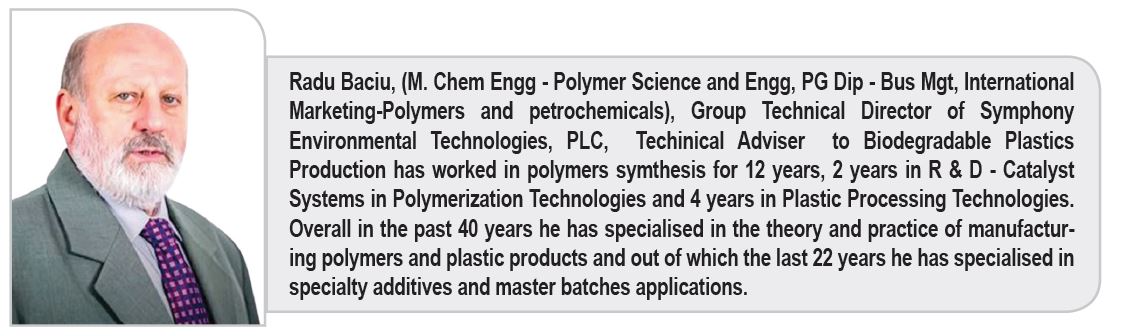
Dr Radu Baciu, Technical Director of Symphony Group, UK elaborates on how their ground breaking additives are making plastics 100% biodegradable.

Infocus
1. Significance of Vacuum System In Chemical Industry and it’s Optimization Study
2. Waste To Wealth – Resource Recovery From Highly Contaminated Wastewater – A Case Study
3. Zero Liquid Discharge

Role of Emerging Technologies in Advancing Sustainability

Abstract

Chemical industry plays a crucial role in the global economy. They encompass a wide range of sectors, including petrochemicals, pharmaceuticals, specialty chemicals, agrochemicals, and more. Chemical industry is a significant source of employment and provides a wide range of job opportunities across various skill levels. It also supports indirect employment in related sectors, such as logistics and support services. Chemical Industry invests heavily in research and development to develop new products, improve existing processes and enhance sustainability.

Introduction

Chemical industry is facing various challenges related to environmental pollution, waste management, and sustainable practices. Chemical industry needs to adopt responsible and sustainable approaches to minimize negative impacts while maximizing economic contribution. Emerging technologies like Artificial Intelligence (AI), Blockchain, Machine Learning (ML), Data Analytics, and Digitalization are powerful tools for enabling sustainability within the chemical industry. A collaborative digital ecosystem can promote sustainable development by enabling the improved management of natural resources, supporting waste monitoring and management, optimizing the supply chain, improving safety measures, reducing energy consumption, and accelerating innovation.
To give an example, the use of Artificial Intelligence in agriculture has resulted in (a) Reduced usage of pesticides resulting in less pollution of the environment (b) Accurate identification of soil health and nutrient deficiency (c)  Intelligent spraying of crop protection chemicals to reduce wastage (d) ) Prediction of Toxicity of pesticides (e) Discovery research. All these are contributing to achieving Sustainable Development Goals and will have a significant impact in the coming years.

Role of Artificial Intelligence in Advancing Sustainability

Artificial Intelligence has emerged as an important tool in diverse areas including Sustainability. If utilized properly, Artificial Intelligence (AI) along with Machine Learning and Data Analytics can make a major impact on Sustainable Operations. We already have many examples where AI is contributing positively to sustainability. Here, we will discuss a few cases from the agriculture sector. Similar examples can be found in many other sectors.

Reduced usage of Chemical Pesticides by Intelligent Spraying

We know that pesticides are important for crop protection, but, at the same time, these chemicals are also  major source of pollution. Normally, pesticides are sprayed in the entire field, following a spray schedule. Only a small part of the pesticide sprayed is used up by the plant. The remaining part is left on the soil, which is ultimately carried to water bodies like ponds, rivers, etc through irrigation and rainwater. It then enters the food chain and affects human health. This practice is not sustainable in the long run and significant improvement is required.
Artificial intelligence has proved its capability in improving the situation. Drones with high-resolution cameras are used to survey the entire field, With the use of Artificial Intelligence and Data Analytics, it is now possible to detect at an early stage the exact location where the crop is affected due to pests, disease, and fungus, the extent to which it is affected and the nature of the damage. This data is now used by Artificial Intelligence based tools to spray right time, right spot, right quantity, and right product. This has resulted in a significant reduction in the use of harmful pesticides and an improvement in crop yield.

Artificial Intelligence in Discovery Research

Research activity to discover a new molecule, whether in pharmaceutical or agrochemical or any other sector is time-consuming, expensive, and requires synthesis of a large number of compounds. It also involves toxicity testing involving a large number of animals that are subsequently sacrificed.
It has been estimated that it requires about $300 million to bring a new agrochemical to the market after approximately 11 years of R&D and related activities. The situation is now going to change with the help of artificial intelligence. In recent times, many chemical and pharmaceutical companies have made collaborations with  AI specialists to unleash the power of AI in discovery research which will enhance sustainability. To give few examples of such collaboration:
Bayer has set up a collaboration with Ketobix which is a spin-out from Harvard University. Ketobix has done significant work on the application of Artificial Intelligence, Machine Learning and Robotics in discovery research. This collaboration is expected to deliver faster innovative solutions. The AI tools of Ketobix will help in discovering paths for higher yields, which means fewer by-products and sustainable operation. Ketobix has developed a self-driving lab for new product discovery using Artificial Intelligence and Robotics.
Another example is of Syngenta, which has collaborated with “Insilico Medicines”, which is a global leader in the application of AI and Deep Learning in the discovery of new active ingredients. The collaboration aims to speed up new, highly effective, sustainable products and technologies while protecting the environment. It is also expected that the use of AI and deep learning tools will reduce the time in the research phase by 20% and will lead to the discovery of a diverse range of molecules with new chemistries.
With traditional research methods, it is expensive and time-consuming to discover a new effective molecule. It is expected that Artificial Intelligence and Data Analytics will dramatically change the discovery process in the near future. The process will take much less time, use of laboratory experiments will drastically come down thereby reducing chemical usage and pollution,  leading to sustainable operation.
It is interesting to note that a new herbicide Benquitione  for weed control in sorghum has been discovered using Artificial Intelligence (W.C. Yang, G.F. Yang et al).
Ref: https://spj.science.org/doi/10.34133/2019/2602414 Hong-Yan Lin, Xi Chen, Jia-Nan Chen, Da-Wei Wang, Feng-Xu Wu, Song-Yun Lin, Chang-Guo Zhan, Jia-Wei Wu, Wen-Chao Yang, Guang-Fu Yang, “Crystal Structure of 4- hydroxyphenyl pyruvate Dioxygenase in Complex with Substrate Reveals a New Starting Point for Herbicide Discovery”, Research, vol. 2019, Article ID 2602414, 11 pages, 2019. https://doi.org/10.34133/2019/2602414

In a similar way, a new fungicide Flubenteram has been discovered (G.F. Yang et al). This new fungicide is effective against many fungal diseases in crops including rust, sheath blight, mulberry powdery mildew, etc.

New fungicide Flubenterum

Synthetic Route Design in Organic Chemistry

An organic compound can be synthesized through multiple routes. The yield, cost and environmental impact will be different by different methods. Using Artificial Intelligence, it is now possible to design a large number of routes within a short time. Not only that, AI will be helpful to guide which process will be sustainable both from environmental and economic points of view.

Blockchain Technology in Chemical Industry

Blockchain is a technology that uses cryptographic principles and acts as a distributed repository. It is a database, managed in a decentralized way, and can store any information, including transactions, records, events, and even scripts in a distributed fashion. Data is recorded in individual blocks of the blockchain. By using a compliance algorithm, each block will capture new data and transactions and be added to the blockchain so that it grows with each transaction.
Blockchain technology has the potential to transform the chemical industry by enhancing transparency, traceability, efficiency, security, and waste management, and contribute to sustainability in various processes. Here are some of the areas where we can implement blockchain technology that can impact the chemical industry:
1. Supply Chain Management: By adopting blockchain technology, chemical industries can become more transparent. It can record and keep track of transactions, shipments, and quality control measures at each stage of the supply chain. This will help the organization in identifying inefficiencies, waste, and unsustainable practices within supply chain management. Based on the report generated by the blockchain, companies can take decisions to optimize processes and reduce environmental impact.
2. Traceability and Authentication: With the help of blockchain, each chemical product can be assigned a unique digital code that includes information about its composition, origin, and manufacturing process. This will help to trace the product throughout its lifecycle and also help in verifying the authenticity of chemicals, preventing fake products from entering the market, and ensuring compliance with quality standards.
3. Waste management and recycling: Chemical industry can benefit from using blockchain to improve waste management and recycling. By recording the disposal and treatment of hazardous waste on the blockchain, industries can assure correct handling and reduce environmental hazards. Blockchain-based systems can also reward recycling efforts and keep track of them by generating certificates for every recycling accomplishment.
4. Carbon Footprint Tracking: Chemical industries are significant contributors to greenhouse gas emissions. Blockchain technology can help in tracking carbon emissions throughout the process that is from raw materials to finished goods and supply chain. By recording emission data on the blockchain,  companies can establish a transparent and auditable system for carbon accounting. This will help the organization in identifying emission hotspots, setting reduction targets, and supporting carbon offset initiatives.
5. Intellectual Property Protection: Blockchain technology can help in protecting intellectual property (IP) rights in the chemical industry. By keeping detailed records of the research, innovations, and patents on the blockchain, companies can establish a time stamped and immutable record of their creations. This can serve as evidence in case of disputes or infringement claims, safeguarding the rights and innovations of chemical companies.
6. Energy management: Blockchain technology can play a vital role in improving energy consumption and promoting renewable energy sources within the chemical industry. This can be done by integrating smart meters, sensors, and energy management systems with blockchain. On real-time basis,  industry can trace the records of energy usage data, which will help in identifying energy-saving opportunities and adopting renewable energy.

Digitalization in the chemical industry

Chemical industries are increasingly implementing digitalization to achieve business growth and sustainability goals. Digitalization has become the second most important prominent investment in the chemical industry. According to one of the reports, chemical companies are going to invest 5% of their annual revenue on an average in digital operations solutions over the next five years. By 2026 most chemical companies will implement advanced digitalization. It has been observed that chemical industries are ahead of manufacturing industries in a digital maturity profile.
Adoption and integration of digitalization across an organization’s operation can help chemical companies to meet the world’s chemical needs now and in the future. Here are some specific applications of digitalization in the chemical industry:
1. Industrial Internet of Things (IIoT): It refers to interconnected sensors, instruments, and other devices networked together with computers’ industrial applications, including manufacturing and energy management. It uses smart sensors, actuators, real-time analytics, and smart machines to enhance manufacturing and industrial processes. IIoT will collect data from sensors, instruments, and equipment throughout the production process. This will enable real-time monitoring of various parameters such as temperature, pressure, flow rates, and chemical composition. The collected data is stored in the centralized system for further analysis. The data can be analyzed to optimize processes, detect glitches, and enable Predictive maintenance (PdM), field service, energy management, and asset tracking.
2. Big Data Analytics and Machine Learning (ML): Chemical industry generates a huge amount of data from different resources on daily basis, which includes data from laboratory tests, production processes, supply chain logistics, etc. By analyzing a large set of data, the manufacturer can identify areas for improvement in production processing, and product quality,  help in reducing wastage, and opportunities for new products in the market. Big Data Analytics will also help in making data-driven decisions, which will improve efficiency, reduce costs and drive innovations. Machine Learning is applied in the chemical industry for various purposes such as developing predictive models for process optimization, quality control, and demand forecasting. It also helps in the discovery of drugs, catalyst design, and material and research development.
3. Supply Chain Management: Digitalization in the chemical industry can enable end-to-end visibility and coordination across the chemical supply chain. Industries can monitor the movement of their raw material, intermediate products, and finished goods by using digital tools like sensors, RFID, and other connected devices. By obtaining real-time data, they can improve inventory management, forecast demand, and optimize logistics which can lead to cost savings and improve customer service.

Future of Artificial Intelligence, Machine Learning, Blockchain Technology and Digitalization  in Sustainable Chemistry

Chemists are moving towards sustainable chemistry which includes sustainable organic synthesis, sustainable analytical methodology, new sustainable advanced materials, etc. It is expected that Artificial Intelligence will play an important role in Sustainable Chemistry in the coming years. Technologies for effective utilization of alternative raw materials such as Biomass and Carbon Dioxide are very important for sustainability. Artificial intelligence and Data Analytics will be extensively used in these areas and also in catalysis research. It will also be used in finding sustainable reaction pathways and optimization of reaction conditions. Another area is the prediction of chemical toxicity based on structure. It will save a lot of time and resources during the development of a new drug or agrochemical if toxicity is predicted well in advance. In short, Artificial Intelligence will find extensive application in various disciplines of Chemistry. It is necessary that undergraduate and postgraduate chemistry curricula are modified to take into consideration the application of Artificial Intelligence in Sustainable Chemistry.
The future of the application of blockchain technology and digitalization in the chemical industry holds great promise towards sustainability. These technologies can address key challenges like supply chain management,  carbon footprint, automation, energy management system etc. By taking advantage of blockchain technology and digitalization, chemical industries can increase their efficiency, reduce waste, enhance resource management, and promote sustainable practices. The integration of blockchain technology and digitalization into the chemical industry can contribute significantly to sustainability goals by collaboration of Industry stakeholders, government departments and technology providers.

Understand Biodegradable Plastics

“We make plastics sustainable by ensuring biodegradation after the usage life ends” – Radu Baciu, Symphony Group Technical Director

Symphony Environmental Technologies, a UK headquartered company, invented a ground-breaking and scientifically proven d2w additive technology that makes plastics biodegradable. Offering a futuristic and globally trusted solution to one of the world’s most severe environmental problems of non-biodegradable plastic waste, Symphony Environmental’s d2w additive can be used in plastics manufacturing to convert end-of-life plastics to nothing more than a soil component that is naturally bio-assimilated by bacteria and fungi. This novel innovation is a paradigm shift, making plastics behave green like any other biodegradable substance on the planet. The d2w technology has been studied for over 25 years and has passed heavy metal analysis and Organization for Economic Co-operation and Development (OECD) eco-toxicity tests.

To understand more on this and also on tackling the gargantuan problem of plastics waste, Chemical Industry Digest had an email interaction with Radu Baciu, Technical Director of Symphony Environmental Technologies, whose views are presented here.

Chemical Industry Digest (CID): Despite intensified R&D into biodegradable plastics, reportedly it has not made much headway. We are talking of polymers created biodegradable ab initio (virgin polymers). There are only few polymers available such as PLA and that too not as versatile in applications like the current polymers.
What is the current status? How many such biodegradable polymers are available in the international market today?  And do they have applications across the board from household, construction, automotive, industry and engineering sectors? 
Radu Baciu (RB): Biodegradable plastics are in use in many countries as sustainable solution to single use plastics. In India, the definition of Biodegradable Plastics was included in PWM Rules in February 2022. The tentative provisional standard for a assessment of biodegradability of plastics issued by BIS was first time mentioned in PWM Rules in the notification issued by MoEFCC on July 07th, 2022. This tentative provisional standard of BIS is called IS 17899 T: 2022. It is currently under review. Testing of biodegradable plastics is a long duration testing and may take about 2.5 years. Testing of all the samples submitted by producers is underway and therefore no producer in India has received certificate from CPCB yet. This is reason of biodegradable plastics have not made much headway yet.
PLA based materials come under the category of compostables and not biodegradable plastics.
In international market there are several suppliers of biodegradable additives. Addition of additives in polyolefin based polymers makes it biodegradable. The applications are possible in household consumer packaging, automotive industry, cement industry, iron and steel, healthcare, HORECA, agriculture, consumer durables, pharmaceuticals and bulk storage FIBC bags etc.
CID: As mentioned, one approach is developing polymers, which are ab initio biodegradable. Now we understand that your company Symphony Environmental Technologies has developed a pathbreaking technology by inventing additives that make existing non-biodegradable polymers, biodegradable. Can you please elaborate on this. Does it make plastics waste only biodegradable or even the ‘to be used polymers’ like PVC, PP, PE etc biodegradable? And how effective are these ones made biodegradable for various applications?
RB: We make plastic sustainable by ensuring 100% biodegradation after the usage life ends. This is done by adding 1% d2w® in the form of masterbatch at the time of manufacturing. The plastic manufactured with d2w® additive also retains 100% recyclable property. Our biodegradable technology works with polyolefins like LDPE, LLDPE, HDPE, PP BOPP. The plastics products could be made with extruded films, blow moulded, injection moulded or thermoformed using d2w additive. Our d2w® additive technology makes consumer plastic waste biodegradable in 17 to 22 months without leaving any heavy metals, microplastics or eco-toxicity. It has passed the globally acceptable ASTM D6954 testing with over 90% biodegradation in 180 days. Testing as per IS 17899 T: 2022 is underway in BIS accredited laboratory in India.
CID: As your additive (d2w) is just introduced in India, how do you propose to market in India, particularly in terms of novel concept introduction and applications? Can manufacturers of polymers like PVC, PE, PP etc directly use it and provide such polymers, now made biodegradable, for processing?
RB: Symphony Environmental India is operational since October 2021 with office based in New Delhi. We are manufacturing d2w additives in India. We have a large distribution network available PAN India.
CID: MNCs, into plastics, doesn’t sound very optimistic on biodegradable plastics. They were emphasising more on developing the circular economy for plastics, totally concentrating on making them more recyclable.  What are your views on this?   To what extent is this possible considering innate human nature of ‘use and throw anywhere’, and the foolproof ‘collections and return to source’ system for this?
RB: Plastic packaging materials made with d2w biodegradable additive have 100% recyclable property while biodegradable. These products can recycled and made into other useful products after the end of usage life therefore meets the requirement of circular economy. It has passed the eco—toxicity testing like OECD 207 and OECD 208. Littering must be avoided but in case a packaging items ends up becoming single use plastic then products made with d2w will biodegrade itself safely without leaving at eco-toxicity.
CID: What do you suggest are workable solutions with all existing options in terms of the polymer materials, its versatile and widespread applications and innate human nature and inadequate collection systems to address the problem of mounting plastics wastes in our environment?
RB: Plastic is a versatile material and it can be recycled and re-used repeatedly. It is not the fault of plastic material but ignorance and irresponsible conduct of humans and lack of infrastructure to effectively and efficiently recycle and re-use the plastic materials.
The workable solutions would involve the following:
  • Segregate solid waste at the origin
  • Do not litter
  • Deposit recyclable waste in a responsible way
  • Reduce the use of packaging materials
  • Reuse all the materials as much as possible
  • Adopt the sustainable technology solutions
  • Do not delay and adopt globally acceptable testing standards
  • Educate our children from early age to become responsible citizens. Do not litter and responsibly discard the solid waste so that organic wet waste can be converted into compost and recyclable waste gets segregated so that it can get reused by converting into other useful products.

Advertisement

Newsletter

Subscribe to our FREE Newsletter & Stay Updated

Advertisement