Home Blog Page 495

Will Hydrogen Prevent Global Climate Crisis – Hope Or Hype?

0

Green hydrogen is the most focused subject in the world today, as it is believed that the optimal utilisation of green hydrogen as feedstock and energy source could be the most desirable strategy for achieving the target of zero emission in the next few decades.

In recent months, there have been several announcements and statements from governments, technologists, investors and large companies all over the world about their commitment to promote hydrogen industry.  Obviously, these entities are of the view that the ultimate solution for the impending global climate crisis is the massive production of hydrogen that would substitute the use of fossil fuels, since hydrogen is an eco-friendly gas that can be used as fuel as well as feedstock to some extent. At the same time, there are also sceptics who think that hydrogen production technology in an eco-friendly manner at economic cost  is yet to be adequately and optimally developed and  advocacy of hydrogen industry  as immediate cure to overcome the climate crisis is somewhat premature  and is similar to  the act of  putting the cart before the horse.

Hydrogen can certainly be used as fuel, though some technology issues remain with regard to storage and transportation of hydrogen   gas at acceptable cost level, which can be overcome soon.  However, use of hydrogen as feedstock for the production of derivative products does not have much scope, while substituting use of fossil fuels by hydrogen.  For example, several petrochemicals such as ethylene, propylene, toluene, etc. which are all strong building blocks and which are presently produced from petrochemical feedstock   such as natural gas, crude oil or coal, cannot be produced from hydrogen.

Alternate ways of producing hydrogen

Hydrogen produced by a process that leaves some carbon footprint is not eco-friendly green hydrogen. Most of the hydrogen today is produced by steam reforming of methane (natural gas) which produces some carbon dioxide. When the nomenclature brown hydrogen is used, it refers to hydrogen produced from coal. Hydrogen  produced from natural gas or crude oil  is called  grey hydrogen, If grey or brown hydrogen is produced and the carbon dioxide generated is captured  and stored  safely away, such hydrogen is called blue hydrogen.

Green hydrogen is hydrogen produced by a process that does not emit any greenhouse gases such as carbon dioxide or methane. The best example of green hydrogen is the hydrogen produced by splitting water using electricity from solar plants or wind turbine or hydro power projects.

Most of the hydrogen produced in the world today and several new projects announced for hydrogen production in recent time are based on fossil fuel such as natural gas. In the case of such   brown, grey or blue hydrogen, there is inherent climate warming component in the feedstock used for the hydrogen generation, though hydrogen, by itself, is an eco-friendly product.

  Challenges in green hydrogen production

Green hydrogen should be produced by the electrolysis of water using renewable energy. The major challenge is cost of production of green hydrogen. To bring down cost, the cost of the electrolyser, which splits water has to be reduced. Possibly, scale of green hydrogen plant capacity can bring down the cost to some extent. Another challenge is the efficiency of the electrolysers – basically, how much electricity it consumes to produce a kg of hydrogen.

As far as the existing technology is concerned, the water electrolytic process for generation of green hydrogen   is power intensive and production cost is higher for the green hydrogen than the cost of production of hydrogen presently made by alternate routes.  Today,   the power requirement for production of green hydrogen is as high as 55 kWhr per kg of hydrogen.

Non availability of renewable power

Claiming it to be the production of green hydrogen, several existing and new projects use power generated from fossil fuel for operating the electrolytic process for green hydrogen.  This is a counter-productive way.

The power generated from fossil fuel is being used, since the installed capacity for power generation from renewable source such as hydro, wind, solar are not adequate and are unlikely to be adequate in future when large capacity for green hydrogen production would be planned for build-up. Further, the capacity utilisation of solar and wind power   and hydro power plant are much lower than the thermal power plant. Moreover, generation of solar power, wind power and hydro power are seasonal and undependable due to possible climate changes   and depending on monsoon conditions from time to time. Under the circumstances, large scale production of green hydrogen -based on electrolysis of water using renewable power source is unrealistic and wishful thinking.

 Case study – How much green hydrogen India needs?

The current consumption of hydrogen in India is about 5.6 million tons, but almost all of it comes from the ‘steam methane reforming’ process, based on fossil fuel, which emits the dreaded greenhouse gas carbon dioxide. Another 1.9 million tons of hydrogen is embedded in the methanol and fertilisers that the country imports. So, today, if India were to replace all the hydrogen in use with green hydrogen, the demand for green hydrogen would be around 7.5 million ton per annum.

To produce this much, electrolyser capacity of 130-140 GW is required. Roughly, the production of 1 ton per annum of green hydrogen requires 18 GW of electrolyser capacity, equivalent to 26 GW of solar power. Considering that the average capacity utilisation of renewable power industry (hydro, solar and wind) is only around 20 percent or even less, it is unrealistic to think that all the hydrogen   that India would need could be switched over to green hydrogen.

Alternate process development for green hydrogen

It is necessary to improve and optimise the electrolyser manufacturing for producing green hydrogen. There is not much to choose from in the immediate future except the age-old alkaline technology. While electrolysis of water is the prevailing process for production of green hydrogen, alternate routes are under development.

Alternate technologies are under development such as proton exchange membrane (PEM), anode exchange membrane (AEM), high temperature reactors (HTR), production from biomass, production using sunshine, etc.  All such possible technologies are under development and their commercial suitability is yet to be firmly established.

As such, the above technologies and a few more can best be termed as technology under development, whose date of commercial exploitation, if found feasible, cannot be reasonably predicted at the present time. The technology development efforts to produce eco-friendly green hydrogen at economical cost is at fluid stage at present.

Green hydrogen – Hope or hype?

Several world governments seem to be assuming that   development of cost-effective green hydrogen production technology would happen sooner or later, perhaps, sooner than later. Obviously, plans of the several governments are based on hope. However, by not adequately explaining the present limitations of green hydrogen technology and challenges involved in developing the commercially exploitable green hydrogen production technology in public domain and the world media not discussing the issues involved in depth, there is a hype today on appropriate green hydrogen technology emerging very soon.

Under the circumstances, it is strange that the Government of India through its national hydrogen mission have announced specific policy interventions to push for the widespread adoption of green hydrogen in India. The Indian government wants to make it mandatory for industries (first fertilisers and oil refining) to use green hydrogen for certain specified percentage of its overall energy requirements. Such a requirement is called Green Purchase Obligation   (GPO).  This strategy of the Government of India amounts to planning in vacuum, as no one can be sure at present time as to when the green hydrogen would be adequately available in the market.

Gain a Digital Line of Sight of your Plant

Overview: To remain productive, safe, reliable and competitive, everyone within the plant should have access to the most up to date and trusted digital information, but without a digital line of sight that ensures information integrity, accuracy and access, your plant could be at risk.

To learn how a digital twin can give you line of sight, see who benefits within the plant, and discover how it affects the whole lifecycle of the plant Click Here

Chemingineering – Safety Always

Safety culture has to be painstakingly built and assiduously nurtured. The recent spate of accidents in the chemical industry probably points to a breakdown in the safety culture. Complacence and overconfidence are arch enemies of safety. Digital tools of Industry 4.0 can be leveraged to enhance safety in multiple ways.

After a significant downtrend in the number of accidents and fatalities in the chemical industry in the years leading up to the pandemic, 2020 and 2021 have witnessed an unfortunate reversal. A major explosion in a chemical plant in Leverkusen, Germany, that killed seven people in July 2021, was eerily reminiscent of the notorious Seveso incident of 1976 due to the possible release of dioxin. A chemical leak in a Texas plant in July 2021 that killed two and injured thirty, is being regarded as the worst chemical accident since 2019. India witnessed a sudden spurt in accidents following the resumption of industrial activities after the lockdown restrictions were eased in mid-2020. 118 fatalities were reported in 64 accidents between May and December 2020. This unfortunate turn of events has extended into 2021 with 117 fatalities and 142 injuries reported from 52 industrial accidents between January and June. Even as this article was being drafted, a major fire broke out in Indian Oil refinery, killing three and injured more than 40. Poor safety awareness, lax implementation of safety protocols, inadequate risk assessment, large number of poorly trained contract workers and breakdown of emergency response systems are responsible for this setback.

Seveso Directive
On 10th July 1976, Dioxin, an extremely toxic chemical was released into the atmosphere from a reactor in a chemical plant on the Italian town of Seveso. Over the next few weeks, several people took ill and a large swathe of area around the plant to the extent of 17 square km was declared contaminated. Following this incident, the European Commission developed a legislation that is now famously known as the Seveso Directive. Formally adopted in 1982, the Seveso Directive soon became the gold standard for policy and legislation on industrial accidents in many countries across the world. In the aftermath of the Bhopal tragedy, the directive was amended in 1987 and 1988 to expand its ambit to include storage of hazardous substances. In 1996, Seveso II Directive came into existence and it laid down the requirements of a Safety Management System and planning for emergency. The Seveso III Directive, which was adopted in 2012, made the provisions more robust by strengthening the standards of inspection and recognising the community’s Right to Know. In September this year, the European Commission published its first report on the effectiveness of the Seveso Directive, which covers some 12,000 establishments across Europe. The report has come out with the very encouraging conclusion that the number of major accidents has continuously decreased between 2000 and 2018 to reach less than 25 per year.

Leverkusen Explosion
Ironically, just a couple of months before the release of this report, there was a major explosion in a plant in Leverkusen, Germany. Seven people died in the explosion that could be heard over a radius of 40 km. The accident occurred in a waste disposal plant and is being attributed to the negligence in handling and storing the waste. The accident raised the spectre of transboundary consequences should the toxic substances contaminate the nearly Rhine river. The accident prompted France to review and test its readiness in notifying the neighbouring countries in the event of a transboundary incident. The Leverkusen accident is yet another timely reminder of the challenges faced by the chemical industry as villages and towns expand and encroach into the sterile zone around hazardous chemical plants.

Illinois Incident
In September this year, the US Chemical Safety and Hazard Investigation Board (CSB) released its final report on the May 2019 accident at a specialty chemicals plant in Illinois, USA. The accident which killed 4 employees occurred during a batch operation that involved manually adding and mixing chemicals in a tank, a scenario that happens day in and day out in hundreds of MSMEs across our country. In the Illinois incident, the operator added a wrong chemical, which was incompatible with another chemical already present in the tank. The mistake happened because the two substances were stored in identical drums with poorly differentiated markings. The two incompatible chemicals resulted in a chemical reaction that released hydrogen which ignited causing an explosion and fire. CSB has attributed the incident to deficiencies in the company’s policies and practices including a weakness in process safety culture and lack of a safety management system.

Lessons from Illinois
In its recommendations, that ought to resonate through the Indian specialty chemicals sector, CSB suggests to put in place a system to manage chemical reactivity hazards covering the elements recommended by Centre for Chemical Process Safety (CCPS) of American Institute of Chemical Engineers. These include collecting reactivity hazard information, identifying chemical reactivity hazards and assessing their risks and testing for chemical reactivity. CSB wants companies to document chemical reactivity risks and use it for communication and training. Further, CSB has advocated the development of a gas detection and alarm programme for all hazardous gases that could be released in the work area. The programme should address proper installation, calibration, inspection, maintenance and training to ensure that the hazardous gas detection and alarm systems are functional at all times.

Digital Tools
Digital tools of Industry 4.0 are now being leveraged by big chemical companies in multiple ways to enhance safety. Internet Of Things (IOT) coupled with predictive analytics is significantly improving the Mean Time Between Failures (MTBF) of safety-related hardware. It is possible to use Artificial Intelligence for gleaning valuable insights from incident databases and unstructured near-miss reports. Digital Twins – virtual replicas of the physical plant – have been used for improved decision making and thus enhance process safety. Virtual Reality and Augmented Reality (VR/AR) platforms are now making it possible for plant operators to be trained in a safe, controlled and realistic environment and learn to respond to emergencies. Operators are plunged into simulatedenvironments that are otherwise too dangerous and expensive to recreate in real life. The trainer can also join the simulation and provide feedback in real time.

Afterword
Creating and nurturing a robust safety culture is a complex multi-layered and multidimensional endeavour. Safety management systems need to be regularly reviewed, audited and updated. Safety related hardware need to be regularly inspected, tested and maintained. Operators need to be continuously trained and retrained. Disaster management plans should be regularly reviewed and tested for preparedness to handle emergencies. Long incident-free periods can lull us into complacence and overconfidence.

Readers’ responses may be sent to:
k.sahasranaman@gmail.com or
chemindigest@gmail.com

Chemingineering – Decarbonising Cement

Decarbonising of the cement industry is a challenging but pressing problem as the demand for concrete is expected to grow unabated. Release of carbon dioxide is intrinsic to the process of cement manufacture, yet concrete with its ability to absorb carbon dioxide can become a global carbon sink. This month’s column examines the many dimensions of the cement-concrete conundrum.

If the cement industry were a country, it would be the third largest emitter of carbon dioxide in the world after China and USA and above India. The cement industry’s contribution to global warming is 8 percent. But unlike many other sectors, the emission from the cement industry is intrinsic to the manufacturing process. 60 percent of the carbon dioxide emitted in cement industry is released during the calcination process; the remaining 40 percent is contributed by the use of fuel and electricity. Thus decarbonisation of cement industry is extremely difficult as it cannot be achieved through change of fuel or higher energy efficiency.

Cement is the primary constituent of concrete, the second most consumed material in the world next only to water. The per capita consumption of concrete is threetons per annum. Twice as much concrete is used in construction than all the other materials combined. With infrastructure in much of the developed world rapidly approaching the limit of their useful life and an insatiable appetite in the developing world, the demand for concrete and cement is likely to grow unabated in the foreseeable future.

Carbon dioxide is released in the cement industry during the production of clinker by calcination of limestone. Substitution of clinker partially or even eliminating it completely is emerging as the main strategy for decarbonisation of the cement manufacturing process. Carbon dioxide capture and storage is another alternative. Also important are recycling and reuse of concrete and reducing the usage of concrete through design.

Clinker Substitution
The key ingredient of cement is clinker. Clinker is produced by calcination of limestone, a process that releases large quantities of carbon dioxide. Clinker production is also the most energy-intensive part of the cement manufacturing process. Typically, the cement specification lays down a range for clinker concentration and most cement producers have traditionally been erring on the side of caution and including more clinker than necessary to meet the specification. Closer a cement plant can get to the lower end of the clinker concentration range, lower would be its operating costs and carbon footprint. The average global clinker to cement ratio is currently 0.81. The balance is made up of gypsum and Supplementary Cementitious Materials (SCM). Among the SCM widely used today are blast furnace slag, fly ash from coal-fired boilers, calcined clay and natural pozzolans. It is estimated that the average clinker to cement ratio will fall below 0.60 by 2030.

Concrete without Cement
Carbicrete, a Montreal-based company has developed a technology to make concrete without using cement. Instead of cement, the company uses waste slag from the steel industry plus carbon dioxide captured from other industrial plants. The technology can thus stake claim for negative emission. During the curing of traditional concrete with water, the calcium oxide in cement reacts with carbon dioxide in atmosphere to form strengthened calcium carbonate. In Carbicrete’s technology, carbon dioxide captured from other industrial processes is injected to react with the calcium oxide present in the waste slag from steel industry. Though having exactly the same chemical composition, Carbicrete claims that concrete made this way has 30 percen higher compressive strength than the traditional concrete. However, Carbicrete’s technology can only be used in the controlled environment of a factory to produce precast concrete panels that can be delivered to a construction site. It cannot be used for production of ready-mix for on-site curing of foundations at the construction sites. Also the process depends on a steady supply of steel slag, which is not enough to meet the global demand of concrete.

Carbon Capture
Concrete has the potential to become a global carbon sink. This will happen when carbon capture utilisation and storage (CCUS) technologies mature to a level, where more carbon dioxide is captured and stored in concrete than is generated during its production. Carbon dioxide from a cement kiln or even from other external sources can be captured and injected into fresh concrete, where it becomes permanently embedded through a process of mineralisation and actually helps in improving the strength of concrete. Among the handful of companies that are working on this solution is the Canada-based CarbonCure, which has won the Carbon XPrize for the successful demonstration of a fully integrated CCUS solution, where the carbon dioxide from a cement kiln was used for the production of ready mix concrete.

Circular Economy
Concrete structures are now being recycled after demolition instead of being dumped in landfills. Recycled concrete is made up of several constituents, among them hardened cement paste together with fines from sand and aggregates. The hardened cement paste has hydrates rich in calcium that are able to react with carbon dioxide and form calcite, the main component of limestone originally used for cement production. Theoretically all the carbon dioxide released from limestone during calcination can be bound back by the hardened cement paste. But since the rate of carbonation is low, only half of the carbon dioxide gets bound, thereby creating an opportunity for perpetual recycling in a circular economy.

Embodied Carbon
Embodied carbon of an infrastructure project is the carbon dioxide emitted during its entire lifecycle. It includes carbon dioxide released during different phases of the project lifecycle – manufacture of building materials, transport of materials to the manufacturer, the manufacturing process, transport of manufactured products to the job site, the construction process, maintenance of the asset and finally demolition and recycling of waste. It is estimated that embodied carbon will account for 50% of the carbon footprint of all new construction from now and 2050. Cement is the biggest contributor to embodied carbon in the built environment. Several leading organisations including World Green Building Council have embarked on a mission to reduce embodied carbon in buildings. One of the easiest ways of achieving this is to alter the specification of concrete. At the recent COP26 in Glasgow, 5 countries – India, UK, Germany, Canada and UAE pledged to achieve net-zero in major public construction of steel and concrete by 2050.

Sustainable Specification
Concrete is a unique material in that the specifier has the ability to directly influence the constituents to ensure that the performance criteria are met while also satisfying the precepts of circular economy. Guidelines encompassing many considerations are available for designers to specify a concrete that is more sustainable.

Afterword
Energy consumption levels for clinker production are almost at the theoretical value. Nearly all the available SCMs have already been exploited for cement and concrete production. Also the energy transition will see a decrease in the availability of fly ash and blast furnace slag, which will become inadequate to meet the growing appetite for concrete. CCUS based solutions are currently the best approach for decarbonising the cement industry. Reducing concrete in construction, extending the service life of concrete and recycling and reuse of concrete at the end of their useful life are also extremely important ways of reducing the Embodied Carbon in our built environment.

Readers’ responses may be sent to:
k.sahasranaman@gmail.com or
chemindigest@gmail.com

Chemical Industry Digest – November 2021 Issue

0

Interview with Seema Rayal, Cairn Oil & Gas 
This interview profiles Seema Rayal, Installation Manager, Aishwariya oil field, who has overcome several social barriers to become the first woman from Rajasthan to head an oil and gas producing field in Rajasthan. Her successfull foray into a male-dominated profession can inspire many young girls to follow their dreams, irrespective of social constructs.

Centrifugal Compressors Surge Control Using Invariant Coordinates 
– S Raghava Chari, Independent Consultant
Centrifugal compressor surge is destructive as within seconds it damages a compressor internals, bearings and seals – which leads to plant outages. The author talks about methods for controlling compressor surge such as utilising gas-loaded surge relief valve, spring-loaded pressure safety valves, pilotoperated valves and more.

Sustainability Efforts Link Supply Chain
– Sean Ottewell
Supply chain sustainability refers to companies’ efforts to consider the environmental and human impact of their products’ journey through the supply chain, from raw materials sourcing to production, storage, packaging, delivery and every link in between. This not only helps in living up to set standards, but also gives positive results overall.

New Hydrocarbon Technologies, Processes and Products
– Dr Anjan Ray, et al, CSIR-IIP
The CSIR-Indian Institute of Petroleum is in the forefront for developing many hydrocarbon techniques, which find applications in refinery & petrochemical industries. Some of the latest developments are covered here.

Understanding Pyrolytic Behaviour of Polyester Polyol
– Pallavi Gupta, Ritu Gupta, Shivani Sapra, Ruchi Gupta, Pinaki Ranjan Samantha
A validated instrumented method to identify the optimum pyrolysis temperature of polyester polyol is described. Establishing & understanding pyrolytic behaviour helps in the
characterisation of a wide variety of polymers.

Chemingineering – Decarbonising Cement 
– K Sahasranaman, Independent Consultant
Cement, the primary constituent of concrete, is the second- most-consumed product globally after water. The cement industry alone is responsible for about a quarter of all industry CO2 emissions, and it also generates the most CO2 emissions. Here the author highlights how companies have several options to decarbonise cement.

The Inspiring Role of Seema Rayal in Oil & Gas field job, with Cairn Oil & Gas

Women have been breaking male bastions, one after the other, and today there are hardly any areas left where women are not playing a significant role. From even in the armed forces to challenging onsite jobs in industry. Yes. The overall percentages of women in these areas are quite minor; but they are growing. What is important is that once the glass ceiling is broken by few intrepid women by their entry into areas, otherwise dominated by men, it serves as an inspiration for others to follow suit.

Impeding social, cultural and traditional forces restraining women are now being overtaken by the forces let loose by education, modernism and enabling corporate culture, governmental encouragement and regulations.

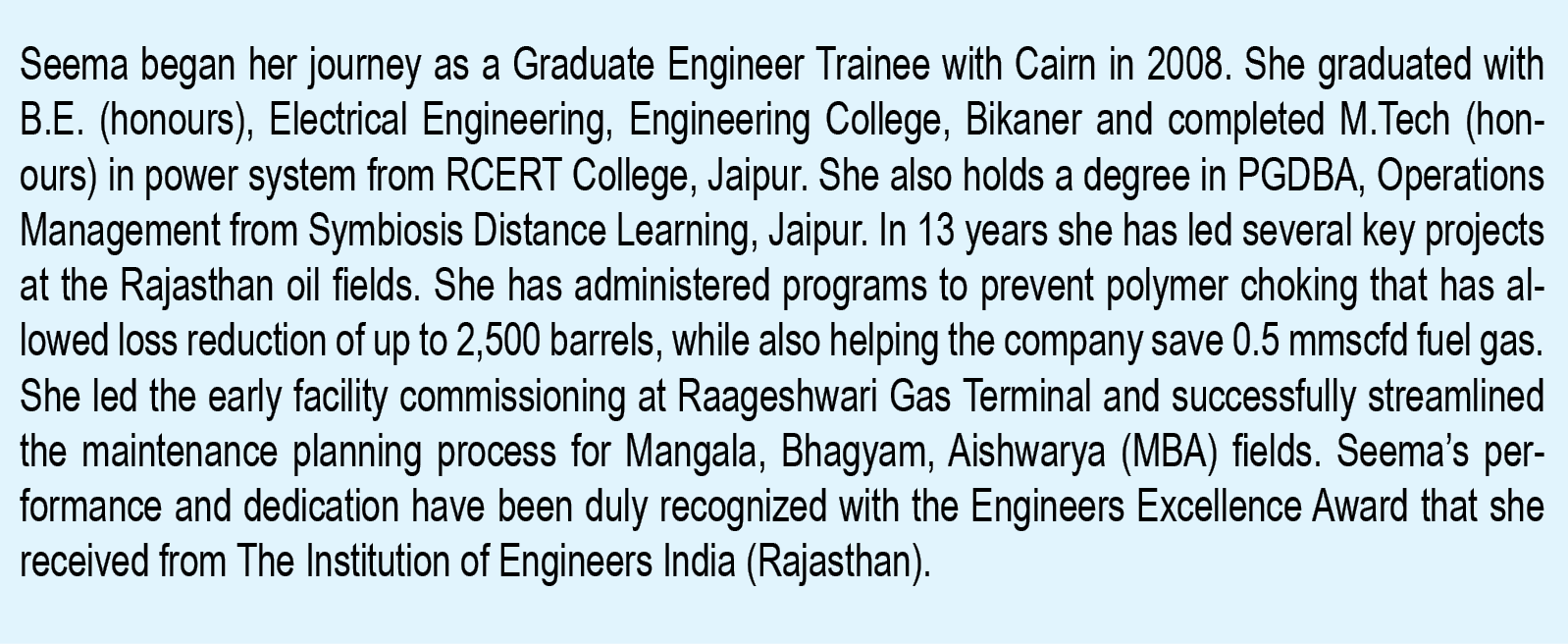
Here is the saga of one such intrepid woman, Seema Rayal, who after her education as an engineer, joined a very challenging field – oil & gas. This pathbreaking role is quite laudable, as even when women get trained as engineers, many prefer to take cushy white collar jobs, eschewing areas which are perceived as too challenging for women. But not Seema Rayal. Despite the many societal and other challenges she faced she decided to take on the tough area of a predominantly male preserve.

Seema is the first woman engineer from Rajasthan and at Cairn Oil & Gas to occupy this coveted leadership position at an oil and gas installation that has traditionally been considered a male bastion. Hailing from the state of Rajasthan, a region very conservative and traditional. Seema has overcome several social barriers to become the first woman from the state to head an oil and gas producing field of Cairn Oil & Gas.

Read this interesting profile on her persistence, perseverance and resoluteness in this interview with Chemical Industry Digest.

Chemical Industry Digest (CID): Despite knowing that the hydrocarbon exploration industry is not only challenging but also a male bastion, particularly in the engineering sectors – what motivated you to take up a career in this sector? Was this your preference over other options, why?

Seema Rayal (SR): When I decided to pursue a career in engineering there were other options available too. But, I was confident in my decision of working in this sector as my interests lay here. I agree that this is a male dominated sector, but that never stopped me from dreaming or pursuing a career in this field. There were occasions when my capabilities were questioned, because I was a woman, but my team at Cairn has always supported me. Eventually, people around me started believing in me and became confident in my skills.

CID: Hailing from Rajasthan, a very patriarchal and conservative society, how did your family and your community react to you becoming an engineer and taking up an oil and gas field job?

SR: It is true that Rajasthan still suffers from a patriarchal society. But I believe I have been very fortunate to have had complete support from my family. My parents never discriminated between my brothers and me, even when I was a child. They have always been supportive of my desire to pursue a career in engineering, because I was a bright kid who they reposed immense faith in. When I appeared for the engineering entrance exam, I ranked 12th among the girls and was one of the four females who got selected for Cairn. When I got married in 2010, the support I received from my in-laws was exceptional. My mother-in-law played a key role in helping me balance my personal and professional life. She was the reason I could continue with my profession successfully after having two kids. She ensured I could fulfil my role as a mother while I practised as a field engineer. She stepped up and took the responsibility of ensuring that everything was taken care of at home so that I could pursue my career. I managed to create a perfect work-life balance with her support.

CID: Beginning as a graduate engineer trainee in 2008, to becoming Senior Engineer, to becoming Superintendent Manager, to now Installation Manager – you have consistently grown in rank. Could you briefly state the activities you handled in each position, i.e., your job responsibilities? How were you trained at Cairn Oil & Gas?

SR: After completing my training, I was given the opportunity to work for six months at both Suvali and Ravva. I returned to Rajasthan in 2008, just as the project was about to begin. Since MPT had not yet been properly commissioned, we were relocated to a small area in Mangala where we would set up an early production facility to get the oil out for sale. I decided to switch to the installation vertical after working around that facility for a while. After 2-3 years as an Installation Engineer, I was promoted to Senior Engineer. As a Senior Engineer, I oversaw instrument maintenance, mentored the crew, and provided further training. When I became a manager, I decided to train my team for the field. I made sure I provided them unwavering support. While training them, I realised that I had to be more than just a manager – I needed to be a leader.

CID: In the various functions/projects you handled in your job to date, can you describe any two most challenging projects that you handled successfully? Any regrets in any other projects which you feel you could have handled better?

SR: My priority, right from the start, has been to ensure compliance and an incident-free work environment. When I was promoted to Installation Manager, I discovered that I needed to be even more careful with compliance, employee safety, and production figures. This has helped me manage my projects more efficiently. While I was in Mangala, a team arrived from Gurgaon, and I was assigned to them. The Gurgaon team’s leader was taken aback when he saw a lady stepping up to work for them. But my employer assured them that the job would be done well. In the months that followed, I ensured that the project was finished successfully, and the team leader was left with no doubt in the capabilities of a woman field engineer.

CID: As a woman engineer, what challenges did you face? How did your male colleagues react to you – especially as you went up the ladder and became a boss? Did you find being a woman in your job a disadvantage or was it advantageous?

SR: Once I decided that I wanted to pursue electrical engineering there was no turning back. When I was working in Rajasthan, people had a misconception that women are incapable of withstanding the harsh temperatures – but we stood equally with the rest of the team. Nothing is impossible for a woman to achieve. Women have great team spirit and that is a great advantage. These are some early learnings from my school days that I still hold very dear. Although patriarchy is predominant in Indian society, things are changing. It will take time for the perception that women cannot do as well as men in this industry to change. In Cairn, no one has ever questioned my competence because of my gender. However, it was not an easy road for me; there were numerous roadblocks, and people began to believe in me only once I stepped up and proved myself through good work.

CID: What were the conditions at the various terminals you operated (Rageshwari and Mangala) and now at the Aishwarya oil field site? Are the facilities and working conditions women-friendly?

SR: Women-friendly conditions that push them to achieve their full potential are usually limited in businesses in this sector. But I must appreciate Cairn for the kind of environment they have provided me and other lady engineers throughout our stay here. The company has always been very supportive and assisted us in our professional development. We’ve always been treated equally, and I don’t recall ever being looked down upon because of my gender. Cairn as a company has always ensured women-friendly working conditions, irrespective of the levels we work on.

CID: Today, many women are becoming engineers, though as a percentage they remain fewer than men. However, after they receive their degrees, many women opt against working in the plants or at project sites. Most prefer office-based, white-collar careers. Why do you think this is so? What is your advice for aspiring young women engineers?

SR: There are two reasons for this attrition. On one hand, conditions are not conducive for women in several field jobs – this includes providing security, segregating washrooms, etc; on the other hand, given societal norms, there is also some amount of apprehension among women on their ability to succeed in the field. I believe that determination is key to excelling in any subject. Depending on her willingness, a woman can alter the atmosphere. If you want to work in a plant or on a project site, you must be mentally prepared. Both working at a plant or an office, require effort and dedication. Women are generally advised to take up ‘comfortable’ jobs. I believe every work environment has its challenges. I think women should take up any job that they like and give their cent per cent to it. If they remain determined and convinced, every obstacle and challenge can be overcome.

Chemingineering – Electrifying Chemical Industry

Electrochemical processes are energy efficient, safer and have a high atom economy. Coupled with the use of renewable electricity, electrochemical processes are a greener and more sustainable alternative for the production of chemicals. Electrochemistry also opens up hitherto uncharted pathways for synthesis of specific molecules of interest for agrochemical and pharmaceutical industries.

Michael Faraday laid down the laws of electrolysis in 1834 and Hermann Kolbe carried out the first organic electrosynthesis in 1848. While electrolysis is used for the large scale manufacture of caustic soda/chlorine and aluminium, electrochemistry has been received with lukewarm enthusiasm in the production of organic chemicals on an industrial scale. The largest commercial scale organic electrosynthesis process in vogue today is for the manufacture of adiponitrile, a precursor for Nylon 6,6. Commercialised in 1965 by Monsanto, the process involves electrohydrodimerisation of acrylonitrile to adiponitrile. With more and more electricity being generated from renewable resources at lower and lower costs, electrochemistry is experiencing a renaissance. Not only has electrosynthesis emerged as a potential tool in the sustainable manufacture of chemicals, it has also opened up novel mechanistic pathways for innovative chemical transformations. Electrosynthesis has many advantages over conventional methods of synthesising chemicals. It is energy efficient, inherently safe and eliminates waste. However, there are several barriers for the adoption of electrosynthesis in the mainstream chemical industry.

Greener Process
Redox reactions are an important technique for synthesising organic compounds and have been traditionally accomplished by the use of oxidising and reducing chemicals. This conventional approach inevitably leads to generation of waste, which often pose environmental concerns during disposal. Electrosynthesis achieves the redox transformation by replacing chemical reagents with electric current. Redox transformation through anodic oxidation and cathodic reduction does away with the use of oxidising and reducing chemicals and is thus a greener alternative. Another important advantage of electrochemical reactions is that they occur under milder conditions compared to traditional methods which require elevated temperatures and pressures. Electrosynthesis thus saves energy.

Safety
Electrochemistry also confers other advantages that are singularly lacking in conventional chemical processes. Electrochemical reactions are faster and thus require lesser residence time and smaller inventories. The reaction can be controlled with greater precision by manipulating the current or voltage. The reaction can also be stopped instantly by switching off the power. The improved control features coupled with the milder conditions make electrosynthesis safer than conventional processes.

Novel Platform
Besides offering a more sustainable and safer alternative, electrosynthesis provides a uniquely powerful platform to synthesise targeted molecules. Electrochemistry offers redox potentials that are incapable of being achieved by chemical oxidants and reductants. This allows creation of new reactive intermediates and currently unimaginable strategies to synthesise molecules with novel properties. Electrosynthesis enables enantioselective reactions and thus offers great value to agrochemical and pharmaceutical industries.

Energy Economy
Every electrochemical reaction consists of two half-reactions – the oxidation at anode and the reduction at cathode. The two half-reactions are linked to one another through electron transfer from cathode to anode through the electrolyte. But typically, only the anodic oxidation is utilised for synthesis and the cathodic reduction is frittered away. This reduces the energy economy of the overall electrochemical redox reaction. The energy economy can be improved if the reduction reaction at cathode can be gainfully utilised to create another product. This has led to the concept of “paired electrolysis”, in which both the half-reactions are used to produce desirable products at the anode and cathode. One way of achieving this is to carry out the electrolysis in a divided cell, in which the anode and cathode are separated by a semi-permeable membrane. For example, the oxidation of an alcohol at the anode can be matched with the reduction of unsaturated C-C bonds by the hydrogen released at the cathode. The same outcome can be realised by piping away the hydrogen liberated at cathode and carrying out the hydrogenation reaction in a separate reactor.

Flow Reactors
Electrosynthesis is best carried out in Flow Reactors (See Chemingineering – Small is Beautiful, June 2019). Electrochemical reactions are regarded as heterogeneous as they take place at the surface of electrodes. The two key requirements for an electrochemical reactor are a small interelectrode gap so as to minimise the ohmic drop in the electrolyte and having a sufficiently high flow velocity to avoid gas hold-up at the electrode. Flow Reactors will also facilitate easy scale-up from lab to commercial production.

Electrodes
Electrodes are at the core of electrosynthesis. Material of electrodes and their morphology are both important in determining the outcome of the electrochemical reaction. A wide range of materials have been studied by researchers. These include both non-metallic electrodes such as graphitic carbon as well as metallic electrodes. Transition metals such as copper and nickel and noble metals like platinum, palladium and ruthenium have been examined. The electrodes usually provide the oxidising or reducing equivalent of the chemical reagent, but sometimes play a catalytic role. In some situations, active transition metal catalysts are generated electrochemically at the electrodes to drive challenging reactions like C-C coupling and C-H activation. Chemoselectivity, the preference for one functional group over other competing groups, can be induced into redox transformations through the use of appropriately modified electrodes. For example, while carbonyl compounds were produced at a platinum anode, carbon-based anode yielded tetrahydrofuranes. Using different materials for electrodes coupled with appropriate surface modifications, innovative strategies can be developed for molecular synthesis.

CO2 Capture
Electrochemical reduction of carbon dioxide to carbon monoxide and subsequently to valuable feedstocks and fuels is emerging as a promising technology in the battle against global warming. Since the electrochemical reaction can be powered by renewable energy, the technology simultaneously provides an elegant solution to the problem of energy storage. The reduction occurs in the presence of a catalyst and a variety of catalysts have been examined. Catalysts are primarily of two types – transition metals and nanostructures. Copper has emerged as the most effective transition metal catalyst. However, it is plagued by poor efficiency and low stability. Nanostructures of copper supported on graphene have shown encouraging efficiencies in the electrochemical conversion of carbon dioxide to ethanol. Lack of a stable, efficient and inexpensive catalyst continues to be a major impediment in the commercialisation of this technology.

Afterword
A multinational consortium in EU called PERFORM has been set up with the objective of developing electrochemical processes for the production of chemicals from bio-feedstocks. Under this initiative, two demonstration projects are under development – one for electrochemical production of maleic acid from furfural paired with production of valeric acid from levulinic acid and the other to produce adipic acid from glucose.

Readers’ responses may be sent to:
k.sahasranaman@gmail.com or
chemindigest@gmail.com

Chemical Industry Digest – October 2021 Issue

0

Prospects of Biosimilars in India
– Dr R B Smarta, Interlink
Biosimilars are slowly picking up pace in the Indian pharma sector. However, there is still a long way to go for pharma companies as investments required are quite high. Success depends upon the right selection of the molecules.

New Catalytic Processes for Perfumery Chemicals
– Dr Saravanan Subramanian, Dr. Sukalyan Bhadra, Dr. Ankush V. Biradar CSIR-CSMCRI
There are challenges galore in procuring natural ingredients for manufacturing perfumes. The commercial market is witnessing huge demand for perfumery chemicals. This article
talks about how the institute is conceiving new ideas and approaches. It details process
developments and know-how developed by the institute, particularly through the advances
made in catalysis and synthetic chemistry.

PLI Scheme for Reviving India’s API Industry
– Karan Chechi, TechSci Research
The Indian API industry started reeling due to cost competitive imports from China and  any pharma companies closed their API manufacturing. In the wake of supply chain disruptions post-covid, the Government of India introduced PLI schemes for the pharma industry to encourage them to resume manufacturing API’s and raw materials. Details of the scheme are outlined.

Succeed at Mixing Scale-up
– David Dickey, Mix Tech, Inc
The thumb rule is to always follow the simple rules for mixing. Adhere to the process
needs and keep the essential features the same with scale-up. Process knowledge
and knowledge of basics is the key.

Out of the Box – Solutions to Industrial Problems
– S Raghava Chari, Independent Consultant
Here the author talks about how he and his team solved four major problems faced by process industries.

Chemingineering – Electrifying Chemical Industry
– K Sahasranaman, Independent Consultant
Our columnist talks about how the electrochemical processes, which are not only energy-efficient and safe, but also have a high atom efficiency are becoming attractive. Today, many companies are taking the initiative to develop electrochemical processes to produce chemicals. The advances in electrochemistry are well explained in this column.

Reducing Carbon Footprint through Energy Efficient Industrial Pumps

In the industry sector alone motor-driven systems have been consuming the most electricity. [i] Given this background and the insights from the recent Intergovernmental Panel on Climate Change, there is a crucial need to cut down on the energy usage of motors and improve their efficiencies for reducing carbon emissions.

It is also said that approximately 90% of the cost of a pump through its lifetime comes from the amount of energy it consumes.[ii] This also explains why motors and pumps have the highest potential in increasing the number of Negawatts – watt of energy that has not been used through energy conservation or the use of energy-efficient products.

Industries switching to energy efficient pumps can significantly cut down their carbon footprint, in turn, having a positive impact on the environment and also saving on costs.

Understanding energy efficient pumps

When it comes to pumps, motors are a crucial component. Energy efficiency in motors is measured in five levels from IE1 to IE5. The usage of IE5 (International Efficiency) motors provides the highest energy efficiency, by reducing the energy consumption of the system and improving it to a minimum of15% in comparison to a typical pump load profile.

E-pumps use IE5 motors and offer increased functionality, making them easy to use in a wide-range of complex applications. With innovations being incorporated into E-pumps, they are manufactured with the capabilities of being smart and intelligent enabling us to meet the changing demands of a climate conscious industry. E-pumps analyse the consumption patterns of a system and recommend only the required resources necessary for conserving energy as well as resources in use. High efficiency E-pumps with IE5 motors contribute substantially to energy savings, reduced CO2 footprint and cut operational costs. In 2020 alone the avoided CO2 emissions from Grundfos E-pumps was 270,000 tons.

For instance, Rakshit Pharma, a leading API manufacturer based in Vishakhapatnam, is an establishment that is conscious about its water usage. The company utilized Grundfos iSOLUTIONS and went a long way in reducing complexity of its water systems by using E-pumps. The result being that energy efficiency and dependability of the pumping systems saw a significant increase.

Similarly, the application of technologies like Internet of Things and Artificial Intelligence have enabled predictive maintenance of pumps through remote management of water infrastructure.

A UK chemical company needed to upgrade its existing system to improve the reliability of its manufacturing processes. Since cooling is such a critical element of this company’s processes and product output, control and reliability of that process was critical along with efficient energy savings. The company chose iSOLUTIONS package with intelligent pumps and controls which helped them in savings of more than 50% than before.[iii]

Industries can also opt for energy audits that help them understand their ‘actual’ needs. An Energy Audit is the most comprehensive analysis of installed pumps.It is a detailed, measurement-based analysis of the current pump’s performance with suggestions for future energy savings and improved performance. These audits can help industries understand what systems to replace with newer, efficient pumps, enabling reduction in energy consumption and increase in efficiency.

Unlocking a sustainable future

Industries are proactively shifting to more energy efficient and sustainable methods as they realise their role in creating a cleaner world. Looking at this from a business angle, there are substantial benefits in terms of cost savingsby adopting sustainable solutions. Through efficient implementation, the magnitude of energy savings is truly significant. Saving on negawatts will help the industry and the world, positively impact the climate and reduce carbon emissions. As per the IPCC report, it is the right time to shift and adopt sustainable policies to avoid irreversible climate catastrophes in the days to come.

[i] https://www.grundfos.com/about-us/news-and-media/news/grundfos-endorses-the-use-of-high-efficiency-ie5-motors-and-pump

[ii] https://www.searchingindustrial.com/media/1078/pumps-could-change-the-world-again

[iii] https://www.grundfos.com/solutions/learn/cases/50-percent-energy-savings-thanks-to-optimised-industrial-cooling


Note: Grundfos says that it manufactures energy efficient E-pumps with IE-5 motors. The company claims that in 2020 alone the avoided CO2 emissions from Grundfos E-pumps was 270,000 tons. For instance, Rakshit Pharma, a leading API manufacturer based in Vishakhapatnam, is an establishment that is conscious about its water usage. The company utilized GrundfosiSOLUTIONS and went a long way in reducing complexity of its water systems by using E-pumps. The result being that energy efficiency and dependability of the pumping systems saw a significant increase.

Advertisement

Newsletter

Subscribe to our FREE Newsletter & Stay Updated

Advertisement