Home Blog Page 526

Otto Hahn (1879 – 1968)- The Father of Nuclear Chemistry

One of the greatest pioneers in radioactivity and radiochemistry, German chemist Otto Emil Hahn was awarded the 1944 Nobel Prize in Chemistry for his phenomenal discovery of nuclear fission. He was an experimental chemist of such eminence that before he actually became a Nobel Laureate, he had been nominated for the Nobel Prize in Chemistry for a record 22 times, and 16 times for the Nobel Prize in Physics!

Hahn’s historic discovery that the nucleus of atoms could be split, followed by a number of other important discoveries made a few years earlier. In 1932, James Chadwick discovered the neutron, offering researchers a powerful new tool for investigating atoms. In 1934, Irène Joliot-Curie and her husband Frédéric Joliot-Curie discovered artificial radioactivity. Soon afterwards, Enrico Fermi successfully bombarded over 60 elements with neutrons including the nuclei of the heaviest natural element Uranium. Keenly interested in Fermi’s work, Hahn, along with his long-time collaborator in research Prof. Lise Meitner, and his student Fritz Strassmann began to further research the bombardment of uranium nuclei, leading to the discovery of what came to be called nuclear fission.

Earlier, Hahn had also discovered a number of radioactive elements, but significant among these, especially from the oncology point of view, was his discovery of mesothorium-1 (Radium-228), a radioactive element that cost half as much to manufacture as Radium-226 that had been discovered by Pierre and Marie Curie, but was equally effective for use in radiation therapy for cancer patients. This discovery won Otto Hahn his first nomination for the Nobel Prize in Chemistry in 1914. He didn’t win it that year, but mesothorium began to be widely used for treating all types of cancer.

One of the many greats emerging from Sir Ernest Rutherford’s group, Hahn’s claim to fame came even before he joined the famed physicist in 1906. During a short stint with another celebrated chemist Sir William Ramsay, he discovered what he thought was a new radioactive element. He called it radiothorium. This was in fact a new isotope of thorium, though the concept of isotopes had not yet been introduced then, being first suggested by Frederick Soddy in 1913. But, Hahn’s discovery set the stage for the discovery and study of radio isotopes.

Early Life

Otto Emil Hahn was born in Frankfurt-on-Main, Germany, on 8 March, 1879. His father Heinrich was a successful glazier. His mother Charlotte came from a family of merchants. Having developed an interest in chemistry while in high school, Hahn pursued further studies in this subject at the German Universities of Marburg and Munich.

In his autobiography, Hahn wrote that during his college days he often spent more time in the beer halls than in studying, regretting that he didn’t pay more attention to physics and mathematics then. But, obviously, he did give enough time to studying chemistry for he got his doctorate in organic chemistry in 1901 from Marburg with Theodor Zincke as his doctoral supervisor.

After completing his one year of military service, Hahn returned to Marburg to serve as assistant to Professor Zincke. Being interested in becoming an industrial chemist, he knew that a recommendation from Zincke would make it easier for him to get a job in a major chemicals company. After two years, in 1904, when Hahn wanted to go to England to improve his grasp on English, Zincke helped him get a job as an assistant in Ramsay’s laboratory at University College, London. Working under Ramsay for a year, Hahn discovered the thorium isotope, and also developed an interest in radiochemistry, an underexploited field at that time. Encouraged by Ramsay, he changed his mind about a career in industry, deciding to persist with research on radioactivity instead.

In 1905, on Ramsay’s recommendation, Rutherford asked Hahn to join him at McGill University in Montreal, Canada. Here, Hahn discovered other new radioactive isotopes before returning to Germany and joining Emil Fischer’s institute at the University of Berlin in 1906, rising quickly through the faculty ranks to become a Professor of Chemistry.

In search of a collaborator for pursuing research on radioactivity, Hahn met and teamed up with the Austrian-born physicist Lise Meitner soon after returning to Germany, commencing a collaboration and friendship that would last for over three decades. Within five years Hahn’s research group moved to the new Kaiser Wilhelm Institute for Chemistry at Berlin-Dahlen where Hahn was made the head of the department of radiochemistry. Soon afterwards, World War I broke out. Hahn served in the German gas warfare service as a chemical warfare specialist, while Meitner volunteered as an X-ray nurse for the Austrian army.

When the war ended, Hahn and Meitner resumed their research work and in 1917 discovered protactinium (meaning ‘mother of actinium’), the till then missing element between thorium and uranium whose existence Mendeleev had predicted in 1871. The protactinium-231 that they discovered was a much longer-lived isotope (half-life 32,670 years) of protactinium than the one discovered in 1913 by Fajans and Göhring (protactinium-234 having half-life of just 1.17 minutes). During the 1920s, Hahn and Meitner were unsuccessfully nominated many times by several scientists for their discovery of protactinium.

In 1929, the brilliant young chemist Strassmann, just 27 years old then, joined the Kaiser Wilhelm Institute. And when Hahn decided to focus his attention on Fermi’s work, Strassmann joined him and Meitner in studying the decay patterns of the products created by the neutron bombardment of uranium nuclei.

Discovery of nuclear fission

In 1938, with the Nazis beginning to persecute all people of Jewish ancestry, Meitner fled from Germany with Hahn’s help and moved to Sweden. Hahn and Strassmann continued with their radioactivity experiments on uranium, but their work threw up perplexing results. The general belief then was in accordance with what Fermi had concluded—that following neutron bombardment of uranium, the products would be elements with atomic weights close to or greater than that of uranium. And so, Hahn had thought the radioactive transmutation products resulting from their experiments could be radium isotopes. But, he and Strassmann found that one of the products they got, seemed to be a radioactive form of the much lighter element barium. Hahn wondered how uranium could have transmuted into a much lighter element. The heavy nucleus of uranium would have to be split to produce something like that. Despite his long years of experience in research work, being a chemist, Hahn was hesitant about announcing something revolutionary related to physics.

So, he sent a detailed letter to Meitner in December 1938. He wrote: “… we are more and more coming to the awful conclusion that our Ra isotopes behave not like Ra, but like Ba. … Perhaps you can suggest some fantastic explanation. We ourselves realise that it can’t really burst into Ba.” He referred to the possible splitting of the uranium atom as “bursting”. Meitner replied that such a “bursting of the uranium nucleus” was hard to accept, but was possible.

A month later, further evidence related to barium, made Hahn almost certain his experiments had produced lighter elements. He published an article in the peer-reviewed monthly scientific journal Naturwissenschaften (The Science of Nature) asserting the same.

In the meanwhile, Meitner and her nephew, the young physicist Otto Frisch, used physics calculations to theoretically understand the baffling results of Hahn’s work and correctly interpreted that the uranium nucleus had indeed been split into lighter atoms, naming the phenomenon “fission”.

Scientists the world over realised the tremendous implications of Hahn’s discovery. Before World War II broke out, the German authorities set up a group to study the possible military applications of nuclear fission. Hahn was relieved that he was excluded from this group and allowed to continue with his own research work.

But, despite not being involved with Germany’s Nuclear Energy Project, Hahn was taken into custody by the Allied forces along with some other leading German scientists and interned in England at Farm Hall, Godmanchester, from July 1945 until January 1946. During his forced stay in England, Hahn kept himself fit by going on a daily run. It was here that he and the other German scientists learned about the atom bombs dropped on Hiroshima and Nagasaki in August 1945. Hahn was completely devastated that his discovery of fission had made it possible to construct the atom bomb and felt he was responsible for the loss of thousands of innocent lives. According to those who held him captive, “With the help of considerable alcoholic stimulant, he was calmed down.”

Hahn was still at Farm Hill when in November 1945 he learned from the Daily Telegraph newspaper that he had been awarded the Nobel Prize in Chemistry for 1944. Being refused permission by his captors to attend the prize ceremony, he attended the one held the following year in December 1946 after returning to his homeland earlier that same year.

Honours and acclaim

In 1948 Otto Hahn was elected President of the former Kaiser Wilhelm Society, newly renamed as the Max Planck Society. Honours and awards continued to be bestowed on him from all parts of the world. Just a list of such recognitions would run into pages. Across Europe and elsewhere, streets, squares, schools, institutes, and bridges were named after him and many medals and prizes declared in his name. As for the 1944 Nobel Prize, when it was announced, some scientists felt that injustice had been done to Meitner and that she too should have got it along with Hahn. But, Meitner said Hahn “fully deserved the Nobel prize in Chemistry”, and later, in a TV interview in 1959, commented on his discovery of fission saying, “Hahn and Strassmann were able to do this by exceptionally good chemistry, fantastically good chemistry, which was way ahead of what anyone else was capable of at that time.”

In 1966 however, Hahn, Meitner, and Strassmann were honoured with the prestigious Enrico Fermi Award. In 1959, the Otto Hahn Institute in Mainz and the Hahn-Meitner-Institute for Nuclear Research (HMI) were thrown open in Berlin. In 1964, the only nuclear-powered civilian ship in Europe was named the NS Otto Hahn. To honour Hahn for his special contribution to German-Israeli relations, in 1974, a wing of the Weizmann Institute of Science in Rehovot, Israel, was named after him.

Unfortunately, tragedy struck Hahn’s family in 1960 when his only son, Hanno—a reputed art historian, and his daughter-in-law Ilse, were killed in an automobile accident. Hahn and his wife never really recovered from this terrible shock. Otto Hahn died on 28 July, 1968 after a fall. His wife passed away just two weeks later.

Advocate of world peace and social responsibility

Convinced that it was a crime to use nuclear energy for developing weapons of war, Otto Hahn began campaigning against further development and testing of nuclear weapons after the war ended. He also initiated the Mainau Declaration of 1955 to highlight the dangers of atomic weapons and in 1959 co-founded the Federation of German Scientists, a non-governmental organisation committed to upholding the ideal of responsible science.
Hahn underscored the inherent dangers of a nuclear arms race and the radioactive contamination of planet Earth through light verse writer Ethel Jacobson’s rhyme:

  • To smash the simple atom
  • All mankind was intent
  • Now any day
  • The atom may
  • Return the compliment.

References

1. NobelPrize.org: Otto Hahn – Biographical – Nobel Media AB 2014, https://www.nobelprize.org/prizes/chemistry/1944/hahn/biographical/
2. Robert Spence: Otto Hahn – Encyclopaedia Britannica, 16 March, 2018, https://www.britannica.com/biography/Otto-Hahn#ref5260
3. The New York Times: Not Forgotten – nytimes.com, 28 July, 2016, https://www.nytimes.com/interactive/projects/cp/obituaries/archives/otto-hahn
4. Atomic Heritage Foundation: Otto Hahn – atomicheritage.org, https://www.atomicheritage.org/profile/otto-hahn
5. Science History Institute: Otto Hahn, Lise Meitner, and Fritz Strassmann – Sciencehistory.org, 7 December 2017, https://www.sciencehistory.org/historical-profile/otto-hahn-lise-meitner-and-fritz-strassmann
6. M. Sgantzos, G. Kyrgias, et al: Otto Hahn (1879-1968): Pioneer in radiochemistry and discoverer of radiotherapeutic mesothorium – Journal of Balkan Union of Oncology, 19(3): 866-869, July 2014
7. Complete Dictionary of Scientific Biography: Hahn, Otto – Encyclopedia.com, 11 Sep. 2018, https://www.encyclopedia.com/people/science-and-technology/chemistry-biographies/otto-hahn
8. ChemViews Magazine: 50th Anniversary: Death of Otto Hahn – chemistryviews.org, 28 July 2018, https://www.chemistryviews.org/details/ezine/11077587/50th_Anniversary_Death_of_Otto_Hahn.html.

Stripping Liquids from Gas / Vapours – S. Raghava Chari

Separating entrained liquids from gas / vapours is a very important function in many chemical processes e.g. stripping entrained water particles from steam exiting a boiler drum, entrained water particles from gases entering a compressor and stripping oil even to < 5 PPM from flooded screw compressors delivered gases . Read on to get full details on Stripping Liquids from Gas / Vapours.

Why strip liquids from gases and vapours?
Boiler drums exiting saturated steam entrained water particles reaching the super-heater could damage it. < 5 ppm oil content in flooded screw compressors delivered gases is necessary for downstream processes using the gas and to recover the oil for reuse for saving oil costs. > 5 ppm oil content in the instrument damages the valve positioners and other precision pneumatic instrument components. Thus, the reason for efficiently and effectively stripping liquids from gases is an indispensable operation in many chemical processes. Separators using demister pads play a very important role in Stripping Liquids from Gas / Vapours.
Demister Pads
Demisters pads debuted in the late fifties. Special wrinkle wire woven mesh layers pads constitute demister pads. Designers select pad length, width, and thickness (fig 1, item 4) to suit vessel sizes and application requirements. The pads supported on suitable frame (item 3) constitute the demister pad assembly. Wires tie the demister assembly (DPA) to the support ring. However, bolting the DPA to the support ring is preferable. DPAs besides stripping the liquids from gases and vapours effectively, offer very low flow resistance i.e. low pressure drops, another plus point, which no other separating device offers. Hence, demister pads’ wide application in almost all liquid stripping tasks in chemical, petroleum, pharmaceutical, light industry, metals producing plants, seawater desalination and desulfurization processes to remove oil mist from gases including toxic and poisonous.
How Demisters Strip liquids from gas / vapours? Working principle of demister pad
The low inertia travelling gas stream bends around the demister wire strand (fig 2) and moves on; but the entrained high inertia liquid particles travel straight, collide with the demister pad wire and adheres to it. The adhering mist particles diffuse on the filament surface, travel along the filament wires till it reaches a two wire intersection and stop there. Moreover, thus separated liquid particles reach there and join with the first stopped driplent. They combine with one another and grow bigger and bigger. This phenomenon is called coalescence. When the particle has grown sufficiently big and its weight exceeds the gas stream velocity imparted and liquid adhering surface tension forces, it drops to the vessel bottom and collects. Draining the collected liquid periodically, maintaining prescribed liquid level collects the liquid e.g. oil flooding a screw compressor for reuse. The liquid freed gas / vapour exits the demister pads for use in subsequent processes.
Separating liquids from gases / vapours improves exiting gas quality fit for uses, optimizes the process, reduces gas / liquid using equipment corrosion, extends their lives, decreases air pollution and recovers the liquids for reuse where applicable.
Demister Pad Features
Below given are demister pad features:
a. Simple structure
b. Lightweight and easy to transport
c. High porosity, less pressure drops.
d. Large surface area and high separating effi ciency.
e. Easy to install, operate and maintain
f. Durable and long service life
g. Corrosion and rust resistance
h. Long live
Demister pads come in four models: 1 standard type, 2 efficient type, 3 high penetration type and 4 shock absorber type. Table 1 lists a standard type demister pad specifications and fig 2 shows two demister pad applications.

Demister Pad Salient Details
Demister pad separation efficiency depends on the voids and the specific wire mesh surface area. It increases with gas flow velocities, up to the manufacturer recommended velocities. At still higher velocities, the separated liquid floods the pads, the gas re-entrains the liquid and separation efficiency materially decreases. Most pads’ separation efficiency is 99.9% for droplets diameters. The maximum droplet diameter for 5 to 12 µm droplets diameters. On request, vendors offer separators containing specially designed pads to separate droplets as low as 3 µm. As table 1 shows, 0.1 mm and 0.5 mm pad mesh wire dia, 150 to 1100 m2/m3 specific surface areas are common. The manufacturers provide specially designed supports and/or cover grids to support the mesh pads. Additionally, they arrange the grids to get approximately 90% free flow areas. Field crew installing the demisters shall ensure the pads tight fit with the vessel wall and with one another to avoid the moisture laden gas bypassing demister pads assembly.
The pad of the wire mesh droplet separators (demisters) is between 100 and 150 mm deep in most applications. If the gas- or steam flow contains very fine droplets, e.g. as created during condensation, considerably deeper pads or multiple layers are required
Demister Pad Maintenance
After using for a long time, the demister pad will clog or develop flooding problem and consequently lead to increased pressure drops, because of gas carried over particles fouling and reducing gas pass paths area. Periodic demister maintenance prevents this problem. Water or other harmless solvent wash and sun drying mostly restore the demisters’ performance.
Demister Case Study 1:
Fouled demister pads, consequent too poor granulator performance a month after commissioning threatened total ammonia and urea complex shutdown
A large fan delivers air at around 2000 mm WC to strip moisture out of the stationary granulator granulated urea. The foreign process licensor engineer asked the author to lower the Demister Pads (D) containing Duct Spool (DS fig 4) flanged to the 10 m elevation 2000×1500 mm rectangular air duct and to bolt the DS back to the duct after he water washes the demisters
Constraints
The author faced the following constraints:
Suddenly decided heavy task & too short permitted completion time
Scaffolding, unbolting the over 250 Nos. of 10 mm dia DS flange bolts, and DS lowering from 10-metre elevation and assembling back are min 24 hours tasks
The long boom crane to lower the DS is available for hire fifteen days hence only
The permitted time for the hardest and impossible to overcome constraint task was 6 hours only because of the below given constraints:
Bi-urate content – an impurity in surge tank stored partially processed urea solution – increases to unacceptable 1%
The above can’t be re-processed
Nor can it be dumped because of strict pollution regulations
Longer than 6-hours granulation section SD requires shutting down the high pressure synthesis section also
Correcting the several 250-bars large size flange leaks usually seen during Synthesis Section restart might extend the shutdown indefinitely
The missed urea and NH3 export orders deliveries heavy penalties aggravated the situation still more
Hence, the task should be completed in 6 hours by hook or crook
The author’s first innovative idea of in-situ demister cleaning saved the day:
Pre-shut down tasks: Field crew installed the scaffolding, water hose connection and flame cutting set at DS
They chalk marked 600×540 mm opening at DS bottom
The shop made a 640 high x 580 wide x 10-mm thick door
They cut 660×600 mm door gasket out of 4.5 mm thick scrap conveyor belt piece
The author put a hold – drill the several 12 mm dia bolt holes for bolting the door to the duct after he Okays it.
Fortunately, the second innovative idea that flashed during the tasks progress:
The shop welded two Nos. of 16 dia x 50 mm long studs 400 mm apart (see fig 4- door details).
Inserted the gasket over the studs via holes cut in the gasket. The door + gasket was ready in 2½ hours!
Operators shutdown the granulation section an hour after pre-shutdown task-start and issued hot work permit to flame cut the person-entry opening on the DS an hour later. Further tasks proceeded thus:
Field crew flame cut the marked opening (O; Fig 4)
Operators entered the DS via O and water hosed the demisters in-situ. The dirty water drained to the waste water disposal system via the existing 2” drain pipe
The operators exited the DS
They inserted the door via the opening diagonal, matched the door with the opening, inserted the angle irons on the studs and tightened the nuts – just a 15 minutes task. In addition to bolting load the air pressure too loads the door making it leak tight akin to a boiler drum man-hole and hand holes doors.
Granulator was ready for use in 5 hours – a much feared total shutdown averted most economically and with least efforts!
Advantages of the two innovations are:
The much feared and terrible financial loss causing 24 or more hours synthesis section outage gone
Immediate job completion and continued full capacity plant operation was possible because of not using, the 15-days later available crane
Thanks to the two innovative ideas jobs were complete easily, economical
Above all, it averted granulator shutdowns for demister cleaning – recurring in two weeks task – as under:
Operators themselves clean the demisters within an hour during periodic ½ shift long granulator cleaning shutdowns without maintenance help.
They use the maintenance provided permanent cat ladder, cleaning water connection and working platform at DS.
Case Study 2:
4500 T yearly lost ammonia production and the upstream plants produced & wastefully vented RFG to produce it:
Problem details; Yearly 4500 Tons lost ammonia production from Syn Gas Compressor K 601 Intermediate Pressure Barrel (IPB) low throughput shutdown the ammonia plant 5 days ea. six monthly.
Crew found highly eroded last 2 labys 6 months after commissioning shutdown. None did RCA; they lived with the 6-monthly ammonia plant shutdown, lost production and other losses over 9 years.
Author’s RCA: The table given above is a set of Q&A during RCA after the author taking over as maintenance superintendent. He did the root cause analysis that solved the problem forever:
RCA Benefits: SEMS arrived 6-months later. Crew installed it existing MS downstream. Vanished 6 monthly SDs surprised one and all. However, how the SEMS performs so well is still a mystery as the vendor declined supplying the all welded SEMS section drawing under the pretext of “proprietary confidential information, and the SEMS requires no field maintenance!”

Dow, aiming to be Technology Leaders in India

Dow, having broad range of technology-based products in specialty chemicals, advanced materials, agricultural sciences, and plastics businesses, is investing heavily in India, with emphasis on sustainability. On that front, Chemical Industry Digest (CID) had a valuable interaction with Adriano Alfani (Global Business Director, Polyurethanes), Herman Motmans (Sr. Product and Asset Director, Polyurethanes) and Chandrakant H Nayak (IMEA commercial Director, Polyurethanes). The interview shares how Dow India is expanding its business in the country, the details of its new System House, Dow India Technology Centre (DITC), the importance of sustainability in Dow India’s business vision and its expectations from the Indian market.

Excerpts from the interview:

Chemical Industry Digest (CID): We understand that Dow is expanding in India. Could you give us a perspective on your growth in the Indian market? And how do you view growth from the sustainability angle?
Adriano Alfani: The Indian market is gaining more momentum and our aim is to participate in this Indian market successfully. With this objective, we have completed big investments in India including in R&D. One of the major investments we have made recently is the new System House at Lote – in Ratnagiri, which is much bigger than the earlier system house we had. We have also built the new Dow India Technology Centre (DITC), as innovation is fundamental to our growth and strategy – the most important driving force – to be more competitive. Innovation for us means developing not only new and better products, but based on sustainability, waste reduction, lesser emissions and resource efficiency. All innovations and customer development projects will happen at DITC – which will also showcase our capabilities to our customers. Another key criterion for us is energy efficiency and conservation – which is our global mantra. We are in continuous development and improving processes and technologies for optimal use of chemicals while generating less waste and emissions.

Market wise, automotives is a big market for us in India. Our products also find applications in footwear, refrigerators, mattresses and many other areas.

Chandrakant H Nayak: On sustainability, I would like to add to what Adriano mentioned. One of the many aspects we also look at is recyclability. We also explore how we can make the same products, be it for footwear or automotive seats or any other applications using lesser PU material but at the same time, provide same or even better performance including durability. So, also for insulation we see how we can improve energy conservation using less material. This also helps in using thinner panels, providing more internal space. All these lead to sustainability, one way or the other. We have many solutions to offer for waste management to ensure that waste is recycled or put to better use.

Herman Motmans: Now that there is a huge demand for more and more energy efficient appliances, the use of advanced polyurethanes is a great enabler to improve energy efficiency – another example of our role in sustainability.

CID: Anything more on the new system house at Lote?
The new system house will develop newer applications for PU which are more sustainable. It will help us cater to a wider variety of applications. We have equipped the system house with new reactors to experiment and produce novel solutions.

CID: How do you ensure the safety in the production and the use of your chemicals?
Safety is paramount for all our operations at Dow India. There is never any compromise on safety standards. Our standards are stringent. We are also a signatory to the Responsible Care Charter. We have strict guidelines for safe handling of chemicals, particularly since we handle hazardous chemicals like isocyanates. We provide sound training to our staff as well as our customers. We have a robust training programme to train and educate our customers in terms of handling, storage and disposal of chemicals. Our training is comprehensive from storage of chemicals, whether at port or in warehouse to the point of use. We employ latest IT technologies in our supply chain whereby we can track and trace the chemicals in the logistics of transporting them.

CID: What types of raw materials are preferred for PU synthesis?
For the purpose of energy efficiency, we prefer to use rigid polyols, based on propylene. The other raw material is isocyanate.

CID: In terms of the Indian market, what are your expectations in coming years?
With India’s huge population, infrastructure and other requirements, we expect the use of many consumer products such as mattresses, refrigerators, etc. to increase tremendously. This industry growth is measured by the per capita consumption in kilograms, which provides a huge potential for growth in India. We expect to grow in a big way in India and hence, the reason for increasing our investments in India.

CID: What thrust areas are expected for PU in India?
We will be technology leaders in India driving the direction of the latest technologies. We will be working closely with customers towards this, to understand their needs and help them in applying Dow technologies.

CID: What are the applications of your products in the chemical and the medical industries?
PU has a range of applications in the chemical industry, for instance, for the lining of chemical tanks and vessels and also other unit equipment. PU has applications in the medical field too, like for use in wound dressing, for coating hospital floors, for waterproofing, etc.

CID: What is DOW’s USP compared with competitors?
We believe that our strength is our strong focus on innovation, our global outlook, and futuristic perspective. We position ourselves as solution providers and not just as suppliers of raw materials. We are committed and known to be reliable.
We are like the first movers, quick with new technology. The other aspect is our closeness to customers, to people whose needs we understand. New products from our global platform are implemented as quickly as possible in India with the required adaptation.

CID: What challenges do you face in the Indian market?
As much as India is a fast-growing and attractive market, it is challenging due to the complexities in business. The fast pace of growth itself is a challenge. To do business in India, strong and long-term collaborations are required with the customers. It is always rewarding to face challenges in a fast-growing market than in a sluggish market.

GHCL Ltd diversified from traditional areas into fast moving consumer segments to drive growth


In an email interaction with Chemical Industry Digest, RS Jalan, Managing Director of GHCL Ltd, speaks on how and why the company moved into textiles, fortified salts, and soda bicarb, businesses that are quite different to their traditional soda ash business. He recounts how they have grown swiftly in these new businesses, describing the structure and growth, while at the same time, consolidating and growing the soda ash business.


Chemical Industry Digest (CID): GHCL is known as a ‘heavy chemicals’ company. How did you get into textiles and what is the synergy between these two businesses? When it comes to marketing, how would the end-use consumers for textiles relate to a ‘chemicals’ named company?

RS Jalan (RSJ): GHCL was known as a heavy chemicals company till 21st November 2003 when we rechristened it as GHCL Limited. Since we had diversified into textiles, we took a conscious decision to change the “Heavy chemicals” tab.
In 2001, we had taken over the Meenakshi mills, the timing was just right, the quota regime on the textile industry was on its way out. There was a phenomenal growth opportunity in the business. As we started achieving results the team was motivated and put in their best with a renewed enthusiasm. As a result, very soon we moved into the home textile business.
Chemicals and textiles are two separate businesses. In fact, both businesses are different, with a completely distinct set of operations, business cycles, customers and marketing strategy. Our customers are completely aware of us as a diverse organization which is into chemicals, textiles and consumer products.

CID: Other than detergents and glass which are the other markets of soda ash you serve? Could you give the percentage of consumption in each end use area (detergents, glass etc)? And how do you foresee the demand growth from these sectors in the next few years?

RSJ: At the moment, almost 40% of Soda ash produced in the country is consumed by the detergent industry, 32% by glass manufacturers. Apart from this, almost 15% is used up by the chemical industry for the production of various inorganic and organic compounds, 9% for producing silicates and the rest is put to use in various other industries like nonferrous metallurgy, water treatment, mining etc. just to name a few.
Soda ash is a key industrial commodity as it serves as a raw material for various industries. Its demand is directly proportional to the growth in the economy, so if the GDP of India is growing at 7%, soda ash demand will grow at a similar pace. Apart from this, an increase in the standard of living in the country directly impacts the consumption of various products which use soda ash. For example, an increase in the consumption of detergents due to a better standard of living, or increased use of glass in construction or glass products, positively impacts the demand for soda ash.

CID: In terms of your business classification, can we say you are into chemicals, food business (soda bicarb + fortified salts) and textiles? What is the percentage share of each in your turnover and how do you foresee the growth prospects of each in the next five years?

RSJ: GHCL Ltd today is a well-diversified group with ascertained footprints in Chemicals, Textiles, and Consumer Products segment. In Chemicals, we mainly manufacture Soda Ash (Anhydrous Sodium Carbonate) and Sodium Bicarbonate. We also have a trading division which offers a variety of quality chemicals to industrial and consumer markets sourced from domestic and global chemical producers and maintains packaged and bulk inventory in our warehouses across the country, ensuring prompt delivery of the products.
Our Textiles operations is an integrated set up which commences right from spinning of fiber (yarn), weaving, dyeing, printing till the finished products, like sheets & duvets, take shape which are primarily exported worldwide. We have launched a sustainable, traceable bedding concept, christened REKOOP and are receiving encouraging response from many international retailers.
The Consumer Products division manufactures and sells edible salt, industrial grade salt and honey, spices and blended spices in the country under the brand name of I-Flo.
At the moment, the Inorganic Chemicals and Consumer Products division contribute almost 60% share of the turnover and Textiles division contributes 40%.
In the next five years, we foresee a 20% growth in bottom line on a CAGR basis. We also envision GHCL Limited to be the single largest producer of soda ash in India at one location.

CID: Since soda ash manufacture is an energy or power intensive process, in the face of rising energy costs, what steps have you taken to remain competitive? Any tweaking of the Akzo Nobel soda ash process that your process is based on? Any major achievements of your R&D? How competitive are you in your manufacturing costs, when compared to other Indian producers?

RSJ: Akzo Nobel is a patented process for making soda ash and worldwide, the process is mostly followed without much tweaking. However, innovation and process improvement is a way of life at GHCL and is a continuous process. Instead of using coke fines, we are using coke briquettes which has improved our process of calcination. This culture of continuous improvement in the process has ensured that our capacity utilization is at 97%, which is one of the highest in the industry.
We are domestically competitive when it comes to manufacturing costs and it is a regular practice to benchmark ourselves against the costs of our competitors so that we retain our edge.

CID: And how competitive are you compared to overseas competitors and also due to the very competitive mined soda ash?

RSJ: We are competitive globally as compared to other Solvay process manufacturers.

CID: What is your current capacity and any plans to further expand it? What are your other strategic plans into the future?

RSJ: In the inorganic chemicals segment, we have an existing capacity of 9.75 Lakh MT which will be increased to 11 Lakh MT by the end of the fiscal, which will then make us the single largest producer of Soda ash in India at one location.
We plan to further expand our production capacity to 12.25 lakh MT by March 2020.

CID: In terms of sustainability, environmental management, resource efficiency, etc., could you describe any measures you have taken?

RSJ: At GHCL, we believe in the principle of well being for everyone. This is in line with our core value of “respect” for individuals and environment. For us, the well being of our stakeholders especially the communities in which we operate is an integral part of business sustainability and strategy and we see this as an opportunity to add value towards promoting inclusive growth. All such interventions are undertaken under the aegis of CSR through GHCL Foundation. The foundation has identified 3 major strategic/flagship themes viz. Agriculture/Animal Husbandry, Health Care (Primary) and Education (including Vocational Training). Majority of investments of the foundation are directed towards these theme areas, while in other areas interventions are largely need based.
Our actions and approach to achieve environmental stewardship include energy and water efficiency, waste management, renewable energy and greener manufacturing processes and technologies. GHCL is driven by the spirit of innovation and is continuously focusing upon sustainable products and packaging innovations. Some examples of interventions at

GHCL highlighting our commitment towards environmental protection are outlined here:
1. Our Renewable Energy Portfolio:
25.2 MW capacity of power source (40% of requirement) from wind energy set-up in Tamil Nadu for captive use at our Spinning unit (Yarn Division)
2.1 MW capacity of power source from wind energy set-up in Vapi for our Home Textiles unit
2. Condensing turbine of capacity 12.5 MW to meet additional energy requirements while maintaining perfect steam and power balance at Sutrapada
3. Deployment of energy efficient Akzo technology for manufacture of soda ash involving dry liming technology
4. Own cogeneration plant at Sutrapada which has a capacity of producing 38.7 MW of power
5. Latest membrane based nano technology to meet requirement of water for salt dissolution with reduced purification costs
6. ‘REKOOP’-new brand of bedding products made from recycled plastic (rPET); it employs Applied DNA’s CertainT platform to trace and authenticate the plastic being utilized
7. Waste to resource – Use of industrial waste material (fly ash, limestone fines & plastic) in development of construction material e.g. of Paver blocks.

Innovative Precision-Weighing Solutions Offer Top Speed and Accuracy in Tough Environments

METTLER TOLEDO recently launched its new range of flexible XPR precision balances. These balances are designed to speed up weighing processes and simplify sample preparation
even under challenging conditions.

Lab operators around the world are aware that a small mistake in weight value can become magnified in subsequent analysis steps. This makes getting the weight right the first time key to analytical success. Efficient weighing also saves time and lets users focus on the analysis in addition to weighing. New METTLER TOLEDO Excellence XPR precision balances
supports the kind of process efficiency that enhances accuracy, reduces rework and lowers costs due to features such as user guidance and sample ID management.

New XPR balance models also include the SmartPan™ weighing pan. This innovative pan delivers results in half the time by minimizing air-current effects on the weighing cell for significantly shorter stabilization and better repeatability—even when weighing in a demanding environment such as a fume cupboard, production environment or high-traffic area.

Normally, at very low minimum weights, a draft shield is needed to produce accurate results. However, opening and closing draft-shield doors adds procedural steps, while reducing them increases speed and helps to protect operators from repetitive-motion injuries. Under standard conditions, even a 1 miligram XPR balance with SmartPan can be used without a draft shield. In turbulent conditions, these sensitive balances can be used with the draft shield doors open.

XPR precision balances negates the guesswork from sample handling by guiding users through the weighing process via built-in applications or saved customized methods. The results of each step are displayed on the balance notepad where users can add comments and export data and ability to print barcode-ready labels ensures results are attributed to the correct step. This avoids sample mix-ups, ensures accurate formulation and creates process traceability.

To know more, you can log on to www.mt.com/ xpr-precision

METTLER TOLEDO is a global manufacturer and marketer of weighing instruments for use in laboratory, industrial and food retailing applications.

For more information, contact:
Snehal Naik
Mettler-Toledo India Pvt Ltd
Mumbai, Maharashtra
Tel: 022-42910209
Email: snehal.naik@mt.com
Web: www.mt.com

Chemical Industry Digest- August 2018

Articles in this issue:

Ecology and Pumps
S L Abhyankar, Independent Consultant
In this article, the author, with the help of several examples discusses ways to achieve energy efficiency. He also explains how the right kind of pump can help reduce environmental problems.

Phosgenation – a unique unit process of industrial importance
Prof Shreerang Joshi, Institute of Chemical Technology
This article outlines the basic process of phosgene manufacture and some of its major derivatives as well as its market potential. It says that phosgene if handled with all required safeguards, can find multifarious applications in many industries.

Analytical Instrumentation for Chemical Industries
Dr. U.V.R. Vijayasarathi – IICT Hyderabad
The author comprehensively reviews the wide variety of techniques and equipment used, the functional attributes, advantages of analytical instrumentation in today’s chemical industry.

Recent Advances in Engineering Aspects of Pharmaceutical Crystallization – Part 1
K.Hemalatha, Dr. S.Vedantam, Dr. K.Yamuna Rani – IICT Hyderabad
This article summarises recent developments from an engineering perspective in the key aspects of the crystallization process.

Subscribe Now

Chemingineering | Capturing Carbon


This month, our columnist explains why Carbon Capture and Sequestration (CCS) is an important tool to mitigate Global Warming. The prohibitive costs of CCS make it unviable without government intervention through regulation and subsidy. Innovative applications of the captured carbon dioxide will improve the economics and hasten its adoption.

The scorching summer in Europe is yet another grim reminder, if one is still required for the Doubting Thomases, of Global Warming. In December 2015, 195 countries signed the Paris accord to collectively bring down the emission of Greenhouse Gases to limit the temperature rise to below 2 Degrees Celsius of the pre-industrial levels. Carbon dioxide accounts for 70% of the gases. Though renewable forms like solar and wind constitute an ever-increasing share of our energy requirements, coal is still being burned for generating power and oil is still being drilled to meet the transport requirements. A fossil fuel free economy is still decades away and carbon dioxide will continue to be spewed out into the atmosphere. Till the utopia of fossil fuel free economy is realised, Carbon Capture and Sequestration (CCS) is required to prevent further build up of carbon dioxide in the environment. Additionally, there is the historic emission that needs to be cleaned-up. Intergovernmental Panel on Climate Change (IPCC) recognises the importance of CCS as essential in the portfolio of carbon mitigation technologies along with energy efficient systems and renewable energy sources.

CCS

A CCS project has three components – Capture, Transport and Storage. Carbon dioxide is first captured by separating it from other gases. It is then compressed and transported by pipelines over long distances to the disposal site, where it is injected into the chosen geological reservoir. Three types of geological formations have been proposed for carbon dioxide sequestration – oil and gas reservoirs, deep saline reservoirs and unmineable coal seams. The deep ocean is another potential storehouse, but environmental concerns have been raised. CCS is conceptually simple, but since the scale is gargantuan, it is cost and energy intensive.

The primary target of CCS are the thermal power plants. But there are also industries that are attractive for CCS – Cement, Iron and Steel, Fertilisers, Refinery and Waste Incineration. Some of these emit gases that have a higher concentration of carbon dioxide than from power plants, improving the economics of CCS. For example, the flue gases from iron and steel plants contain 20-27% Carbon dioxide against 10-15% for a typical coal-based power plant.

Current Status

To date, 17 large-scale CCS facilities are in operation globally, capturing 37 million tons of carbon dioxide per annum. 220 million tons of carbon dioxide have been injected deep underground so far. Four large-scale CCS plants, with a total capacity of 6 Mtpa, are scheduled to go onstream this year in Australia, Canada and China. Significantly, CCS has also been used in smaller capacities. 15 facilities in the range of 50,000 to 400,000 tpa are either in operation or under construction.

CCS faces many challenges, almost none of them technical. The capital investments are large. The gestation period is long. The stakeholders are many. Legal and regulatory framework is non-existent. Public awareness is low or largely negative because CCS is associated with polluting fuels.

High costs pose the biggest change for widespread adoption of CCS. CCS is unlikely to be implemented on a large scale without a judicious mix of fiscal carrot and regulatory stick. In USA, already the largest CCS deployer with 9 out of the 17 large-scale facilities, there was a vocal demand for fiscal incentives to support CCS projects. In February this year, the Congress passed an act that significantly enhances the tax credit for CCS projects. Analysts of International Energy Agency (IEA) estimate that the enhanced tax credit could drive up the investments in CCS projects significantly to touch $1 billion over the next 6 years.

EOR

The reason for success of CCS in USA is that it goes hand in hand with Enhanced Oil Recovery (EOR). USA uses a lot of carbon dioxide for Enhanced Oil Recovery (EOR) projects. Carbon dioxide under pressure is injected into nearly depleted wells to force out the remaining petroleum. IEA estimates that the captured carbon dioxide will increase US crude output significantly. This paradoxical use of CCS to further increase production of fossil fuel is not looked upon kindly by environmentalists and is the main reason for the negative perception. 13 out of the 17 large-scale CCS projects are currently linked to EOR.

Concrete Capture

Many innovative applications are being developed to use Carbon dioxide. A Canadian company, CarbonCure Technologies, has patented a process to inject carbon dioxide into wet concrete mix, where it reacts with calcium to form nano-sized calcium carbonate particles that finally get embedded in the concrete. The process claims to improve the compressive strength of concrete by as much as 20%. Designers can thus use less amount of cement, which will reduce emission further. A concrete producer in USA has been using this process since 2016, buying captured carbon dioxide from a fertiliser plant. More than 60 concrete plants across Canada and USA are using this carbon dioxide injection technology. The technology has the potential to reduce carbon dioxide emissions by 700 million tpa globally.

Feedstock

Another Canadian company, Carbon Engineering uses carbon dioxide to synthesise fuels – gasoline and diesel. The process uses renewable electricity to generate hydrogen from water and combines it with captured carbon dioxide. Funded by Bill Gates, a prototype plant is already in operation since October 2015.

UK-based Econic Technologies has developed a process that uses Carbon dioxide as a feedstock to make Polyols. Polyurethane foams made from such Polyols have demonstrated superior performance in fire retardance and smoke generation. The company is targeting a 30% market share by 2027, which will reduce carbon dioxide emissions by 3.5 million tpa annually.

In Tuticorin, carbon dioxide from a coal-based power plant is captured and used to produce Soda Ash. The process, a brainchild of a London based start-up by IIT alumni, uses a proprietary solvent and will lock up 60,000 tons of carbon dioxide annually.

Carbon dioxide captured from flue gases has also been used for cultivating fast growing algae. The algae in turn is a good feedstock for biofuel production.

Epilogue

CCS costs are prohibitively expensive to be economically viable without government support and public funding. Three of the world’s largest oil companies have appealed to Norway to maintain funding support for CCS projects. Funding is coming under increased public pressure because the costs of rival green technologies like solar and wind are plunging. Environmentalists are concerned that adoption of CCS will only delay the progress of renewable energy. Also, the consequences of burying carbon dioxide deep underground are not fully understood. The tragedy of CCS could very well be that it is not “visible”.

Readers’ responses may be sent to k.sahasranaman@gmail.com or chemindigest@gmail.com

Herbert C. Brown (1912 – 2004)

A few times in the history of chemistry have new synthetic methods been deemed so important that the originators have been awarded the Nobel Prize.” This is how the magnitude of the research work of the winners of the Nobel Prize in Chemistry for 1979 was emphasized in the Award Ceremony Speech. The England-born American chemist Herbert Charles Brown and the German chemist Georg Wittig had been awarded the Nobel prize that year for the innovative development of boron and phosphorous compounds, respectively, into important reagents for use in organic synthesis.

Choosing to work on the often-ignored element boron, Herbert Brown discovered borohydrides and organoboranes that gave chemists, to quote from the Award Ceremony Speech again, “new and powerful tools for organic synthesis”. Today, organoboranes have become the most versatile reagents in organic synthesis. Brown created over 50 combinations of boron and hydrogen that proved to be invaluable for manufacturing pharmaceuticals and other biological compounds that would have otherwise been difficult to synthesize. Boranes are currently used for synthesizing important medications such as the cholesterol-lowering drug Lipitor, and the antidepressant Prozac.

Early Years

Brown’s early years were marked by hardship. Born Herbert Brovarnik (Brown being an anglicised form of his original surname) on 22 May 1912 in London to Ukrainian immigrant parents, he was just a toddler when his family moved to Chicago in June 1914. His father, who ran a hardware store, passed away when he was 14. So, he had to drop out of school for a few years to run the store though he excelled in studies and had been allowed to skip several grades. After his mother took over the running of the family store, he was able to resume his school education and finally completed it in 1930.

To support the family, he did a few odd jobs for a while before starting his college education at Crane Junior College. But, no sooner he began his studies there than it was announced the institution was likely to close. So, he shifted to night school and funded his education by working part-time as a shoe clerk. Luckily for him, one of the instructors at Crane decided to let some students use his lab and complete their education on their own, and Brown happily accepted the offer. That’s when he met his future wife Sarah Baylen, the brightest chemistry student at the lab before he joined the group. The two of them and a few other students then moved to Wright Junior College. When they completed their course here in 1935, his girlfriend Sarah had scribbled a message in his yearbook, beginning with: To a future Nobel Laureate. Prophetic words that later on came true. That same year, Brown joined the University of Chicago from where he earned a B. S. degree in 1936, completing the two-year course in one year.

Interest in boron chemistry – a stroke of serendipity

As a graduation gift, Sarah, who had also joined the University of Chicago, gave Brown a copy of Alfred Stock’s book—The Hydrides of Boron and Silicon. Running short of cash, she had picked this book because at $2 it was the cheapest one in the University bookstore! However, it was this gift that peaked Brown’s interest in an obscure subject like the hydrides of boron. Deciding to choose it for his Ph.D. thesis, he studied with Professor H.I. Schlesinger who taught at the University of Chicago and was a well-known chemist actively engaged in this area of research.

The very next year, in 1937, Herbert married Sarah. He was then earning a meagre $400 a year as a graduate assistant from which he had to pay $300 for his tuition fees. But with Sarah obtaining a position at Billings Hospital in Medical Chemistry, they somehow managed to make ends meet. Brown got his Ph.D. in 1938, and being a married man now, tried in vain to find a job in the industry. Finally, he accepted the postdoctoral position offered by Professor M. S. Kharasch at a stipend of $1600, and that was how his academic career began. Out of necessity. When honoured with the Nobel Prize, he had famously said: “I am an unusual example of a chemist who ended up in academic work because he could not find an industrial position.”

One year later, Professor Schlesinger invited him to become his research assistant with the rank of instructor. This job gave him the opportunity to research methods of preparing lithium and sodium borohydrides and other related borohydrides, and studying their reactions. The compound sodium borohydride, NaBH4, that he and his Ph.D. and postdoctoral mentor Schlesinger discovered was used to generate hydrogen gas for weather balloons during World War II. It also has multiple applications today including the manufacture of different antibiotics, as a bleaching agent in the dyeing industry, and as a reducing agent in the synthesis of gold nanoparticles.

In 1947, Herbert Brown joined Purdue University in West Lafayette, Indiana, as professor of inorganic chemistry. In 1959, he was promoted to the position of R. B. Wetherill Professor and in 1960 to R. B, Wetherill Research Professor. When he retired in 1978, he acquired the status of R. B. Wetherill Research Professor Emeritus. He retained this position till his death in 2004.

Meritorious achievements

The fortuitous gift of a cheap chemistry-related book motivated Brown to focus on boron for his Ph. D. research, and also led him to an area in chemistry for which he developed a lifelong attachment.

During the 1950s, he and his team of graduate students and post-doctoral researchers discovered that the simplest compound of boron and hydrogen, diborane, easily reacts with unsaturated organic molecules to produce organoboranes. He then carried out extensive research on organoboranes and on the reduction of different organic compounds with sodium borohydride, other related borohydrides, and aluminohydrides. His research work revolutionised many areas of chemistry, including synthetic organic chemistry, the compounds he discovered drastically reducing the time required for synthesising new compounds that could potentially be used as drugs, many of them directly leading to the successful manufacturing of important drugs such as hydrocortisone, steroids, and prostaglandins.

Brown mentored a large number of students and researchers. He would repeatedly urge his team members to refrain from spending more than eight hours a day in the laboratories. Instead, he stressed the value of sound thinking, planning, preparation, and execution of laboratory experiments, and timely interpretation of the results. The celebrated Japanese chemists Ei-ichi Negishi and Akira Suzuki, both 2010 Nobel Laureates in Chemistry, studied with Brown in the 1960s.

Herbert Brown held dozens of patents. During the course of his illustrious career spanning around seven decades, he published almost 1300 scientific publications, including a number of books, authoring on an average around 20 publications a year.

Brown’s many achievements were internationally acknowledged by way of a slew of awards. He was awarded the Nichols Medal for 1959, the ACS Award for Creative Research in Synthetic Organic Chemistry for 1960, the Linus Pauling Medal for 1968, the National Medal of Science for 1969, the Roger Adams Medal for 1971, the Charles Frederick Chandler Medal for 1973, the Madison Marshall Award for 1975, among others, and of course, the Nobel Prize for 1979.

He was elected to the National Academy of Sciences in 1957 and the American Academy of Arts and Sciences in 1966. He received an honorary Doctorate of Science degree from the University of Chicago in 1968, was an honorary member of the International Academy of Science, a member of the American National Academy of Sciences, honorary fellow of the Chemical Society (London), and a foreign member of the Indian National Academy of Sciences. He was inducted into the Alpha Chi Sigma Hall of Fame in 2000.
Besides, the Herbert C. Brown Laboratory of Chemistry at Purdue University has been named after him.

Herbert and Sarah generously provided a number of endowments – the ACS Herbert C. Brown Award for Creative Work in Synthetic Methodology, the Herbert C. Brown Lectures in 1983, the Herbert C. Brown Distinguished Professorship in 1998, and the Herbert C. Brown Center for Borane Research in 1998, to name a few.

Herbert Charles Brown died at the age of 92 on 19 December 2004 of a heart attack at a hospital in West Lafayette. Sarah died a few months later on 29 May 2005 at the age of 89. Interestingly, Brown’s distinguished one-time assistant Ei-ichi Negishi had visited him at his home barely 10 hours before he died to discuss an urgent chemistry-related matter. Negishi said, “For his age he appeared well, showing no sign of his sudden death the next morning.”

After Brown passed away, a biography issued by Purdue University lauded him for having discovered ‘a new continent in chemistry, a continent that will take many years of enthusiastic research effort to explore in detail and exploit for the good of mankind’.
His wife Sarah had sort of predicted decades earlier that he would someday be a Nobel Laureate. But, Brown not only achieved this distinction, he also rose to the stature of a trailblazing giant in the fields of organic and organoboron chemistry and came to be acknowledged as one of the foremost American chemists of the 20th century.

References

1. Nobelprize.org: Herbert C. Brown – Biographical – Nobel Media AB 2014, https://www.nobelprize.org/nobel_prizes/chemistry/laureates/1979/brown-bio.html
2. Editors, Biography.com: Herbert C. Brown Biography – Biography.com, 2 April 2014, https://www.biography.com/people/herbert-c-brown-9228287
3. Mitch Jacoby: Herbert C. Brown Dead At Age 92 – Chemical & Engineering News, 21 December 2004, http://pubs.acs.org/cen/news/8251/8251brown12_23.html
4. Ei-Ichi Negishi: Herbert Charles Brown 1912 – 2004: A Biographical Memoir – National Academy of Sciences, 2008.
5. Purdue University, Department of Chemistry: Herbert C. Brown: 1979 Nobel Prize in Chemistry – https://www.chem.purdue.edu/hcbrown/
6. Editors, TheFamousPeople.com: Herbert C. Brown Biography – TheFamousPeople.com, 31 October 2017, https://www.thefamouspeople.com/profiles/herbert-c-brown-7571.php
7. Bea Perks: Obituary: Herbert C. Brown – Chemistry World, 1 February 2005, https://www.chemistryworld.com/news/obituary-herbert-c-brown/3003031.article.

Boron – Not boring, but complex and versatile

Boron, the fifth element of the Periodic Table, is one of its unsung heroes, but a hero all the same. Unfortunately, overshadowed by its high-profile neighbouring element, carbon, it does not get the attention it deserves.

Like carbon, boron too is amazingly multifaceted. And far from being boring as its name might suggest, it is highly complex in its intriguing chemical behaviour, its unusual chemical compounds, and the multiple amorphous and crystalline allotropes it can form.

Also, like carbon, boron is one of the lightest elements. But, it is extremely difficult to isolate in the pure form mainly because of its high reactivity and the fact that studying it has always proved to be too challenging. In fact, many scientists are of the view that this fascinating element has not yet been fully understood.

As for the applications of boron and its compounds, they range from being used as a flux by goldsmiths centuries ago to their modern-day use in the production of Organic Light Emitting Diodes (OLEDs) for flat-screen TVs and smartphones.

Interestingly, boron also plays a behind-the-scenes, dazzling role when it comes to gems. It gives the rare and valuable blue diamonds, including the most famous of them all—the Hope Diamond, their attractive blue colour. Blue diamonds contain trace amounts of boron trapped within the matrix of carbon atoms. And since boron absorbs low-energy red light, the white light passing through such diamonds emerges with a bluish colour.

A long history and problematic discovery

Though a naturally occurring element, boron is hardly ever found in its elemental form because of its high reactivity. It typically exists in combination with other elements in the form of boric acid or borates, compounds that are present in oceans and also in sedimentary rocks, coal, shale, and soil. Boric acid or sassolite occurs in certain volcanic springs, whereas seawater contains boric acid and borates. Large quantities of borate minerals are found as white crystalline deposits in desert-like areas.

Borax or sodium borate, the most important compound of boron, may be a common household cleaner today, but people have been using naturally occurring borax for centuries in different ways. Arabian and European goldsmiths used it as a flux, while the Chinese used it in glazes for ceramics. It is believed that ancient Egyptians could have used it for mummification.

The Tibetan lakes are considered to be the earliest source of borax. On his travels to China, Marco Polo, the famous Italian merchant, and explorer, had discovered the well-established trade of borates between Tibet and Indian cities. He is believed to be the first to import borax to Europe around the early 14th century via the historic Silk Route.

For centuries, boron proved to be a puzzling element for early researchers who often mistook it for carbon because of the similarities in some properties of these two elements. Then, in 1808, the first breakthrough was claimed to have taken place. Within a few days of each other, two research teams working on extracting boron from borate minerals—one led by Sir Humphry Davy in London and the other by Joseph Louis Gay-Lussac and Louis-Jacques Thénard in Paris—declared they had succeeded in isolating boron. As it turned out, they were mistaken. It took almost another nine decades and the efforts of another great chemist Henri Moissan to prove that what those two teams had produced was a compound containing around 60% boron. In 1892, Moissan isolated a much purer form of the element containing around 90% boron. It was not until the American chemist Ezekiel Weintraub isolated 99% pure boron in 1909 that the real breakthrough was achieved.

The name ‘Boron’ was created for the new element by Sir Humphry Davy. He coined it by combining the word ‘Borax’—since it was the mineral from which it was isolated, and the word ‘Carbon’—given its resemblance to this element.

Today, to produce a reasonably pure form of boron powder, boron oxide present in one of the four main borate minerals—tincal, kernite, colemanite, or ulexite—is heated with magnesium or aluminium flux. Through this reduction process, elemental boron powder that is around 92% pure can be produced.

Turkey, that has rich deposits of borate minerals, is the world’s largest producer of borates, exporting concentrates of borate minerals as also refined borax decahydrate, borax pentahydrate, anhydrous borax, and boric acid.

Why boron is so remarkable?

Boron, the first element of Group 13, is a metalloid or semi-metal. But, the other naturally occurring elements following below it in this group—aluminium, gallium, indium, and thallium—are all metals. Also, unlike the other elements in Group 13 that are soft and have low melting points, boron has an extremely high melting point of roughly 2076oC.
Boron is also an allotropic metalloid and can exist in several different amorphous and crystalline forms, each form having its own distinctive physical and chemical properties. Even the smallest amount of impurities can alter the structure of these forms. According to some scientists, many of the reported forms of crystalline boron could actually be boron-rich borides and not pure elemental boron.

Pure boron is either an amorphous deep brown to black powder or a dark, lustrous, hard and brittle crystalline metal. It is this brittle nature of pure elemental boron that limits its practical applications. The crystalline from of boron is the second hardest of all elements next only to the diamond form of carbon.

Boron atoms also have the special property of being able to absorb neutrons, a property that is exploited in making control rods for nuclear reactors and in instruments used for detecting neutrons.

As an alkaloid, some of boron’s properties are similar to those of metals, while others are like those of non-metals, and therefore it forms a number of interesting compounds with both metals and non-metals.

Just as carbon forms hydrocarbons, boron forms compounds called boranes. These proved to be more complex than hydrocarbons and more difficult to prepare as the pioneering chemists in this field found. Professor Herbert C. Brown, an English-born American chemist carried out further research using boranes developed earlier. In 1979, he won the Nobel Prize in Chemistry for developing new reagents containing boron for use in organic synthesis. The compounds that Dr. Brown developed, known as organoboranes, led to chemists using boron in organic reactions in a big way, and to an economical way of synthesising various molecules including some used as medications.

Ever since the discovery of carbon nanotubes, the synthesis of boron nanostructures, such as nano particles, tubes, and sheets, began to attract a lot of interest. Recent research has shown that flat boron or 2-D boron when super-cooled would be a natural, low-temperature superconductor. The researchers said flat boron may be the only such 2-D material to have such an intrinsic property.

Besides, boron is an essential micronutrient for plants, playing a crucial role in the development of their cell walls and reproductive organs, and also in nitrogen fixation and nodulation in legume crops. For some reason, a deficiency in boron results in empty pollen grains, low pollen vitality, and stunted root growth, and destroys the health and growth of crops.

Multiple and diverse modern-day uses

While traditional applications of boron, namely, the production of glass—including the tough and heat-resistant borosilicate glass, ceramics, fertilisers, detergents, and bleaches, continue to account for the use of a major quantity of the world production of boron and boron compounds, boron has also proved to be of crucial importance for satisfying a gamut of modern industrial needs.

Of the few uses that elemental boron has, its metallurgical applications are quite significant. Boron atoms can help get rid of iron and other impurities by bonding with them. And so, even a few parts per million of boron when added to steel can greatly increase its strength to around four times that of the average high-strength steel. Similarly, because of the element’s property of dissolving metal oxide films, it is added to welding fluxes. Boron also forms a critical component in Neodymium magnets—the high-strength permanent magnets whose applications range from computer hard discs and cordless tools to electric vehicles and wind turbines. Amorphous boron is used as a rocket fuel igniter and also in pyrotechnic flares to which it imparts a characteristic green colour.

Boron trichloride is used for removing nitrides, carbides, and oxides from molten metal and is therefore also used in making alloys of aluminium, magnesium, copper and zinc.

Metal borides increase conductivity and mechanical strength in powder metallurgy, increase corrosion resistance and hardness in ferrous products, and increase mechanical strength of titanium alloys used in jet frames and turbine parts.

Boron carbide, the boron-carbide ceramic, is another wonder substance. The third-hardest known material, it also has a very low density and is extremely light. It is used for making bullet proof vests, tank armour, lightweight composite materials, and abrasive and wear-resistant products. Besides, as a neutron absorber, like elemental boron it is also used in the manufacture of control rods for controlling the rate of fission in nuclear reactors.
Boric acid is used as an insecticide and as a mild antiseptic in eye drops. Some borates like disodium octaborate tetrahydrate are used as flame retardants. And Boron-10 (10B), a stable isotope of the element, is used in Boron Neutron Capture Therapy (BNCT) for treating locally invasive malignant tumours.

Recognising boron’s many potential hi-tech uses, scientists worldwide are currently researching how it can be exploited to play a critical role as a source of energy and also for energy storage and heat conservation. Not to mention the research underway on boron nanostructures. Which means, we can look forward to boron never ceasing to surprise us by serving us in astonishingly new ways even in the future.

Phosgenation – a unique unit process of industrial importance – Prof Shreerang Joshi

Abstract
Phosgene, despite being a highly toxic chemical, is industrially an important chemical as its derivatives find myriad applications in many industries. However, its toxicity and fear of any fallout limits its applications. There is also the danger of its misuse due to dual use possibility in chemical weapons. Therefore, manufacturers have to ensure not only its safe usage in production but also ensure only allowed enduse as per the terms in the Chemicals Weapons Convention.
This article outlines the basic process of phosgene manufacture and some of its major derivatives as well as its market potential.

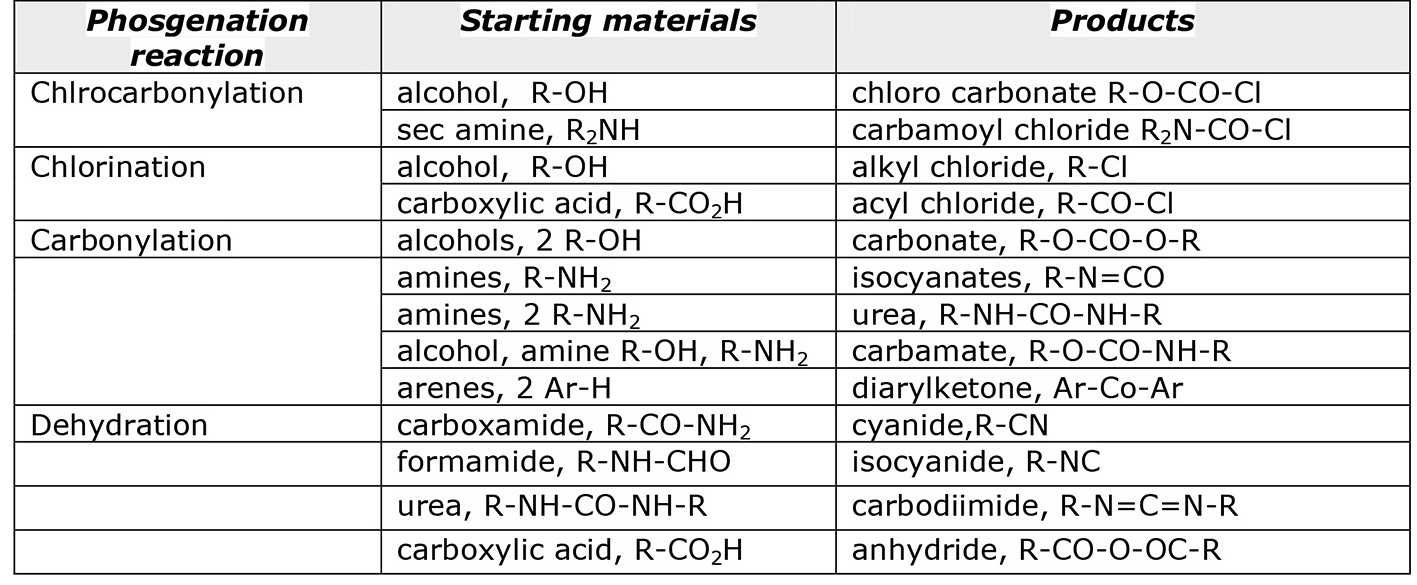
Phosgene, also called carbonyl chloride, is a colourless chemical compound produced by reacting chlorine and carbon monoxide1. In low concentrations, its smell resembles freshly cut grass or hay. It has a suffocating odour and a small amount of phosgene is released in nature from volcanoes. It is mainly produced artificially and is extremely toxic and due to this, it was even used as a chemical weapon during wars. Phosgene is used for deriving a number of chemical compounds used in various industrial sectors. Phosgene is a valued building block and reagent of choice in organic synthesis, in manufacture of dyes, pharmaceuticals, herbicides, insecticides, synthetic foams, resins, and polymers. Diethylcarbamoyl chloride – a derivative of phosgene is used to hydrolyze water insoluble compounds and is extensively used in the pharmaceutical industry.
Industrially, phosgene is produced by passing purified carbon monoxide and chlorine gas through a bed of special porous activated carbon that acts as a catalyst2:
CO + Cl2→ COCl2 (ΔH rxn = -107.6 kJ / mol)
The reaction is exothermic; hence the reactor must be cooled. Typically, the reaction is carried out between 50 and 150°C. Above 200°C, phosgene becomes carbon monoxide and chlorine, Keq (300 K) = 0.05.
Phosgene is highly toxic and symptoms of its inhalation are noticed slowly. It mainly leads to respiratory disorders such as suffocation which is a major constraint for the growth of the phosgene industry.
If this compound is handled with extensive care and all necessary precautions are taken to avoid inhalation, the constraint can be overcome.
Due to safety issues, phosgene is often produced and consumed in the same facility with exceptional measures taken to control and safeguard its use listed in Annex 3 of the Chemical Weapons Convention: All production sites producing more than 30 tons per year must be notified to the OVCW.
The phosgene industry has been showing continuous growth in the past which is expected to continue in the near future. Western Europe has been the leading consumer of this compound followed by North America and China. China and the Middle East are expected to grow at a better pace due to the increasing demand for phosgene derivatives mainly methylene diphenyl diisocyanate (MDI) and toluene diisocyanate (TDI).
Methylene diphenyl diisocyanate, most often abbreviated as MDI, is an aromatic diisocyanate. Three isomers are common, varying by the positions of the isocyanate groups around the rings: 2,2’-MDI, 2,4’-MDI, and 4,4’-MDI. The 4,4’ isomer is most widely used, and is also known as 4,4’-diphenylmethane diisocyanate. This isomer is also known as Pure MDI. MDI reacts with polyols in the manufacture of polyurethane. It is the most produced diisocyanate, accounting for 61.3% of the global market in the year 2000.
The first step of the production of MDI is the reaction of aniline and formaldehyde, using hydrochloric acid as a catalyst to produce a mixture of diamine precursors, as well as their corresponding polyamines.
Then, these diamines are treated with phosgene to form a mixture of isocyanates, the isomer ratio being determined by the isomeric composition of the diamine.
Distillation of the mixture of isocyanates gives a mixture of oligomeric polyisocyanates, known as polymeric MDI, and a mixture of MDI isomers with a low 2,4’ isomer content. Further purification entails fractionation of the MDI isomer mixture.
Toluene diisocyanate (TDI) is an organic compound with the formula CH3C6H3(NCO)2. Two of the six possible isomers are commercially important: 2,4-TDI and 2,6-TDI . 2,4-TDI is produced in the pure state, but TDI is often marketed as 80/20 and 65/35 mixtures of the 2,4 and 2,6 isomers, respectively. It is produced on a large scale, accounting for large percentage of the global isocyanate market, second only to MDI. All isomers of TDI are colourless, although commercial samples can appear yellow.
2,4-TDI is prepared in three steps from toluene via. dinitrotoluene and 2,4-diaminotoluene (TDA). Finally, the TDA is subjected to phosgenation, i.e., treatment with phosgene to form TDI. This final step produces HCl as a by-product and is a major source of industrial hydrochloric acid.
Distillation of the raw TDI mixture produces an 80:20 mixture of 2,4-TDI and 2,6-TDI, known as TDI (80/20). Differentiation or separation of the TDI (80/20) can be used to produce pure 2,4-TDI and a 65:35 mixture of 2,4-TDI and 2,6-TDI, known as TDI (65/35).
China is the largest phosgene-producing and consuming country in the world, representing one-third of total demand in 2017. China is expected to be the main consumer of phosgene over the next five years and Chinese demand growth is expected to be about 4% for the next five years. Western Europe follows with approximately 25% of global phosgene production and demand in 2017; it is expected to have average demand growth of almost 3% for the next five years as a result of new capacity starting up and the expansion of specialty isocyanates such as hexamethylene diisocyanate (HDI), which is used in anticorrosive surface coatings for automobiles, aircraft, and trains. The other Asia region is expected to have lower demand for HDI, because of the introduction of new phosgene derivatives in China and other Asian countries. Most Asian countries consume polycarbonate resin; however, because of the expected use of phosgene-free technology, consumption may decrease.
Since phosgene is generated at the plant in which it is consumed, phosgene is linked to the MDI, TDI, and polycarbonate resin–producing industries. Key findings and future implications for the phosgene market include the following:
• The TDI, MDI, and polycarbonate markets are expanding in, or shifting to, the Middle East and China, as well as other Asian countries.
• Changes in the manufacturing processes for polycarbonate resins to phosgene-free technology have moderated the phosgene growth potential in this application.
• Companies are beginning to emerge that specialize in phosgenation technology, that is, phosgene production and reactions, and phosgene derivatives.
The world production of phosgene was estimated at 7.5 billion in 2015. This number is expected to reach 9.7 billion by 2050. Factors such as reduced mortality rate, improved medical facilities, increased lifespan, and reduced infant mortality are augmenting the rise in global population.
The increasing population is driving the demand for basic household necessities such as bedding, cushions, pillow, and upholstered furniture, which are made of flexible PU foams. The wide application of phosgene for manufacturing PU foams is expected to drive the global phosgene market in the future. Of the two major applications, the MDI/PMPPI segment held the largest market share in 2017, accounting for nearly 57% of the market. The market share for this application is expected to increase by 2022. The fastest growing application is TDI, which will account for nearly 27% of the total market share by 2022.
The key global vendors are BASF, Covestro, Huntsman International , Shandong Tianan Chemicals, Van Demark Chemicals, Wanhua Chemical Group. The top four phosgene producing companies are Covestro (24% of global capacity), BASF (19%), Yantai Wanhua (16%), and DowDuPont (9%).
As regards India, Atul Ltd and Paushak Ltd are the only two players in this market. All the manufacturers of Phosgene are situated in Gujarat state alone, also the ‘Chemical Hub’ of India.Paushak is part of the Alembic group of companies situated in Gujarat. Both the companies have several years of safe Phosgene handling and are key vendors for end users for Indian chemical companies.
Indian Phosgene Council was formed in August, 2014, during 3rd International Phosgene Conference organised at Vadodara, Gujarat
In order to maintain the consistency between Indian manufacturers of Phosgene and international phosgene-producing and using companies the Indian Phosgene Council (IPC) was formed to discuss various key issues related to Phosgene safety and knowledge sharing amongst the members, who are manufacturers / consumers of Phosgene. Indian Chemical Council playing the role of a catalyst and streamline the whole of the activities.
The interaction of international groups and associations with Indian industry representatives handling phosgene, di-phosgene, tri-phosgene and isocyanates will set the tone for phosgene safety dialogue between global industry experts and Indian stakeholders. It also becomes an excellent opportunity for regulatory agencies and experts in the emergency preparedness to learn and exchange the emergency response measures / medical emergency response on tested phosgene industry practices globally.
Main phosgenation reactions 3,4 and the versatile products derived from different substrates are depicted in Table 1.


The pie chart shows world consumption of phosgene.


For the high toxicity of phosgene, many safer procedures and substitutes for phosgene have been developed, which will extensively discussed in next issues.
References
1) L. Cotarca, H. Eckert, Phosgenations – a handbook, wiley-vch, weinheim, pp. 1-656 (2004);
2) K.L. Dunlap, Kirk-othmer Encyclopedia of chemical technology, ed. a. seidel, 18, pp. 802-814 (2006);
3) H. Eckert, J. Auerweck, Org. Process Res. Dev., 14, pp.1501-1505 (2010) and references cited therein
4) H. Eckert, Chimica Oggi/Chemistry Today-29(6) November/December2011.

Advertisement

Newsletter

Subscribe to our FREE Newsletter & Stay Updated

Advertisement