










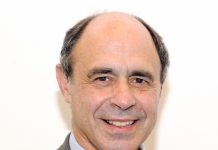




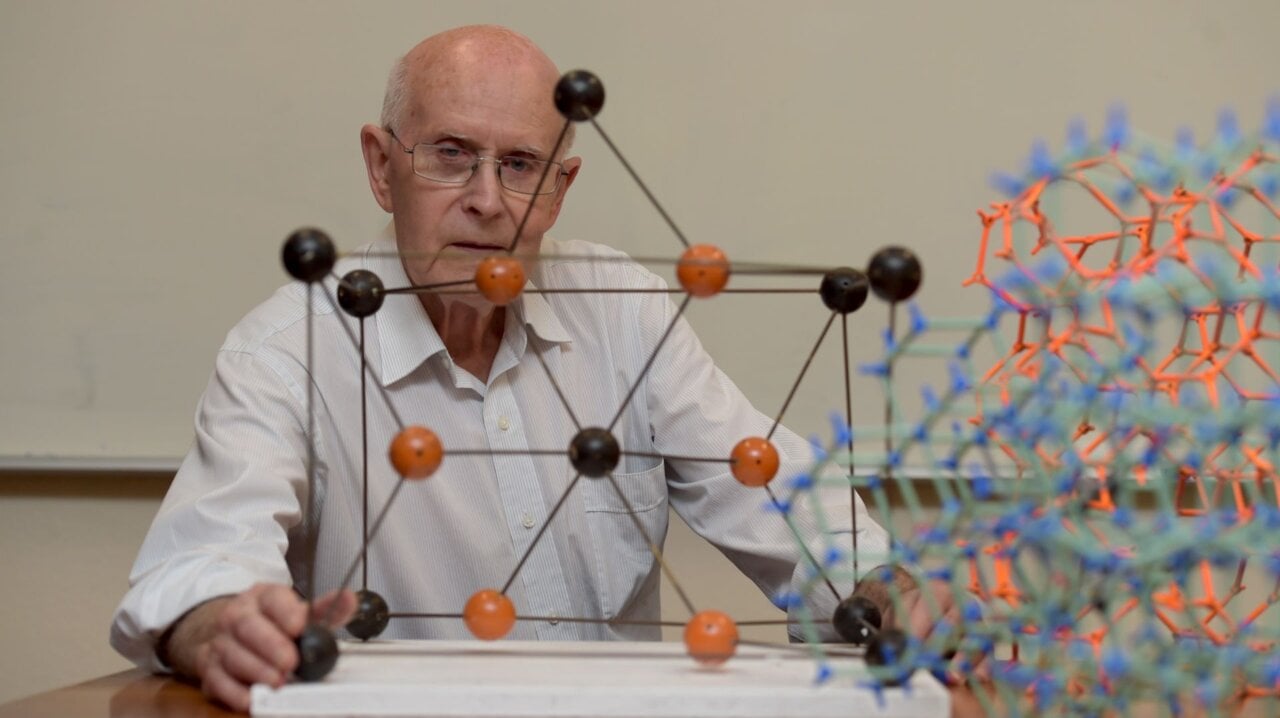
Richard Robson, the 88-year-old chemist behind the groundbreaking concept of metal–organic frameworks (MOFs), didn’t plan on a career in chemistry or a Nobel Prize. His curiosity while building wooden teaching models in the 1970s led to one of the most transformative discoveries in materials science.
His early path to discovery
Richard Robson’s journey to the 2025 Nobel Prize in Chemistry is a story less about ambition and more about curiosity, reflection, and a lifelong commitment to the elegance of molecular structure. Born in England and later settling in Australia, Robson never imagined a future in chemistry. In fact, as he candidly reveals, he initially saw himself as “second-rate” for not becoming a mathematician—an art form he considered the pinnacle of intellectual endeavour.
In his Nobel interview, Robson admits he “drifted into” chemistry, unable to think of a better path at the time. Yet what he lacked in initial passion, he made up for in persistence and an uncanny ability to see patterns in the mundane. His turning point came not in a flash of inspiration, but in the slow, repeated act of preparing classroom models.
From Wooden Balls to Molecular Breakthroughs
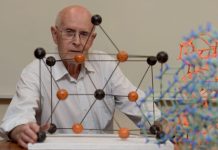
In the 1970s, Robson, then a lecturer at the University of Melbourne, was tasked with building large wooden models of crystal structures—sodium chloride, diamond, fluorite etc.for teaching purposes. This involved calculating precise angles using log tables and having craftsmen drill holes into wooden balls to replicate atomic geometries, not knowing then that these teaching tools would eventually spark the idea behind metal–organic frameworks (MOFs), the very field for which he was awarded the Nobel Prize.
While assembling these models, Robson began to imagine: what if molecules replaced the balls and chemical bonds replaced the rods? Though the idea came to him in 1974, he left it dormant for nearly a decade. Each year, during his lectures on solid-state chemistry, the thought resurfaced. Eventually, in the mid-1980s, he began experimenting at the bench, trying to create polymeric structures from metal ions and organic ligands. He credits this moment as one of desperation as much as inspiration.
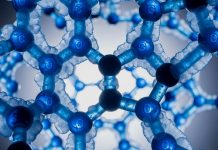
The first results weren’t always successful, but enough of them were. Robson discovered crystalline structures that retained internal void space, defying the assumption that such materials had to be tightly packed. His creations laid the foundation for a transformative new category of materials: MOFs, which would later find use in everything from gas storage to drug delivery.
Robson is refreshingly self-effacing about his role in reshaping modern chemistry. He describes himself, with characteristic understatement, as someone who “just mixed things up” in the lab. Yet his quiet persistence and habit of asking simple questions “What would happen if…?” led to discoveries that laid the conceptual and structural groundwork for what would become metal-organic frameworks (MOFs).
Though often cast as a solitary figure, Robson emphasizes the collaborative fabric of his work. He credits structural chemists Bernard Hoskins and Brendan Abrahams, whose crystallographic insights gave form and credibility to his molecular architectures. “They made the invisible visible,” he has said.
Recognition Beyond the Nobel
When he first shared his ideas in the 1980s, many in the field dismissed them as fanciful or “a whole load of rubbish.” But Robson never set out to build a field. The broad direction, he insists, was “obvious” once the concept existed. What followed—MOFs transforming into essential materials for gas storage, catalysis and sensing—was beyond what he initially imagined, and he’s quick to credit others for that evolution.
Robson continued teaching and researching long after most would retire, remaining a quiet but constant presence in his department. In 2025, at the age of 88, he was jointly awarded the Nobel Prize in Chemistry. When asked about the honour, he responded with a mixture of gratitude, irony and restraint, noting that while it was deeply meaningful, it also carried “a certain finality.”
In addition to the Nobel Prize, Robson received numerous other accolades, including the Burrows Award from the Royal Australian Chemical Institute in 1998 and election as a Fellow of the Australian Academy of Science in 2000. Outside the lab, Robson is also known as the father of Naomi Robson, a prominent Australian television presenter.
There’s a touch of melancholy in his reflections: many of his peers are gone and fame, he admits, brings its own burdens especially when one’s patience for “nonsense” wears thin. Over decades, Robson quietly redrew the architecture of chemistry not with grand designs, but through relentless curiosity, clarity of thought and an enduring willingness to ask: What if?
References
https://www.britannica.com/biography/Richard-Robson
https://findanexpert.unimelb.edu.au/profile/15996-richard-robson
https://www.thenewdaily.com.au/news/people/2025/10/09/richard-robson-nobel
https://www.nobelprize.org/prizes/chemistry/2025/robson/facts/
https://www.nobelprize.org/uploads/2025/10/advanced-chemistryprize2025.pdf
https://www.nobelprize.org/prizes/chemistry/2025/robson/interview/
https://www.nobelprize.org/prizes/chemistry/2025/robson/photo-gallery/