




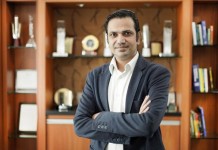















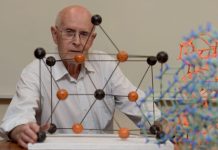

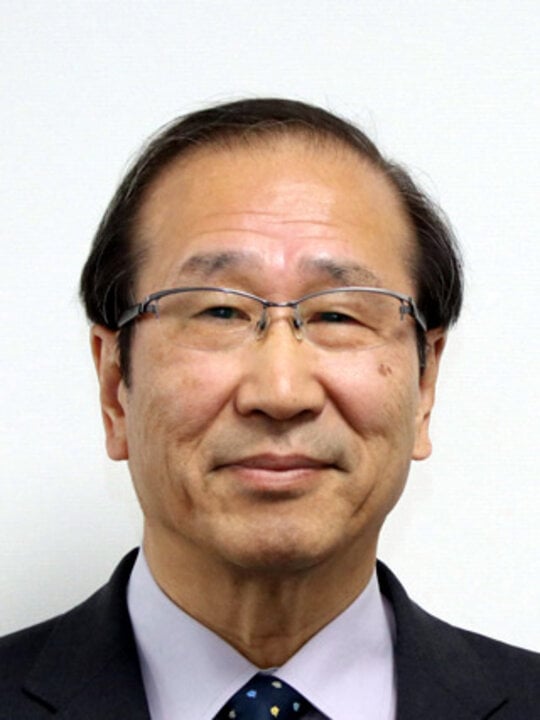
Susumu Kitagawa, Nobel Laureate in Chemistry 2025, pioneered metal-organic frameworks (MOFs), reshaping materials science. Originally drawn to art and architecture, his aesthetic instincts influenced his molecular research. His 2025 Nobel Prize crowns decades of quiet revolution in porous material science.
From Art to Atoms: A Childhood Shaped by Aesthetics
Susumu Kitagawa was born on July 4, 1951. While today he is recognized globally as a Nobel Laureate and pioneer of metal-organic frameworks (MOFs), his journey began with a young boy captivated not by chemistry, but by the fine arts. As a child, Kitagawa was drawn to crafts, painting and architecture, particularly inspired by the whimsical, fluid forms of Antoni Gaudí. The aesthetic sensibilities that initially shaped his dreams of architecture later influenced his intuitive understanding of molecular design and porous structures.
Kitagawa’s academic journey began and flourished at Kyoto University, where he completed his B.Sc., M.Sc., and Ph.D. in hydrocarbon chemistry by 1979. Although his initial training was deeply rooted in physical and quantum chemistry, it was the conceptual frameworks of how materials behave—electronically, magnetically and structurally that began to fascinate him. His early research focused on solid-state materials, but it wasn’t until a chance moment in 1989 that his scientific path took a profound turn.
The Accidental Discovery That Redefined Materials Science
While analysing a crystal structure using a shared supercomputer at Kyoto University, Kitagawa noticed an unexpected feature in what was thought to be a dense material: it had pores. At the time, porous coordination compounds were regarded with scepticism, considered unstable and functionally limited. Yet Kitagawa’s curiosity refused to dismiss the anomaly. Instead, he leaned into it, letting the discovery reshape his research trajectory.
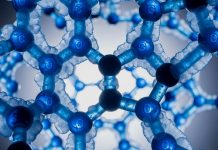
That pivotal moment planted the seeds for what became his life’s work—the development of porous coordination polymers (PCPs), which evolved into what we now know as MOFs. Unlike traditional rigid porous materials, these frameworks could be engineered to respond flexibly to guest molecules, opening new frontiers in gas storage, catalysis, and separation science. Kitagawa’s work not only challenged conventional thinking but redefined how chemists understood solid materials.
Persistence, Philosophy, and the Power of “Useful Uselessness”
His journey, however, was not without difficulty. Early on, the field of MOFs was speculative, untested and, to many, impractical. Kitagawa faced years of doubt from peers and funding agencies. But he held firm to a principle he often quotes from Pasteur: “Chance favours the prepared mind.” He remained devoted to the belief that even seemingly “useless” science could yield transformative utility, a philosophy he calls “useful uselessness.” Over three decades, his persistence turned scepticism into recognition and theoretical frameworks into real-world applications.
Beyond the Nobel Prize, Kitagawa has received several prestigious awards recognizing his pioneering work. In 2017, he was honoured with the Chemistry for the Future Solvay Prize, awarded for scientific discoveries laying the foundation for the chemistry of tomorrow. The same year, he received the Fujihara Award for his significant contributions to the development and application of porous coordination polymers. In 2024, Kitagawa was also named a Highly Cited Researcher by Clarivate Analytics, highlighting his sustained global impact in chemistry for over a decade.
Kitagawa attributes much of his scientific sensibility to his academic lineage. He considers himself a “scientific grandson” of Kenichi Fukui, Japan’s first Nobel Laureate in chemistry and a peer in the lineage of Akira Yoshino, inventor of the lithium-ion battery. The culture at Kyoto University where young minds are encouraged to ask fundamental questions and pursue origin-level science was instrumental in shaping his identity as a researcher.
Beyond the lab, Kitagawa enjoys detective novels, European thrillers and kabuki theatre—perhaps echoing the same love for complexity and structure that guides his molecular explorations. Though little is publicly known about his family life, his dedication to mentorship and education has shaped generations of chemists, including many rising stars in materials science.
His Nobel Prize in Chemistry in 2025, awarded alongside peers for the development of MOFs, is not just a personal triumph but the culmination of a lifetime spent navigating the porous boundary between imagination and experimentation. Reflecting on his journey, Kitagawa said, “Yes, of course. This is the mind of the researcher in Japan. Don’t switch off the light, even at night.” For him, discovery is not a flash of genius but the slow illumination of something unexpected, seen only by those who remain awake, patient, and endlessly curious.
References
https://kuias.kyoto-u.ac.jp/e/profile/kitagawa
https://www.britannica.com/biography/Susumu-Kitagawa
https://pubs.acs.org/doi/10.1021/acsmaterialslett.9b00408?utm_source=chatgpt.com
https://www.kyoto-u.ac.jp/en/news/2025-10-09
https://www.jsps.go.jp/english/e-topics/2025/1010.html
https://www.jst.go.jp/erato/kitagawa/img/CV.Susumu_Kitagawa111005.pdf
https://www.nobelprize.org/prizes/chemistry/2025/kitagawa/interview/
https://www.nobelprize.org/prizes/chemistry/2025/kitagawa/interview/
https://www.nobelprize.org/prizes/chemistry/2025/kitagawa/photo-gallery/