

























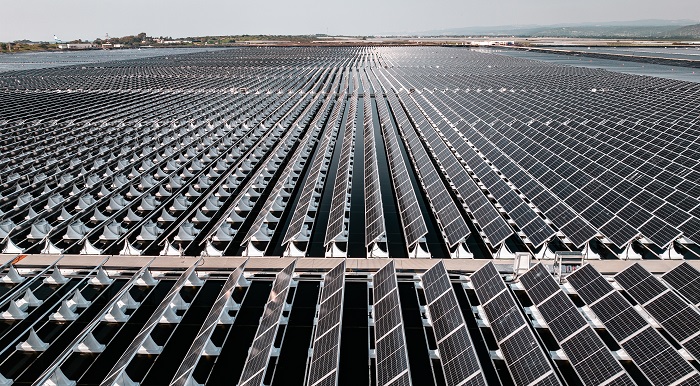
Floating solar specialist Xfloat Ltd. partnered with BASF to strengthen the durability, performance, and sustainability of floating photovoltaic (FPV) systems. By combining Xfloat’s intelligent sun-tracking floating platforms with BASF’s advanced light stabilization technology, the collaboration aims to deliver long-lasting, high-efficiency solar solutions for global markets. Together, the companies are addressing one of floating solar’s biggest challenges — material longevity in harsh outdoor and aquatic environments — while lowering lifecycle costs for developers.
Advanced Materials Strengthen Float Lifespan
At the heart of the partnership, BASF has integrated Tinuvin® 2730 ED, its proprietary light stabilizer, into Xfloat’s High-Density Polyethylene (HDPE) float design. This solution actively protects the polymer from UV radiation, weathering, and environmental degradation. As a result, the floats can now withstand demanding conditions for more than 30 years, matching the operational life of solar modules. This extended lifespan reduces maintenance needs and replacement cycles and ultimately lowers the levelized cost of electricity (LCOE) for project owners.
Intelligent Solar Design Meets Material Innovation
While BASF strengthens material performance, Xfloat enhances energy generation through its FPV-T sun-tracking platforms, which follow the sun to maximize output throughout the day. By merging intelligent design with robust materials, the two companies deliver systems that are not only durable but also more productive. Consequently, operators benefit from higher energy yields, improved reliability, and stronger long-term returns on investment.
Certified for Sensitive Water Environments
Importantly, the stabilizer solution complies with strict international safety standards. It meets the EU Drinking Water Directive (EU) 2020/2184 and is certified under NSF-61 Section 5, making the systems suitable for installation in drinking water reservoirs and other environmentally sensitive locations. The compliance opens new opportunities for floating solar deployment in municipal and regulated water bodies where material safety is critical.
Global Deployments and Proven Performance
Xfloat has already rolled out its technology across the United States, Middle East, Europe, and Southeast Asia. Notably, a recent project in Singapore recorded a 28% improvement in energy yield using the company’s proprietary tracking technology. With demand rising for resilient renewable infrastructure, the company is now expanding its global pipeline and scaling operations to meet market needs.
Industry Leaders Highlight Strategic Value
“At Xfloat, we aim to redefine what is possible in floating solar by combining intelligent design with environmental responsibility,” said Avi Alcalay, Chief Technology Officer, Xfloat. “Partnering with BASF enables us to enhance durability while meeting the highest performance and safety standards, especially for sensitive applications like drinking water reservoirs,” Alcalay added.
Echoing this view, Ricard Vandellos, Vice President, Business Management Plastic Additives EMEA and Latin America at BASF, added, “Floating solar is rapidly emerging as a complementary pillar in the renewable energy landscape. Our collaboration with Xfloat shows how material innovation can support the long-term performance of solar infrastructure.”
Supporting Sustainable Solar Infrastructure
As per the press release, ultimately, the partnership highlights how BASF’s VALERAS® portfolio supports durable, safe, and sustainable solutions across renewable energy applications. By integrating advanced stabilization chemistry with smart floating solar design, Xfloat and BASF are delivering certified, high-performance systems ready for reliable clean energy generation — even in challenging aquatic environments.