Abstract
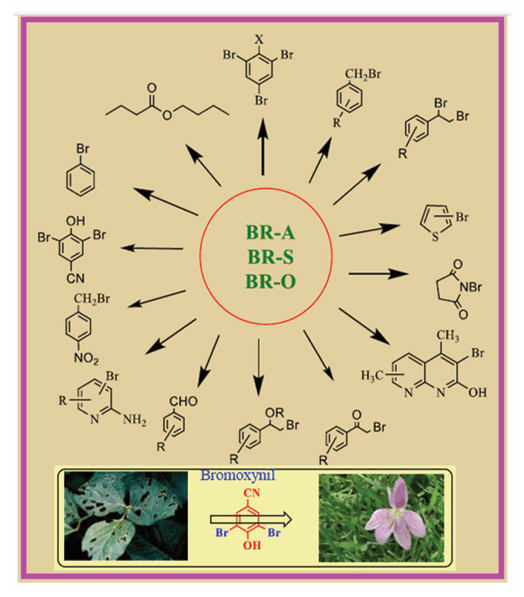
The article covers the use of eco-friendly brominating reagents for the bromination of diverse organic substrates. The brominating reagents comprises of bromide-bromate salts in varying ratios, as these salts upon acidification generates reactive species in situ responsible for the variety of reactions depends upon the compositions. The bromide-bromate couple will be effective for the substitution reactions such as aromatic, heteroaromatic, benzylic brominations. The bromide-bromate couple useful for addition reactions across olefins to yield dibromo alkanes, bromohydrins and α-bromoketones depends upon the composition. In addition, the same reagent could be employed for the oxidation of benzylic alcohols to carbonyl compounds and oxidative esterification of primary aliphatic alcohols. The only aqueous sodium chloride as a benign waste during the bromination process. The use of eco-friendly brominating reagents not only reduce the hazardous by-products generation, but also safe to handle, storage and utilisation.
Introduction
Organo-bromine compounds constitute a class of industrially important chemicals which find many applications in the manufacture of various dyes, drug intermediates,pharmaceuticals, agriculture as well as in the preparation of various types of fire retardants and fine chemicals. These compounds are conventionally prepared by using different brominating agents such as liquid bromine with or without transition metal catalysts, salts of bromine in combination with different oxidants. However, these brominating agents are either hazardous/corrosive by nature or expensive, while the methods of preparation involve several cumbersome steps. For example, bromine is a hazardous fuming liquid and requires extreme care in its production, handling, transportation and utilization. Moreover, these brominating reagents have some practical difficulties. They may produce unwanted side products with low bromine atom efficiency.
Despites the various drawbacks of liquid bromine, industries and academia are still using for the preparation of various bromoderivatives due to the lack of better alternative brominating reagents. There are numerous brominating reagents reported for the bromination of diverse organic substrates under different conditions. 1CSIR-CSMCRI is pioneer in the research and development study on the recovery of bromine from sea brines in India. The institute has developed steaming out process for the recovery of bromine from end liquor (bittern) of salt industry in early seventies and technology has been licensed to industry. To overcome these difficulties of handling and usage of liquid bromine for various organic bromination reactions, CSIR-CSMCRI has developed a novel reagent alternate to liquid bromine called eco-friendly brominating reagent (green bromine).2 The eco-friendly brominang reagent is prepared from the alkaline bromine intermediate obtained from the conventional bromine recovery process, which consists of bromide-bromate salts with varying molar ratios. The bromide-bromate couple is more interesting as it bypasses bromine production when the reagent is prepared directly from the intermediate of liquid bromine manufacture. This intermediate can be suitably designed for three types of reactions such as brominating reagent for addition (BRA) reactions, substitution (BRS)reactions and oxidation (BRO) reactions.3-6 These three types of reagents are prepared by the controlled addition of suitable oxidants and could be used further as per the desired applications under aqueous acidic conditions.
The most advantages of this green brominating reagent are; (i) replacement of the corrosive elemental bromine; (ii) safe, easy to handle & transport; (iii) avoids the need of special equipments; (iv) No need of catalyst; (v) operates under ambient reaction conditions; (vii) easy to scale-up for the processes development; (vii) no formation of hazardous byproducts; (viii) the effluent can be discharged easily without any treatment; (ix) technically feasible, economically competitive, readily available; and hence environment-friendly.
Material and Methods
Preparation of eco-friendly and versatile brominating reagent for bromination of phenols
Bromine is manufactured from sea bittern. Recently Ramachandraiah et al. patented the preparation and utility of a brominating reagent obtained from the liquid bromine precursor in the cold process of bromine manufacture. The precursor comprises a 5:1 mole ratio of NaBr: NaBrO3, which is formed when bromine vapor that has evolved from bittern makes contact with aqueous NaOH. Instead of acidifying the precursor to evolve bromine as practiced in conventional manufacture (eq 1), it is treated with Cl2/NaOH (or NaOCl) to obtain a 2:1 mole ratio of NaBr: NaBrO3 (eq 2), which can be used as such or evaporated to dryness to yield a solid reagent containing 40% (w/w) active Br. The reagent, upon acidification with HCl in the presence of an organic substrate yields bromo derivative as per the stoichiometry of eq 3. The 2:1 mole ratio of NaBr: NaBrO3 upon acidification generates BrOH in situ BR-S (eq. 4) will consume in all substitution reactions. The NaCl that is present in the reagent to the extent of 33% (w/w) does not affect the results, as confirmed through control experiments with a pure 2:1 mixture of NaBr: NaBrO3(Scheme 1).

Results and Discussion
Brominations by aromatic substitution reactions
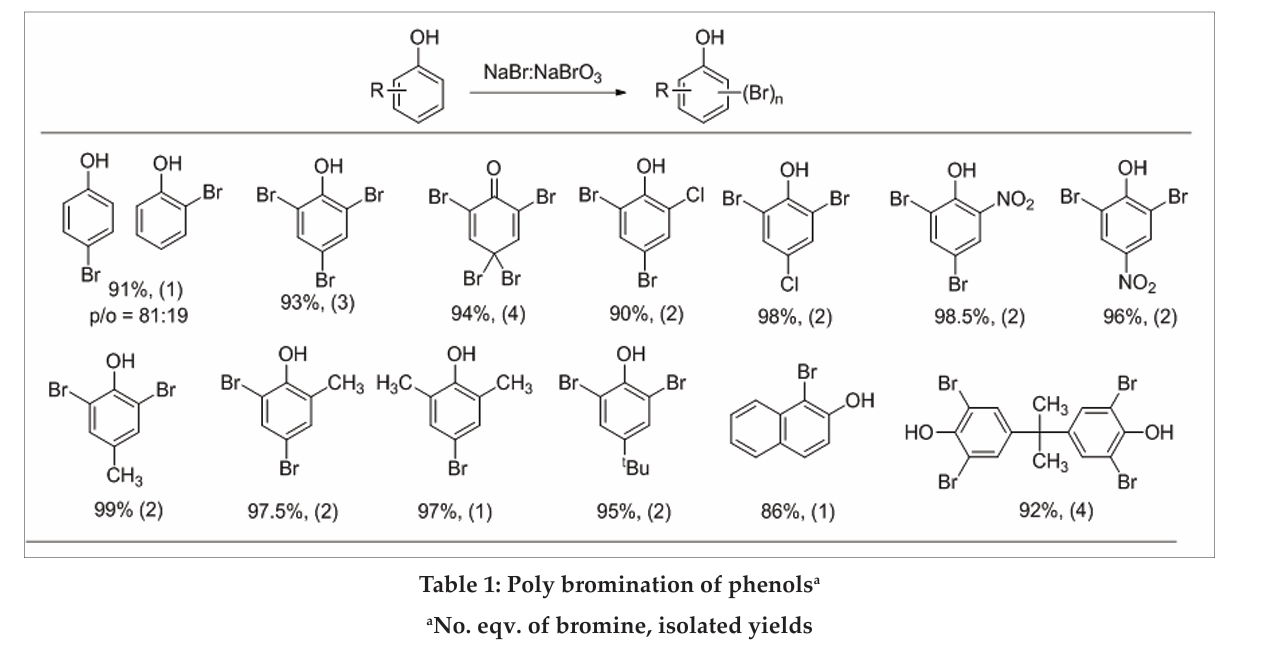
Bromination of phenols: Bromination of phenols using the eco-friendly brominating reagent (BR-S) was performed under aqueous acidic conditions using dichloromethane as solvent at room temperature. All the reactions proceeded in high yields under ambient conditions and without recourse to any catalyst. For the entries 1-3 reactions were carried out with only water as solvent while other substrates which are not soluble in water for such casesdichloromethane CH2Cl2 was employed as a solvent in the remaining reactions. Alternatively, 1,2-dichloroethane can also be used. Most of the reactions provided good to quantitative yields of brominated products, by simple work up through extraction of solvents and stripping out the solvent. Yields reported are crude yields unless otherwise stated. The products showed sufficient purity by NMR analysis of crude product, which avoids the column chromatographic separation, however if it requires one could be purified the products either by recrystallization of by column chromatographic separation. It may be noted that, for the bromination of phenols, the reagent could be used depends upon the degree of bromination. For example, mono bromination of phenols, 1.0 equivalents of brominating reagent and for di and try brominations 2.0 and 3.0 equivalents of brominating reagents may be used. The representative examples are provided in table 1. The use of 3, 5-dibromo-4-hydroxybenzonitrile (bromoxynil) and 3, 5-
diiodo-4-hydroxybenzonitrile (ioxynil) as herbicides is well established.7Certain esters of bromoxynil, especially the octanoate, have been used extensively as herbicides in the controlof broad-leafed weeds, particularly in crop-growing areas.8 Muller et al.9 described a procedure for the bromination of 4-hydroxybenzonitrile with elemental bromine in methanolic acetic acid.Moreover, the purification of the reaction products is often demanding and laborious. Using the eco-friendly brominating (BR-S) reagent developed by CSIR-CSMCRI, the bromination of 4-hydroxy benzo nitrile was reported with high atom efficiency with simplified procedure and the bromoxynil was obtained in quantitative yield in aqueous medium.

Bromination of Anilines
The use of BR-S for the bromination of aniline derivatives were examinedthe efficacy of the reagent. The results are described in Table 2. A molar excess of acid was used for the bromination of anilines, as the amine forms a salt with acid, which was neutralized with sodium bicarbonate after completion of the reaction. 2,4,6-Tribromoaniline could be prepared in a 96%yield from aniline. The brominating reagent (BR-S) is used based on the degree of bromination. For the tribromination of anilines, 3.0 equivalents of brominating reagent was employed. Similarly, for dibromination and mono brominations, 2.0 equivalents and 1.0 equivalents of the reagents was employed.
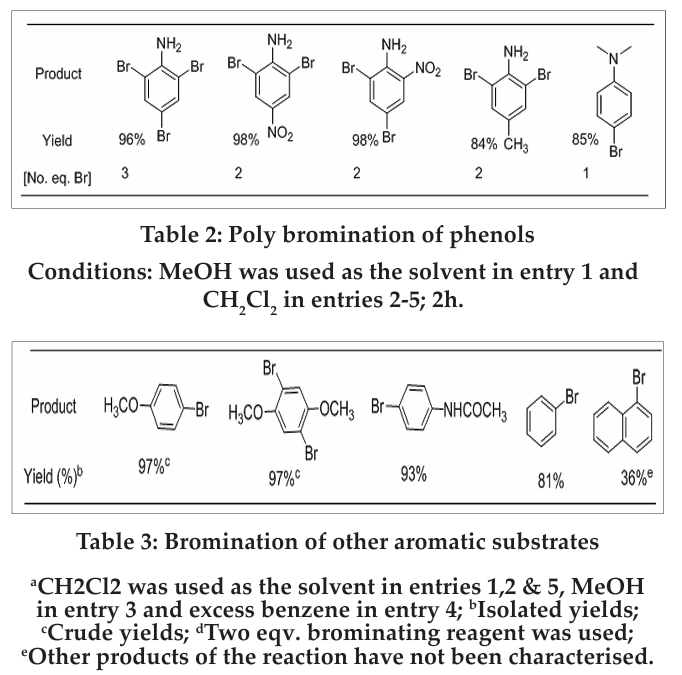
Monobromination of other aromatic substrates such as anisole and acetanilide was achieved in good yields and with high p-selectivity (entries 1 and 3, Table 3). Naphthalene could also be converted into 1-bromonaphthalene, albeit only in a 36% isolated yield under the same conditions. With benzene, the reaction was facile only under reflux conditions, and the yield was better (81% at 100 g scale) when sodium lauryl sulfate (SLS) was used as the phase transfer catalyst.
Heterocyclic Brominations
Environmentally benign method for the monobromination of hetero aromatic compounds using the environment-friendly brominating reagent (2:1 bromide/bromate couple) under very mild reaction conditions with high bromine atom efficiency. Bromination of 2-aminopyridines using 2:1 bromide-bromate couple in aqueous acidic medium and using acetonitrile (MeCN) as solvent at room temperature, a mixture of 5-bromo-2-aminopyridine and 3,5-dibromo-2-aminopyridines were obtained. Some preliminary studies revealed that, the best yield of the product could be obtained in MeCN. Therefore, most of the following experiments were performed using MeCN as solvent.
Therefore the bromination of other aminopyridines was carried out at the same temperature (5-10○C). Then, substituted 2-aminopyridines were subjected to mono-bromination using the above reagent combination under above mentioned reaction conditions. Corresponding monobromo 2-aminopyridines were isolated in yields ranging between 80% and 87% (Table 4). When 3-aminopyridine was subjected dibromination using two equivalents of reagent at room temperature 4,6-dibromo-3-aminopyridine was obtained in 86% isolated yield. Thiophene was subjected to mono-bromination, using biphasic solvent system (water-methylene dichloride); mixture (mono- and di- bromo products) of two isomers (inseparable by column chromatography) were observed. The yields of mono and dibromo thiophenes were analyzed by GC-MS. Analyses showed 63% of 2-bromo thiophene and 27% of 2,5- dibromo thiophene by GC (area %). Similarly, when thiophene was subjected dibromination with two equivalents of brominating reagent, GC-MS analyses of showed a mixture of three products; 2,5-dibromo thiophene, 2,3,5-tribromo thiophene and 2,3,4,5-tetrabromo thiophenes in 60%, 37% and 2% respectively (Table 4). The present bromination system was then extended to other bicycle heterocycles such as 2-hydroxy-1,8-naphthyridines derivatives. 1,8-Naphthyridines are less reactive towards electrophilic substitution compared to other heterocycles (e.g. aminopyridines or thiophenes) therefore the brominations of naphthyridineswere performed at 25-30○C. When 2-hydroxy-4,6-dimethyl-1,8-naphthyridine was subjected mono-bromination, 3-bromo-2-hydroxy-4,6-dimethyl-1,8-naphthyridin was isolated in 75% yield. Whereas 2-hydroxy-4-methyl-1,8- naphthyridine afforded a mixture of 3-bromo-2-hydroxy-4-methyl-1,8-naphthyridine, and 6-bromo- 2-hydroxy-4-methyl-1,8-naphthyridines in 58% and 35% isolated yields respectively. Similarly, mono-bromination of 2-hydroxy-4,5- dimethyl-1,8-naphthyridine provided a mixture of 3-bromo-2-hydroxy-4,5-dimethyl-1,8-naphthyridine and 6-bromo-2-hydroxy-4,5-dimethyl-1,8-naphthyridines in 56% and 30% isolated yields respectively. Mono-bromination of 6-bromo-2-hydroxy-4-methyl-1,8- naphthyridine provided 3,6-dibromo-2-hydroxy-4-methyl-1,8- naphthyridine in 78% isolated yield. The nuclear bromination may take place either the C-3 or C-6 positions depending upon the position and nature of the substituents on the ring.

Benzylic Brominations
Benzylic brominations are traditionally performed through radical mechanism using bromine and NBS with radical initiator.10 The other reagents employed for the benzylic bromination include NaBrO3-NaHSO311 and HBr-H2O2.12 These reagents, however, led to a mixture of mono-, di-, and nuclear brominated products.

A variety of substituted toluenes and xylenes were obtained by this procedure (Tables 5). Side product (dibromo compounds/ nuclear bromination) formation was low with toluene and substituted toluenes, whereas xylenes was accompanied with small amounts of a,a¢-

dibromoxylenes (Table 5). However, dibromination of xylenes using two equivalents of brominating reagents provided good yields of corresponding a,a¢-dibromoxylenes (Table 6) Bromination of para and ortho– xylenes gave the corresponding products in 91% and 85% isolated yields; whereas bromination of m-xylene offered 52.5% yield of desired product along with 45.5 % of mono brominated.
Bromination by Addition Reactions to Alkenes
Vicinal dibromoalkanes are useful synthetic precursors to cyclopropanes, alkynes, and vinylbromides in various cross-coupling chemistry.13 Vicinal dibrominated compounds are easily made from readily available and abundant alkene precursors.14The major interest of synthetic chemists in aliphatic bromo-organics is due to their flexible structural features, such as bromide ion acting as a good leaving group, lone pair electrons on bromine atoms participating in neighboring group participation (NGP) (NGP helps to enhance the rate of reaction and controls its stereochemistry with retention), metal insertion (to form organometallics), etc. The bromination by addition reaction of alkenes were generally carried out using liquid bromine to obtain the dibromo alkanes. Though, liquid bromine is readily available it is corrosive to use and much care should be required for handling and transportation. To avoid such problems, we at CSIR-CSMCRI, Bhavnagar developed an alternative brominating reagent (BR-A) as per the equation 1, for the addition of alkenes to generate the corresponding dibromoalkanes (vicinal dibromoalkanes) (eq. 5). By this procedure, it is realised the complete atom utilisation as well as avoiding the use of hazardous liquid bromine.

The addition of bromine is completely stereo selective; the c is open-chain alkenes producing threo (or d,l) isomers and the trans leading to erythro (or meso) dibromides. The stereo chemical assignment was made by the coupling constants (J values) of the adjacent protons at the carbon atoms attached to bromo groups in agreement with the reported values. The cyclic olefins produced exclusively trans-dibromides (entries 3, 4, Table 7). The activated alkenes (entries 7-13) were also smoothly brominated by the present procedure. Several functional groups such as CO2Et, OAc, OMe, ketocarbonyl, methylenedioxy, and Cl, NO2 remained unaffected under these reaction conditions.

Synthesis of Bromohydrins from Alkenes by Addition Reactions
Bromohydrins are the key strating materials for the synthesis of corresponding epoxides and bromoketones. These bromohydrins were generally prepared by the reaction of alkenes with N-bromosuccinimide (NBS), where the succinimide will be the by-product. Further, NBS preparation it involve the use of corrosive liquid bromine the primary reagent. To avoid such difficulties, we employed the green brominating reagents for the preparation of bromohydrins from alkenes. As per the equation 4, above, the bromide-bromate-acid in the 2:1:3 mole ratios generates hypobromous acid (BrOH) in situ (eq.4), which reacts with alkenes and provide the corresponding bromohydrin derivatives. Using this reagent, representative bromohydrons were prepared from the corresponding alkenes (Table 8). As can be seen from the table 8, the styrenes having electron donating and withdrawing substituents as well as cyclic and long chain alkenes reacted well and provided the bromohydrin derivatives.

Bromoketones from Alkenes
α-Bromoketones are versatile intermediates in organic synthesis and have been synthesized mainly from ketones.15 A limited number of reports for the preparation of α-bromoketones directly from olefins have been published. As olefins substituted with a variety of functionalities are easily accessible, a convenient procedure for α-bromoketones preparation from olefins using various brominating agents will be of interest to the scientific community. We used an eco-friendly brominating reagent for the direct synthesis of α-bromoketones from olefins under ambient conditions. As per the equation 4, the bromide –bromate couple in acidic

medium generates BrOH, and it reacts with alkenes provide the corresponding bromohydrin derivatives as demonstrated in table 8. Another equivalents of BrOH reacts with bromohydrins yield the bromoketones (Scheme 1). Using the environment-friendly brominating reagent, we optimized the conditions for the direct synthesis of α-bromoketones from alkenes.16Several alkenes were subjected to this procedure to produce the corresponding a-bromoketones (Table 9). 4- Methyl styrene and indene (entries 2 and 3, Table 9) showed high selectivity to provide 4-methyl-a-bromoacetophenone and 2-bromo-indan-1-one in 87% and 86% isolated yields. When this procedure was applied to 3-nitro styrene (entry 7, Table 9) the corresponding 3-nitro-a-bromoacetophenone was obtained in 40 % yield. Such deactivated substrates are

reported to be tedious by other methods. The internal olefins, stilbene and chalcone were smoothly converted to 2-bromo-1,2-diphenyl-ethanone and 2-bromo-1,3-diphenylpropane-1,3-dione, respectively in good yields (entries 8 and 9, Table 9). Under the same experimental conditions straight chain as well as cyclic alkenes underwent brominations without any difficulty to provide the corresponding a-bromoketones in moderate to good yields (entries 12-20, Table 9). The bromide/bromate couple in aqueous acidic medium serves as an efficient and green reagent for the synthesis of the α -bromoketones by direct oxybromination of olefins avoiding hazardous molecular bromine. In addition, this procedure offers significant improvements with regard to reaction conditions (room temperature), good yields and user-friendly operation compared to conventional methods.
Oxidation of Benzylic Alcohols to Benzaldehydes
Bromate anion is an important oxy-halo reagent proved as a versatile reagent for the effective oxidation of alcohols.17 It has been used to effect the oxidation of functional groups such as thiols, sulfides and alcohols.17 As discussed in the above sections, the bromide-bromate couple in varying ratios could be used for the substitution reaction, addition reaction and oxybromination reactions. For the oxidation reactions, bromide atom is not part of the final product, however it helps to generate the reactive species (BrOH) to effect the oxidation under aqueous acidic conditions. As realized in the oxybromination reaction, the catalytic amount of bromide reacts with bromate in presence of acid to generate the reactive species (BrOH), hence in the oxidation reaction, only catalytic amount of bromide is required along with bromate and acid. Accordingly, we identified the optimized conditions for oxidation of benzylic alcohols as described in table 10.

When the experiments were carried out with benzyl alcohol, benzaldehyde was obtained in 87% yield under the set of optimized conditions (entry 1, Table 10). It can be further seen from the table that this reagent had sufficient oxidizing power to effect conversion of 4- and 3-nitrobenzyl alcohols in quantitative yields (entries 2 and 3, Table 10). On the other hand, 2-nitrobenzaldehye was obtained only in 61% yield (entry 4, Table 10), indicating the critical importance of steric factors in the reaction. Similarly 4-, 3- and 2-chlorobenzyl alcohols and 4-bromobenzyl alcohol gave the corresponding aldehydes in 88%, >99%, 92% and 92 % GC yields with >99 % selectivity (entries 5-8, Table 10). As mentioned above, 4-methyl benzaldehyde was obtained from the corresponding benzyl alcohol in 97% GC yield (entry 9, Table 10). Since Br is not consumed, as such, in the oxidation reactions–only the bromate ion gets converted into bromide ion and ends up in the aqueous effluent. Therefore it was explored the feasibility of regenerating the reagent through re-oxidation of a part of the bromide ion with NaOCl. The overall process incorporating recycle of the spent reagent is shown in Scheme 2.

Oxidative Esterification of Primary Alcohols
Among all carbonyl compounds, esters are one of the most abundant classes of chemicals, widely utilized in fine chemicals, pharmaceuticals, natural products, agrochemicals, and food additives. Typically aliphatic monoesters found in jojoba oil can be easily synthesized from the fatty acids and alcohols derived from triacylglycerol oils.18 Particularly, long chain fatty esters are used in the preparation waxes for industrial applications and as alternate feedstock in the production of biodiesel. Traditional methods of esters are prepared by the reaction of carboxylic acids or acid derivatives (acyl chlorides and anhydrides) with alcohols. Considering the fact that alcohols are less corrosive and more accessible than acids or aldehydes, hence the direct aerobic oxidation of alcohols to esters is an important alternative, which has been accomplished using bromide-bromate couple under aqueous acidic medium at room temperature (Table 11).19 Under the set of conditions, different primary aliphatic alcohols (butanol, pentanol, hexanol, heptanol, nonan-1-ol, decan-1-ol, undecan-1-ol, dodecan-1-ol, tetradecan-1-ol and hexadecan-1-ol) were subjected to the optimized conditions and corresponding esters (Table 11) were obtained in excellent yields (quantitative yields in many cases). It may be noted that, the yields mentioned in Table 11 are crude yields after extraction and removal of the solvent, but found to be pure by NMR analysis without separation by column chromatography.

Conclusions
In conclusion the use of eco-friendly brominating reagents for the bromination of diverse organic substrates is described briefly. The brominating reagents comprises of bromide-bromate salts in varying ratios, as these salts generate only aqueous sodium chloride as a benign waste during the bromination process. The use of eco-friendly brominating reagents not only reduce the hazardous by-products generation, but also safe to handle, storage and utilisation at postgraduate and undergraduate laboratories. Particularly, it is very convenient to use the safe brominating reagents for the preparation of various organo-bromo intermediates required for the academic researchers at various universities and institutions. Industries may consider adopting the eco-friendly brominating reagents discussed in the paper, these reagents are economically viable when procured in bulk. There may be some advantages of these reagents such as does not require special equipment for handling, avoid use of external oxidants, and avoids the generation of hazardous by-products. Each section focused on specific types of reactions such as aromatic; aliphatic substitutions; addition reactions; oxidation of alcohols to carbonyl compounds; oxybromination of alkenes, and oxidative esterification, etc.The uniqueness of the present method is, use of eco-friendly brominating reagents more useful for academician, who can follow the simple but novel methods for the preparation of chemical reagents required for their further research works. Any industry is interested in this technology may contact business development head, CSIR-CSMCRI, Bhavnagar (kamlesh@csmcri.res.in) or Director (director@csmcri.res.in) for details.
Acknowledgement
CSIR-CSMCRI, Communication No. 37/2025. I am thankful to CSIR-CSMCRI for research grants of different projects (MLP-074 and HCP-049) and Anusandhan National Research Foundation (ANRF), New Delhi for the grants (No. ANRF/IRG/2024/000429/CS). I am very much thankful to my past colleagues and students who were involved in the bromination processes.
References
- See a book entitled “Eco-Friendly Bromination and Oxybromination of Diverse Organic Molecules” by S. Adimurthy, C. Ravi and R. D. Patil, 2024, Pages 1-266, Cambridge Scholars Publication, UK for the different brominating reagents.
- US Patent 6,740,253 (2004); US Patent 7,459,139 (2008); US Patent 6,956,142 (2005); US Patent 8,957,239 (2015).
- S. Adimurthy, S. Ghosh, P. U. Patoliya, G. Ramachandraiah, Manoj Agrawal, M. R. Gandhi, S. C. Upadhyay, P. K. Ghosh and B. C. Ranu Green Chem., 2008, 10, 232-237.
- S. Adimurthy, G. Ramachandraiah, A. V. Bedekar, S. Ghosh, B. C. Ranu and P. K. Ghosh,Green Chem.2006, 8, 916-922.
- S. Adimurthy and G. Ramachandraiah Tetrahedron Lett. 2004, 45, 5251-5252;
- 6.R. D. Patil, G. Joshi, S. AdimurthyInd. & Eng. Chem. Res. 2010, 49, 8100-8105.
- 7.Wain R. L.Nature 1963, 200, 28.
- Dentel, D. A.; Sanders D. C. US Patent 4,349,488, 1982.
- Muller, A.; Rieker, K.; Scheffler, A.; Chem. Ber. 1959, 92, 2278.
- A. Podgorsek, S. Stavber, M. Zupan and J. Iskra, Tetrahedron Lett. 2006, 47, 1097.
- D. Kikuchi, S. Sakaguchi and Y. Ishii, J. Org. Chem. 1998, 63, 6023.
- R. Mestres and J. Palenzuela, Green Chemistry, 2002, 4, 314.
- Karki, M.; Magolan, J.. J. Org. Chem. 2015, 80, 7, 3701.
- Eissen, M.; Lenoir D.; Chem. Eur. J.2014, 14, 9830.
- Porre, M.; Pisano, G.; Nahra, F.; S. J. Cazin, C. Synthetic Access to Aromatic α-Haloketones. Molecules2022, 27, 3583.
- Patil, R. D.; Joshi, G.; Adimurthy, S.; Ranu, B. C. Tetrahedron Lett. 2009, 50, 2529.
- 17.G. Joshi, S. Bhadra, S. Ghosh, M. K. Agrawal, B. Ganguly, S. Adimurthy, P. K. Ghosh, B. C. RanuInd. Eng. Chem. Res. 2010, 49, 1236.
- Bouzidi, L., Li, S.J., Di Biase, S., Rizvi, S.Q., Dawson, P., Narine, S.S., Ind. Eng. Chem. Res.2012, 51, 14892.
- N. N. K. Reddy, C. Ravi, S. Adimurthy Synthetic Commun. 2018, 48, 1663.